
Imperial Ballroom (#1-73), Franciscan A (#74-80), Franciscan B (#81-90), Franciscan C (#91-100), Grand Ballroom (#101-145)
Towards Comprehensive Mobile Application Testing for User-centric Feature Coverage via Simulating Real-World Users with Personas
Ha Min Son ⋅ Huan Ren ⋅ Huan Song ⋅ Zhe Zhao ⋅ Xin Liu
Large Language Model (LLM) agents are increasingly used for black-box mobile application testing, where the ultimate goal is the comprehensive coverage of the features users rely on. However, most existing studies focus on Activity Coverage, which measures the proportion of distinct application screens visited during a test session but does not directly measure whether agents actually test the features users care about. To address this, we focus on two research questions: (1) how to automatically measure whether a testing framework covers the features users care about, and (2) how to design a framework that achieves more comprehensive feature coverage. To answer (1), we introduce the User-Centric Feature Coverage benchmark, which consists of two components: a manually crafted dataset of 3,012 user-centric target features based on real reviews and app descriptions, and an automated evaluation pipeline that translates agent-generated test cases and target features into a shared semantic space, then uses an LLM-as-a-judge to compute coverage. To answer (2), we introduce ECS (Exploration, Critical User Journeys, and Synthetic Reviews). ECS is a framework that explores the application, then uses an LLM to convert exploration traces into Critical User Journeys (CUJs) to bring the semantic meaning of the trace closer to a distinct feature. Each CUJ consists of an LLM-inferred user intent paired with reproducible test steps. ECS then aggregates multiple CUJs using persona-augmented synthetic reviews to capture more complex features, simulating real users who build knowledge of an application across multiple screens before writing a review. ECS achieves 64.1\% feature coverage, a 23.8\% gain over the state-of-the-art baseline, and covers 72.5\% of features in app descriptions, capturing the most prominent features. Our failure analysis shows statelessness and exploration discoverability as main reasons of failures, providing future directions.
CocoaBench: Evaluating unified digital agents in the wild
Shibo Hao ⋅ Zhining Zhang ⋅ Zhiqi Liang ⋅ Tianyang Liu ⋅ Yuheng Zha ⋅ Qiyue Gao ⋅ Jixuan Chen ⋅ Zilong Wang ⋅ Zhoujun Cheng ⋅ Haoxiang Zhang ⋅ Junli Wang ⋅ Hexi Jin ⋅ Boyuan Zheng ⋅ Kun Zhou ⋅ Yu Wang ⋅ Feng Yao ⋅ Licheng Liu ⋅ Yijiang Li ⋅ Zhifei Li ⋅ Zhengtao Han ⋅ Pracha Promthaw ⋅ Tommaso Cerruti ⋅ Xiaohan Fu ⋅ Ziqiao Ma ⋅ Jingbo Shang ⋅ Lianhui Qin ⋅ Julian McAuley ⋅ Eric Xing ⋅ Zhengzhong Liu ⋅ Rupesh K Srivastava ⋅ Zhiting Hu
LLM agents now perform strongly in software engineering, deep research, GUI automation, and various other applications, while recent agent scaffolds and models are increasingly integrating these capabilities into unified systems. Yet, most evaluations still test these capabilities in isolation, which leaves a gap for more diverse use cases that require agents to combine different capabilities. We introduce CocoaBench, a benchmark for unified digital agents built from human designed, long horizon tasks that require flexible composition of vision, search, and coding. Tasks are specified only by an instruction and an automatic evaluation function over the final output, enabling reliable and scalable evaluation across diverse agent infrastructures. We also present CocoaAgent, a lightweight shared scaffold for controlled comparison across model backbones. Experiments show that current agents remain far from reliable on CocoaBench, with the best evaluated system achieving only 45.1% success rate. Our analysis further points to substantial room for improvement in reasoning and planning, tool use and execution, and visual grounding.
AlphaEval: Evaluating Agents in Production
Pengrui Lu ⋅ Bingyu Xu ⋅ Wenjun Zhang ⋅ Shengjia Hua ⋅ Xuanjian Gao ⋅ Ranxiang Ge ⋅ Lyumanshan Ye ⋅ Linxuan Wu ⋅ Yiran Li ⋅ Junfei F Yu ⋅ Yibo Zhang ⋅ Ruixin Li ⋅ Manxiang Li ⋅ Xiao Han ⋅ Xiaocong Zhou ⋅ Guangyao Chi ⋅ Zisheng Chen ⋅ Kaishen Chen ⋅ Kun Wang ⋅ Qihua Xu ⋅ Fengyuemeng ⋅ Yuchen Ni ⋅ Jiajun Li ⋅ Jinxiu Liu ⋅ Danfeng Zhang ⋅ Jingru Zhao ⋅ Pengfei Liu
AI agents are being deployed commercially faster than evaluation methods have adapted to production realities. Existing benchmarks commonly use retrospectively curated tasks with explicit requirements and deterministic metrics, whereas production work contains implicit constraints, heterogeneous documents, fragmented information, undeclared domain knowledge, and expert-defined success criteria. We present AlphaEval, a production-grounded benchmark of 94 tasks sourced from seven companies across six O*NET occupational domains. Unlike model-centric benchmarks, AlphaEval evaluates complete agent products—Claude Code, Cursor, Codex, and GitHub Copilot—across 14 scaffold–model configurations. Its evaluation combines reference metrics, formal verification, fixed expert-authored rubrics applied by an LLM judge, and automated UI testing. Beyond the benchmark, we contribute a two-layer requirement-to-benchmark framework: a structured, human-led playbook for eliciting and validating authentic requirements with partner experts, followed by a technical pipeline that turns a specified task package into an automated, reproducible evaluation. The best configuration scores 64.41/100, with large variation across domains and scaffolds.
ClawsBench: Evaluating Capability and Safety of LLM Productivity Agents in Simulated Workspaces
Xiangyi Li ⋅ Kyoung Whan Choe ⋅ Yimin Liu ⋅ Xiaokun Chen ⋅ Chujun Tao ⋅ Bingran You ⋅ Wenbo Chen ⋅ Zonglin Di ⋅ Jiankai Sun ⋅ Shenghan Zheng ⋅ Jiajun Bao ⋅ Yuanli Wang ⋅ Weixiang Yan ⋅ Yiyuan Li ⋅ Hanchung Lee
Large language model (LLM) agents are increasingly deployed to automate productivity tasks (e.g., email, scheduling, document management), but evaluating them on live services is risky due to potentially irreversible changes. Existing benchmarks rely on simplified environments and fail to capture realistic, stateful, multi-service workflows. We introduce ClawsBench, a benchmark for evaluating and improving LLM agents in realistic productivity settings. It includes five high-fidelity mock services (Gmail, Slack, Calendar, Docs, Drive) with full state management and deterministic snapshot/restore, along with 44 structured tasks covering single-service, cross-service, and safety-critical scenarios. We study two independently varied scaffolding factors: domain skills that inject API knowledge via progressive disclosure and a meta prompt that coordinates behavior across services. Experiments across 6 models, 4 agent harnesses, and 33 conditions show that with full scaffolding, agents achieve task success rates of 39–64% but exhibit unsafe action rates of 7–33%. On OpenClaw, the top five models fall within a 10 percentage-point band on task success (53–63%), with unsafe action rates from 7% to 23% and no consistent ordering between the two metrics. Trajectory analysis identifies eight behavioral patterns spanning policy violations and process failures, including sandbox escalation, unauthorized contract modification, over-refusal, and hallucination. Code is available at https://github.com/benchflow-ai/ClawsBench.
ATBench: A Diverse and Realistic Agent Trajectory Benchmark for Safety Evaluation and Diagnosis
Yu Li ⋅ Haoyu Luo ⋅ Yuejin Xie ⋅ Yuqian Fu ⋅ Zhonghao Yang ⋅ Shuai Shao ⋅ Qihan Ren ⋅ Wanying Qu ⋅ Yanwei Fu ⋅ Yujiu Yang ⋅ Jing Shao ⋅ Dongrui Liu
Evaluating the safety of LLM-based agents is an increasingly important challenge, as risks in realistic deployments often emerge gradually over multi-step interactions rather than from isolated prompts or final responses. Existing trajectory-level benchmarks, however, remain limited in three key dimensions: (1) insufficient interaction diversity, due to restricted tool ecosystems and narrow scenario coverage; (2) limited observability of safety failures, as coarse labels fail to capture how risks arise and evolve; and (3) lack of long-horizon realism, where short or simplified trajectories underestimate delayed and context-dependent risks. To address these limitations, we introduce ATBench, a trajectory-level benchmark that enables structured, diverse, and realistic evaluation of agent safety. ATBench formulates agentic safety risks along three orthogonal dimensions: risk source, failure mode, and real-world harm, which provides a controllable framework for capturing diverse risk patterns. Building on this formulation, we construct trajectories using a taxonomy-guided generation engine with heterogeneous tool pools and incorporate a long-context delayed-trigger protocol that models realistic risk emergence through multi-stage interactions. The benchmark contains 1,000 trajectories (503 safe, 497 unsafe), averaging 9.01 turns and 3.95k tokens, with 1,954 invoked tools drawn from pools spanning 2,084 available tools. Data quality is ensured through rule-based & LLM-based filtering and a human full audit. Experiments across frontier LLMs, open-source models, and specialized guard systems show that ATBench remains challenging even for the strongest evaluators---GPT-5.4 achieves only 76.7\% F1 on binary safety classification and 33.6\% on fine-grained risk-source diagnosis---while enabling taxonomy-stratified analysis, cross-benchmark comparison, and diagnosis of long-horizon failure patterns.
A significant challenge in agentic AI is prospective memory: the ability to execute an intention at a specific future cue or state while other activities are ongoing. We introduce PM-Bench, a text-based benchmark for measuring prospective memory capabilities in modern LLM agents. Inspired by the Virtual Week paradigm from cognitive science, PM-Bench evaluates how well LLM agents maintain user intentions, execute delayed intentions, and monitor latent environment changes. Over the course of a simulated seven-day week, agents must continue an ongoing activity while deciding whether any deferred task is due. We compare eight state-of-the-art LLMs on PM-Bench under eight different agent configurations. PM-Bench proves challenging across all settings: the best method, a GPT-5.4 agent, reaches only 65.1% F1 score under our evaluation. Furthermore, no single strategy for improving prospective memory dominates across models. We release PM-Bench as a controlled testbed for diagnosing these failures and developing training or inference-time interventions that support reliable prospective behavior.
AgentWorld: Benchmarking Long-Horizon Collaboration of Multi-agent LLMs
Raphael Shu ⋅ Yusen Zhang ⋅ Jeffrey (Young Min) Cho ⋅ Jin Mo Yang ⋅ Yuan Yuan ⋅ Wenliang Zheng ⋅ Sharath Chandra Guntuku ⋅ Lyle Ungar ⋅ Zhou Yu ⋅ Rui Zhang
Existing multi-agent benchmarks primarily test in competitive settings, short-horizon interactions under 20 steps, or simply aggregate individual performance, failing to isolate and highlight genuine collaboration capabilities of LLM-based agents. We introduce AgentWorld, a benchmark of 100 human-annotated tasks (with 100 augmented variants) for evaluating long-horizon, multi-agent collaboration. Tasks span 50+ interaction rounds across a rich MMORPG sandbox and require 3 - 20 agents with asymmetric roles and abilities to coordinate through communication, joint planning, and resource sharing under a blackbox setting where each agent acts independently without access to others' internal states. To quantify collaboration effectiveness in addition to conventional binary task success, we propose Causal Collaboration Effectiveness (CCE), a graph-based metric that traces causal dependencies between agent actions and measures what fraction of a team's effort actually contributed to the outcome. Experiments with Gemini 3 Flash, Claude Haiku 4.5, GPT-5 Mini, and DeepSeek R1-70B show that even the best model achieves only 52.0% task success, with systematic failure modes including communication breakdowns, role confusion, and inability to maintain shared plans across rounds. AgentWorld is fully open-source.
MT-PINGEVAL: Evaluating Multi-Turn Collaboration with Private Information Games
Jacob Eisenstein ⋅ Fantine Huot ⋅ Adam Fisch ⋅ Jonathan Berant ⋅ Mirella Lapata
We present a scalable methodology for evaluating language models in multi-turn interactions, using a suite of collaborative games that require effective communication about private information. This enables an interactive scaling analysis, in which a fixed token budget is divided over a variable number of turns. We find that in many cases, language models are unable to use interactive collaboration to improve over the non-interactive baseline in which one agent summarizes its information and the other agent immediately acts -- despite substantial headroom. This suggests that state-of-the-art models still suffer from significant weaknesses in planning and executing multi-turn collaborative conversations. We analyze the linguistic features of these dialogues, assessing the roles of sycophancy, information density, and discourse coherence. While there is no single linguistic explanation for the collaborative weaknesses of contemporary language models, we note that humans achieve comparable task success at superior token efficiency by producing more coherent dialogues. The proactive management of private information is a defining feature of real-world communication, and this work is designed to drive further progress on this capability.
AI Assistance Reduces Persistence and Hurts Independent Performance
Grace Liu ⋅ Brian Christian ⋅ Tsvetomira Dumbalska ⋅ Michiel A Bakker ⋅ Rachit Dubey
People often optimize for *long-term* goals in collaboration: A mentor or companion doesn't just answer questions, but also scaffolds learning, tracks progress, and prioritizes the other person's growth over immediate results. In contrast, current AI systems are fundamentally *short-sighted* collaborators -- optimized for providing instant and complete responses, without ever saying no (unless for safety reasons). What are the consequences of this dynamic? Here, through a series of randomized controlled trials on human-AI interactions (N=1,222), we provide *causal* evidence for two key consequences of AI assistance: reduced persistence and impairment of unassisted performance. Across a variety of tasks, including mathematical reasoning and reading comprehension, we find that although AI assistance improves performance in the short-term, people perform significantly worse without AI and are less likely to attempt the tasks. Notably, these effects emerge after only brief interactions with AI ($\sim$10 minutes). These findings are particularly concerning because persistence is foundational to skill acquisition and is one of the strongest predictors of long-term learning. We posit that persistence is reduced because AI conditions people to expect immediate answers, thereby denying them the experience of working through challenges on their own. These results suggest the need for AI model development to prioritize scaffolding long-term competence alongside immediate task completion.
Verbalizing LLMs' assumptions to explain and control sycophancy
Myra Cheng ⋅ Isabel Sieh ⋅ Humishka Zope ⋅ Sunny Yu ⋅ Lujain Ibrahim ⋅ Aryaman Arora ⋅ Jared Moore ⋅ Desmond Ong ⋅ Dan Jurafsky ⋅ Diyi Yang
LLMs can be socially sycophantic, affirming users when they ask questions like "am I in the wrong?" rather than providing genuine assessment. We hypothesize that this behavior arises from LLMs' incorrect assumptions about the user, like underestimating how often users are seeking information over reassurance. We present Verbalized Assumptions, a framework for eliciting these assumptions from LLMs. Verbalized Assumptions provide insight into LLM sycophancy, delusion, and other safety issues: in social sycophancy datasets, "seeking validation" is the most frequent bigram in LLMs' assumptions. We provide evidence for a causal link between assumptions and sycophantic model behavior: we train linear probes on internal representations associated with Verbalized Assumptions and then use these probes for interpretable, fine-grained steering of social sycophancy. Finally, we identify a human-AI expectation gap that explains why LLMs default to sycophantic assumptions. On identical queries, people expect more objective and informative responses from AI than from other humans, but LLMs trained on human-human conversation do not account for this difference in expectations. Our work contributes a new understanding of assumptions as a mechanism for analyzing and controlling sycophancy.
Can LLM Agents Discover? Evaluating Creativity on ML Engineering Tasks
Shitanshu Bhushan ⋅ Yunxiang Zhang ⋅ Lu Wang
Recent AI systems promise autonomous scientific discovery, claiming to discover algorithms and produce research papers, yet understanding whether they exhibit creativity, the capacity to produce solutions that are both novel and useful, remains an open question. We present a framework for evaluating multi-turn LLM research agents' creativity using ML engineering tasks as a testbed, through three dimensions: P-Creativity (psychological novelty: novel relative to the agent's own prior solutions within a run), H-Creativity (historical novelty: novel relative to the corpus of human solutions), and Usefulness (task performance). Evaluating two agent frameworks, AIDE and AIRA-Dojo, on 10 Kaggle-style machine learning tasks from MLE-Bench, we develop an LLM-as-a-Judge pipeline and verify its strong correlation with human creativity judgments, providing a reliable automated metric for P-Creativity evaluation at scale. Applying this pipeline to agent trajectories, we find: (1) all agents exhibit declining P-Creativity as they transition from exploration to exploitation; (2) LLMs exhibit greater H-Creativity than medal-winning humans, yet achieve lower performance. Our findings reveal that current agents can explore novel regions of the solution space but lack the capacity to convert this novelty into improved task performance.
Synthetic Sandbox for Training ML Engineering Agents
Yuhang Zhou ⋅ Lizhu Zhang ⋅ Yifan Wu ⋅ Jiayi Liu ⋅ Xiangjun Fan ⋅ Zhuokai Zhao ⋅ Hong Yan
As large language model (LLM) agents advance beyond software engineering (SWE) toward machine learning engineering (MLE), verifying agent behavior becomes orders of magnitude more expensive: while SWE tasks can be verified via fast-executing unit tests, MLE verification requires running full ML pipelines---data preprocessing, model training, and metric evaluation---on large datasets at each rollout step, rendering trajectory-wise on-policy reinforcement learning (RL) prohibitively slow. Existing approaches retreat to supervised fine-tuning (SFT) or offline proxy rewards, sacrificing the exploration and generalization benefits of on-policy RL. We argue that sandbox data size is one of the primary sources of this bottleneck. Based on this insight, we introduce SandMLE, a framework that generates diverse, verifiable synthetic MLE environments from seed tasks, preserving the structural and mathematical complexity of real-world problems while constraining datasets to micro-scale (50–200 samples). SandMLE reduces execution time by over 13×, enabling large-scale, on-policy trajectory-wise RL for the first time in the MLE domain. On MLE-bench-lite, SandMLE yields a 20.3\% to 66.9\% relative improvement in medal rate over the SFT baselines across the Qwen3-8B, 14B, and 30B-A3B. Furthermore, the trained policy generalizes across unseen agentic scaffolds, achieving up to 32.4\% relative improvement in HumanRank score on MLE-Dojo.
TritonRL: Training LLMs to Think and Code Triton Without Cheating
Jiin Woo ⋅ Shaowei Zhu ⋅ Allen Nie ⋅ Zhen Jia ⋅ Yida Wang ⋅ Youngsuk Park
The rapid evolution of Large Language Models (LLMs) has driven a growing demand for automated, high-performance system kernels to accelerate machine learning workloads. We introduce TritonRL, a domain-specialized 8B-scale LLM for Triton programming, trained via a novel reinforcement learning (RL) framework. While Triton synthesis faces unique challenges, including data scarcity and a high susceptibility to reward hacking, our approach enables robust kernel generation through two primary innovations. First, we implement a multi-layered verification system that provides high-fidelity reward signals, ensuring that generated kernels are both syntactically and functionally valid. Second, we propose Hierarchical Reward Decomposition (HRD), which decouples reinforcement for high-level reasoning and low-level implementation to improve credit assignment in plan-code structured generation. Comprehensive evaluations on KernelBench and TritonBench-T demonstrate that TritonRL achieves state-of-the-art correctness and runtime speedup, outperforming concurrent Triton-specific models and matching the performance of frontier models with over 100B parameters. Our results highlight the effectiveness of hardware-aware RL paradigms in specialized domain adaptation.
Quasar: A Programming Language Specialized for LLM Code Actions
Stephen Mell ⋅ Botong Zhang ⋅ David Mell ⋅ Shuo Li ⋅ Ramya Ramalingam ⋅ Nathan Yu ⋅ Stephan Zdancewic ⋅ Osbert Bastani
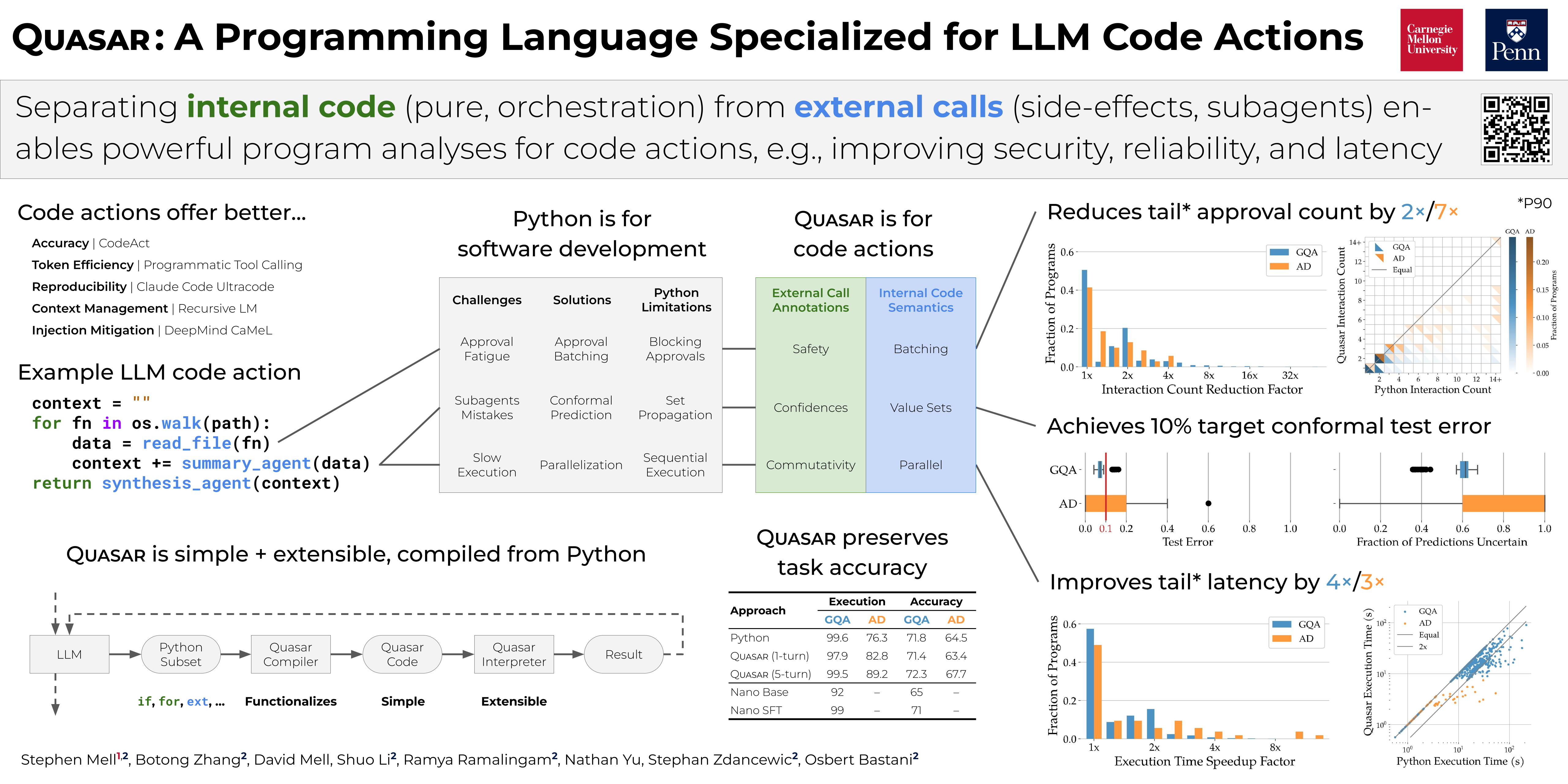
Large language models (LLMs) often call external tools to solve tasks. One effective strategy is for LLMs to write code, enabling them to use complex control flow such as conditionals and loops. Such code actions are typically represented as Python code, since LLMs are proficient at writing it. However, many programming language features that would support more effective code actions are difficult to implement for Python. We propose separating internal code that captures program logic from external calls to tools that interact with the world. New features can then easily be implemented by (1) annotating external calls with the effects relevant to that feature, and (2) modifying the execution of the internal code to track this information. We develop a novel programming language, Quasar, that implements this idea. To illustrate its utility, we implement several useful features on top of Quasar to enhance code actions: access control with batched user queries to improve security, autoparallelization of external calls to reduce latency, and conformal prediction for uncertainty quantification to mitigate hallucinations.
MetaLint: Easy-to-Hard Generalization for Code Linting
Atharva Naik ⋅ Lawanya Baghel ⋅ Dhatchinamoorthi Kunde Govindarajan ⋅ Darsh Agrawal ⋅ Yiqing Xie ⋅ Daniel Fried ⋅ Carolyn Rose
Large language models excel at code generation but struggle with code linting, particularly in generalizing to unseen or evolving best practices beyond those observed during training. We introduce MetaLint, a meta-learning framework that formulates code linting as an instruction-following task, where a model evaluates whether code adheres to a natural language specification of best practices. In contrast to prior work that trains models to detect violations from a fixed set of best practices, MetaLint evaluates code against a provided natural language specification, enabling test-time control over which practices to enforce and generalization to unseen or evolving rules without retraining. We demonstrate that models trained solely on synthetic data generated from automatic linters still generalize to harder, context-dependent best practices for which such linters are not available. To evaluate generalization beyond such easy signals, we introduce a human-curated benchmark of hard best practices inspired by Python Enhancement Proposals (PEPs). On this benchmark, MetaLint substantially improves performance without explicit fine-tuning on target best practices and exhibits strong easy-to-hard generalization. Qwen3-4B achieves a 2.7x detection F-score gain (25.9% → 70.4%), the highest recall, and a 26.7% localization F-score, matching larger models such as o3-mini. These gains generalize across programming languages, model families, scales, reasoning settings, and linter sources. We release the code and benchmark to support reproducibility and future work.
MAPLE: Metadata Augmented Private Language Evolution
Eli Chien ⋅ Yuzheng Hu ⋅ Ryan McKenna ⋅ Shanshan Wu ⋅ Zheng Xu ⋅ Peter Kairouz
Differentially private (DP) fine-tuning of large language models (LLMs) requires massive compute and full model access, which rules out state-of-the-art proprietary APIs for general users. Generating DP synthetic data offers a practical workaround. This approach also allows for transparent exploratory data analysis and arbitrary reuse across downstream tasks, sidestepping the rigid constraints of a model's parameter space. Private Evolution (PE) provides a promising API-based framework for generating this data, but its success relies heavily on initialization. If the private data distribution falls too far outside the foundation model's pre-training priors -- a common issue in highly specialized domain -- PE struggles to align with the target data. This misalignment causes poor convergence, degraded utility, and wasted API calls. To solve this initialization bottleneck, we introduce Metadata Augmented Private Language Evolution (MAPLE). MAPLE extracts DP tabular metadata and uses in-context learning to firmly ground the initial synthetic distribution in the target domain. Our evaluations on domain-specific text generation tasks show that MAPLE yields a strictly better privacy-utility trade-off, converges significantly faster, and sharply reduces API costs compared to baseline PE methods.
PolicyLong: Towards On-Policy Context Extension
Junlong Jia ⋅ Ziyang Chen ⋅ Xing Wu ⋅ Chaochen Gao ⋅ TingHao YU ⋅ feng zhang ⋅ Songlin Hu ⋅ Binghui Guo
Extending LLM context windows is hindered by scarce high-quality long-context data. Recent methods synthesize data with genuine long-range dependencies via information-theoretic verification, selecting contexts that reduce a base model's predictive entropy. However, their single-pass offline construction with a fixed model creates a fundamental \emph{off-policy gap}: the static screening landscape misaligns with the model's evolving capabilities, causing the training distribution to drift. We propose \textbf{PolicyLong}, shifting data construction towards a dynamic on-policy paradigm. By iteratively re-executing data screening (entropy computation, retrieval, and verification) using the \emph{current} model, PolicyLong ensures the training distribution tracks evolving capabilities, yielding an emergent self-curriculum. Crucially, both positive and hard negative contexts derive from the current model's entropy landscape, co-evolving what the model learns to exploit and resist. Experiments on RULER, HELMET, and LongBench-v2 (Qwen2.5-3B) show PolicyLong consistently outperforms EntropyLong and NExtLong, with gains growing at longer contexts (e.g., +2.54 at 128K on RULER). The improvements further hold when scaling up to a 7B model (OLMo3-7B), confirming that the value of on-policy data evolution generalizes across model family and scale.
Studying the Soupability of Documents in State Space Models
Yasaman Jafari ⋅ Zixian Wang ⋅ Leon Bergen ⋅ Taylor Berg-Kirkpatrick
We investigate whether hidden states from Structured State Space Models (SSMs) can be merged post hoc to support downstream reasoning. Inspired by model souping, we study document souping, a strategy where documents are encoded independently, and their representations are pooled, via simple operations like averaging, into a single context state. This approach enables modular encoding and reuse without reprocessing the full input for each query. We demonstrate that finetuned Mamba2 models with souped representations achieve competitive or superior performance across multi-hop QA, sparse retrieval, and long-document reasoning tasks compared to the standard monolithic encoding approach. For example, on the RACE and QuALITY benchmarks for long document question answering, this method substantially outperforms a traditional concatenation approach. Crucially, this modular design scales to hundreds of segments (we test up to 256), while delivering substantial savings in inference cost, unlocking new possibilities for large-scale corpus reasoning.
Reflective Context Learning: Studying the Optimization Primitives of Context Space
Nikita Vassilyev ⋅ William Berrios ⋅ RUOWANG ZHANG ⋅ Bo Han ⋅ Douwe Kiela ⋅ Shikib Mehri
Generally capable agents must learn from experience in ways that generalize across tasks and environments. The fundamental problems of learning, including credit assignment, overfitting, forgetting, local optima, and high-variance learning signals, persist whether the learned object lies in parameter space or context space. While these challenges are well understood in classical machine learning optimization, they remain underexplored in context space, leading current methods to be fragmented and ad hoc. We present Reflective Context Learning (RCL), a unified framework for agents that learn through repeated interaction, reflection on behavior and failure modes, and iterative updates to context. In RCL, reflection converts trajectories and current context into a directional update signal analogous to gradients, while mutation applies that signal to improve future behavior in context space. We recast recent context-optimization approaches as instances of this shared learning problem and systematically extend them with six classical optimization primitives: batching, grouped rollouts, improved credit-assignment signal, auxiliary losses, failure replay, and optimizer state. On AppWorld, BrowseComp+, and RewardBench2, these primitives improve over strong baselines, with their relative importance shifting across task regimes. We further analyze robustness to initialization, batching dynamics, and the impact of allocating stronger or weaker models to different optimization components. Our results suggest that learning through context updates should be treated not as a set of isolated algorithms, but as an optimization problem whose mechanisms can be studied systematically and improved through transferable principles.
Awakening the Sleeping Agent: Lean-Specific Agentic Data Reactivates General Tool Use in Goedel Prover
Jui-Hui Chung ⋅ Hongzhou Lin ⋅ Lai Jiang ⋅ Shange Tang ⋅ Chi Jin
Heavy supervised fine-tuning (SFT) on a target domain can strongly suppress capabilities that were present in the base model. We study this phenomenon in formal mathematics using Goedel-Prover-V2, an open-source model heavily trained on 1.8M formal-math examples. After domain specialization, the model almost completely loses its ability to produce valid tool calls, even when explicitly instructed to use tools, dropping from 89.4% function-calling accuracy in the base model to nearly 0%. We ask whether this agentic collapse is permanent or instead reversible, and fine-tune the specialized model on a small amount of Lean-specific tool-use data. Remarkably, as few as 100 agentic traces are sufficient to restore strong tool-calling behavior. This recovery is not benchmark-specific optimization: the recovery dataset is entirely drawn from the Lean setting, where the model uses natural-language queries to search the Mathlib library, yet these same 100 traces improve the Berkeley Function Calling Leaderboard (BFCL) from near zero to 83.8%, approaching the base model's 89.4% despite the mismatch in task distribution and protocol. The recovered capability is also practically useful in-domain: ProofNet pass@32 improves from 21.51% to 25.81%. Controlled comparisons show that recovery depends strongly on trace structure and diversity, and a code-specialized 7B replication establishes the pattern beyond formal mathematics. Together, these results show that heavy domain SFT can suppress general tool-use ability without permanently erasing it, and that a small amount of domain-specific agentic data can awaken dormant tool-use capabilities.
Recovering Wasted Compute in Autoresearch Agents
Au K Chun ⋅ Amrutha Rao ⋅ Abhigyan Acherjee ⋅ Zaiqian Chen ⋅ Kazem Meidani ⋅ C. B Bruss ⋅ Micah Goldblum
A slew of recent works develop agents for solving research problems end-to-end, a paradigm increasingly referred to as autoresearch. Such agents have inspired large industry investment, motivated by their potential to automate time-consuming human labor and customize machine learning solutions for specialized applications. In this paper, we study the modeling pipeline at the core of these autoresearch systems and identify common failure modes when they are applied to tabular datasets: (1) they waste compute resolving the same bugs over and over again; (2) they often fail to tune hyperparameters even when they have a large remaining compute budget; (3) the tree-search algorithms that power them do not explore; and (4) they perform data analysis, mimicking the humans whose data they are trained on, but do not use that analysis to make downstream decisions. We explore targeted interventions and find that a global debug consultant that shares discovered runtime constraints across all branches of the search tree, prompt- and control-level enhancements, and refined tree-search algorithms successfully recover wasted compute. Our results show that large gains in autoresearch agent performance are achievable through agentic design alone, holding the underlying language model fixed.
Spend Less, Fit Better: Budget-Efficient Scaling Law Fitting via Active Experiment Selection
Sijie Li ⋅ Shanda Li ⋅ Haowei Lin ⋅ Weiwei Sun ⋅ Ameet Talwalkar ⋅ Yiming Yang
Scaling laws are used to plan multi-million-dollar training runs, but fitting those laws can itself cost millions. In modern large-scale workflows, assembling a sufficiently informative set of pilot experiments is already a major budget-allocation problem rather than a routine preprocessing step. We formulate scaling-law fitting as budget-aware sequential experimental design: given a finite pool of runnable experiments with heterogeneous costs, choose which runs to execute so as to maximize extrapolation accuracy in a high-cost target region. We propose $\mathrm{SL}^2$ (Scaling Laws, Spend Less), an uncertainty-aware method for sequentially allocating experimental budget toward the runs most useful for target-region extrapolation. Across a diverse benchmark of scaling-law tasks, $\mathrm{SL}^2$ outperforms classical design-based baselines, and often approaches the performance of fitting on the full experimental set while using only about 10\% of the total training budget. Our code is available at https://github.com/PlanarG/active-sl.
Prescriptive Scaling Laws for Data Constrained Training
Justin Lovelace ⋅ Christian Belardi ⋅ Srivatsa Kundurthy ⋅ Shriya Sudhakar ⋅ Kilian Weinberger
Training compute is increasingly outpacing the availability of high-quality data. This shifts the central challenge from optimal compute allocation to extracting maximum value from limited data. The widely adopted Chinchilla scaling law assumes every training token is unique. This limits its ability to guide pretraining decisions in data-constrained regimes. We model the excess loss under repetition with a simple additive overfitting penalty and find that it accurately describes model behavior. Our scaling law yields qualitatively new compute-optimal allocation advice. Beyond a point, further repetition is counterproductive and compute is better spent on model capacity. We show that following our law's recommended configuration improves performance in data-constrained regimes. Finally, because our one-parameter form isolates overfitting in a single coefficient, it enables direct comparison across training configurations. As a case study, we show that strong weight decay ($\lambda=1.0$) reduces this coefficient by approximately 70\%, providing a scaling-law explanation for recent findings that optimal weight decay in data-constrained regimes is an order of magnitude larger than standard practice.
The Finetuner’s Fallacy: When to Pretrain with Your Finetuning Data
Christina Baek ⋅ Ricardo P Monti ⋅ David J Schwab ⋅ Amro Abbas ⋅ Rishabh Adiga ⋅ Cody Blakeney ⋅ Maximilian Böther ⋅ Paul Burstein ⋅ Aldo G Carranza ⋅ Alvin Deng ⋅ Parth Doshi ⋅ Vineeth Dorna ⋅ Alex Fang ⋅ Tony Jiang ⋅ Siddharth Joshi ⋅ Brett W Larsen ⋅ Jason C Lee ⋅ Katherine L Mentzer ⋅ Luke Merrick ⋅ Haakon Mongstad ⋅ Fan Pan ⋅ Anshuman Suri ⋅ Darren Teh ⋅ Jason Telanoff ⋅ Jack Urbanek ⋅ Zhengping Wang ⋅ Josh Wills ⋅ Haoli Yin ⋅ Aditi Raghunathan ⋅ J Kolter ⋅ Bogdan Gaza ⋅ Ari S Morcos ⋅ Matthew L Leavitt ⋅ Pratyush Maini
Real-world model deployments demand strong performance on narrow domains where data is often scarce. Typically, practitioners finetune models to specialize them, but this risks overfitting to the domain and forgetting general knowledge. We study a simple strategy, specialized pretraining (SPT), where a small domain dataset, typically reserved for finetuning, is repeated starting from pretraining as a fraction of the total tokens. Across three specialized domains (ChemPile, MusicPile, and ProofPile), SPT improves domain performance and preserves general capabilities after finetuning compared to standard pretraining. In our experiments, SPT reduces the pretraining tokens needed to reach a given domain performance by up to 1.75x. These gains grow when the target domain is underrepresented in the pretraining corpus: on domains far from web text, a 1B SPT model outperforms a 3B standard pretrained model. Beyond these empirical gains, we derive overfitting scaling laws to guide practitioners in selecting the optimal domain-data repetition for a given pretraining compute budget. Our observations reveal the finetuner's fallacy: while finetuning may appear to be the cheapest path to domain adaptation, introducing specialized domain data during pretraining stretches its utility. SPT yields better specialized domain performance (via reduced overfitting across repeated exposures) and better general domain performance (via reduced forgetting during finetuning), ultimately achieving stronger results with fewer parameters and less total compute when amortized over inference. To get the most out of domain data, incorporate it as early in training as possible.
Domain-Aware Scaling Laws Uncover Data Synergy
Kimia Hamidieh ⋅ Lester Mackey ⋅ David Alvarez-Melis
Machine learning progress is often attributed to scaling model size and dataset volume, yet the composition of data can be just as consequential. Empirical findings repeatedly show that combining datasets from different domains yields nontrivial interactions. For instance, adding code improves mathematical reasoning, while certain mixtures introduce interference that reduces model performance. We refer to these effects collectively as data synergy, where the contribution of multiple domains exceeds or falls short of the sum of their isolated contributions. In this work, we formalize and quantify data synergy in language model pretraining. Leveraging observational variation across open-weight LLMs with diverse pretraining mixtures, we estimate both direct domain-to-benchmark synergy (how one domain contributes to performance on another) and a second-order domain-domain synergy (capabilities that require co-occurrence of multiple domains). Our framework improves predictive accuracy over domain-agnostic scaling laws and recovers stable synergy estimates. We validate these estimates by training models on predicted optimal and predicted anti-optimal mixtures and confirm that our synergy estimates correctly predict performance rankings.
Discovering Hierarchical Latent Capabilities of Language Models via Causal Representation Learning
Jikai Jin ⋅ Vasilis Syrgkanis ⋅ Sham Kakade ⋅ Hanlin Zhang
Public LLM leaderboards contain rich observational evidence about post-training, but this evidence is strongly confounded by base-model family. We study capability transfer: whether improving one capability tends to improve another, and whether that carryover differs across related families. Our goal is to study this question mainly from cheap observational evaluation data rather than from large collections of expensive training runs. We propose Hierarchical Component Analysis (HCA), a family-aware latent-factor method for studying capability transfer from observational data alone. Applied to Llama and Qwen families containing 1500+ models from the Open LLM Leaderboard, HCA identifies a three-factor structure whose most stable pattern is a positive link from an instruction-aligned factor to a math-aligned factor. We then verify this finding via real fine-tuning with external dataset, showing that it is not merely a benchmark artifact. Overall, this work shows that observational data can already suggest concrete post-training predictions.
Shorthand for Thought: Compressing LLM Reasoning via Entropy-Guided Supertokens
Zhenyu Zhao ⋅ Sander Land ⋅ Daniel M Bikel ⋅ Waseem Alshikh
Reasoning in Large Language Models incurs significant inference-time compute, yet the token-level information structure of reasoning traces remains underexplored. We observe that reasoning tokens split into two functional types: low-entropy \textit{structural} tokens (recurring phrases that scaffold the reasoning process) and higher-entropy \textit{organic} tokens (problem-specific content that drives toward a solution). This asymmetry motivates a simple, model-agnostic compression pipeline: apply cross-word BPE merges on a model's own reasoning traces to derive \textit{supertokens} that capture frequent structural patterns, then teach the model to adopt them via supervised fine-tuning. Across three model families and five mathematical reasoning benchmarks, our approach shortens reasoning traces by 8.1\% on average; under a TOST equivalence analysis at a $\pm 2$~pp margin, accuracy is equivalent or inconclusive on 13/15 model--benchmark cells (2 pass equivalence, 11 inconclusive, predominantly AIME at $N{=}30$), with non-equivalent degradation on 2/15 cells (DeepSeek-R1-Distill-Llama-70B on MATH-500 and OlympiadBench). Beyond compression, learned supertokens often align with interpretable reasoning moves such as backtracking, verification, and strategy shifts. This enables a compact structural analysis of reasoning traces: correct traces show more recovery and verification patterns, while incorrect traces show more repeated hedging and unresolved counterarguments. We release the full pipeline as open-source code.\footnote{Code available at \url{https://github.com/Writer/shorthand-for-thought}.}
Message Passing Enables Efficient Reasoning
Xuecheng Liu ⋅ Daman Arora ⋅ Gokul Swamy ⋅ Andrea Zanette
While inference-time scaling has improved the reasoning abilities of large language models (LLMs), the need to generate long chains-of-thought (CoTs) is a computational bottleneck. Thus, in contrast to sequential scaling methods like CoT, recent parallel scaling techniques instead use fork and join (FJ) primitives to divide work across multiple LLM threads. However, in the fork-join paradigm, threads are typically transient and do not communicate pointwise with one another which limits scalability. To tackle this, we introduce Message Passing Language Models (MPLMs), a framework for LLM reasoning in which threads communicate directly via lightweight send and receive primitives. MPLMs enable efficient scaling through two key mechanisms: (1) reduced communication costs, achieved by avoiding redundant context sharing, and (2) preemption, which allows threads to terminate early based on partial information from their peers. We demonstrate the promise of MPLMs on 3 classes of tasks. First, on Sudoku puzzles, we show that MPLMs require an asymptotically smaller context than both serial CoT and parallel FJ. We then fine-tune a single model to solve 25 x 25 puzzles that remain challenging for standard CoT and FJ approaches, as well as frontier reasoning models without tools. Second, on 3-SAT puzzles, the capability of preemption allows termination of unpromising branches, which results in improved efficiency. Finally, we show that appropriately prompted large pre-trained models follow the MPLM protocol, achieving competitive results on long-context question answering relative to popular fork-join approaches.
Teaching Pretrained Language Models to Think Deeper with Retrofitted Recurrence
Sean McLeish ⋅ Ang Li ⋅ John Kirchenbauer ⋅ Dayal Singh Kalra ⋅ Brian R Bartoldson ⋅ Bhavya Kailkhura ⋅ Avi Schwarzschild ⋅ Jonas Geiping ⋅ Tom Goldstein ⋅ Micah Goldblum
Recent advances in depth-recurrent language models show that recurrence can decouple train-time compute and parameter count from test-time compute. In this work, we study how to retrofit existing pretrained non-recurrent language models into depth-recurrent models. We find that using a curriculum of recurrences to increase the effective depth of the model over the course of training preserves performance while reducing total computational cost. In our experiments, on mathematics, we observe that retrofitting pretrained models to recurrent ones results in better performance at a given compute budget than simply post-training the original non-recurrent language model.
Two accounts recur in explanations of the success of rotary position embeddings (RoPE). Expressivity studies associate periodic position information with modular predicates, whereas mechanistic and long-context studies emphasize positional anchors and local offsets. We formalize both accounts for fully uniform, finite-precision soft-attention transformers. We find that, if every rotary component is periodic, RoPE transformers recognize exactly the languages definable in past temporal logic with modular predicates. Conventional RoPE is different: The rotations it computes never repeat. This yields a precision-dependent bounded simulation of fixed-offset look-back operators, rather than an all-length modular characterization. Controlled experiments match this separation: Constructed periodic schedules length-generalize on modular languages, while conventional RoPE behaves more like a bounded locality bias and can impair tasks requiring position-invariant access to distant context. Altogether, our findings shed light on RoPE transformers, bringing theoretical expressivity characterizations closer to models used in practice.
Compliments to the Complementizer: Indirect Routing of Syntactic Structure in a Transformer Language Model
Lasse van den Berg ⋅ Robert Frank
Unlike recurrent neural networks, which have a fixed path for accumu- lating information from the input, transformer language models’ use of attention accommodates more flexible regimens for how information is routed through the model. We investigate how syntactic information about long-distance filler-gap dependencies is routed in transformers. We focus specifically on German sentences involving ”verb-second” structures. In such sentences, a language model will need to encode information about a fronted element and move it to downstream positions in order to modulate expectations about possible continuations. Through interchange interven- tions on contrastive minimal sentence pairs, we identify that transformers make use of an indirect path routing syntactic information first from the fronted element to the complementizer and from there to the downstream position at which predictions are made. This non-trivial detour of infor- mation through the complementizer aligns with linguistic theories of the structure of long-distance filler-gap dependencies. This information is echoed in abstractly similar dependencies in English and Italian, but not in cases of dependencies that are semantic rather than syntactic in nature. We then explore the content of the model’s internal representations by training a hierarchical Tensor Product Decomposition Network (TPDN) that identifies the model’s representation of grammatical features. We can then reconstruct model activations at the complementizer position under the assumption that this neurosymbolic representation captures the es- sential aspects of the model’s encoding of grammatical structure. Causal interventions using these reconstructions confirm that this manipulation of the grammatical features produces the predicted changes in downstream continuation predictions.
Unveiling the Mechanisms of Multi-Hop Reasoning in Transformers via Identity Bridge
Pengxiao Lin ⋅ Zheng-An Chen ⋅ Zhi-Qin J Xu
Large Language Models (LLMs) excel at multi-hop reasoning in distribution, yet fail on unseen compositions, a phenomenon known as the ``curse of two-hop reasoning". In this work, we argue that this phenomenon can be attributed to a missing supervision on the bridge entity. We formalize this gap by introducing Identity Bridge, a minimal supervision that enforces a identity mapping on bridge tokens. Under this supervision, even a one-layer transformer with uniform attention (Emb–MLP) can achieve out-of-distribution (OOD) two-hop generalization. We provide a theoretical analysis demonstrating that Identity Bridge induces an implicit regularization effect, leading the model to establish a direct subject-to-answer association. From an empirical perspective, the performance of standard GPT-2 models aligns closely with simple Emb--MLP models across varying levels of problem complexity. Finally, analyses of fine-tuned mainstream LLMs indicate that correct two-hop predictions consistently coincide with the establishment of a subject-to-answer relationship, extending our findings to realistic settings.
KAMR: Grounding Generation via Knowledge-Aligned Multi-hop Retrieval
Xiaochen Wang ⋅ Yuan Zhong ⋅ Haoyu Wang ⋅ Ting Wang ⋅ Fenglong Ma
Graph-based retrieval-augmented generation increasingly relies on multi-hop retrieval, where answering a query requires composing multiple connected knowledge-graph triplets. However, existing retrievers often rank triplets independently via global semantic matching. Moreover, many multi-hop benchmarks provide only final answers, which limits supervision for query--triplet alignment and causes structurally necessary but weakly aligned facts to be missed. To address these issues, we propose a knowledge-aligned multi-hop retriever, KAMR, which distinguishes anchor triplets that are strongly constrained by the query from connected triplets that are weakly aligned yet structurally linked to the anchors. To mitigate the lack of query-triplet alignment supervision, we build a partial alignment dataset by masking triplet elements and prompting an LLM to generate corresponding queries, and optimize two contrastive objectives for pair-level and element-level matching. At inference time, KAMR retrieves anchors globally and then expands locally to collect connected evidence. Across four benchmarks, three LLM backbones, and fourteen baselines, KAMR consistently improves multi-hop retrieval and downstream question answering performance.
CLaRa: Bridging Retrieval and Generation with Continuous Latent Reasoning
Jie He ⋅ Richard He Bai ⋅ Sinead Williamson ⋅ Jeff Z Pan ⋅ Navdeep Jaitly ⋅ Yizhe Zhang
Retrieval-augmented generation (RAG) enhances large language models (LLMs) with external knowledge but still suffers from long contexts and disjoint retrieval–generation optimization. Within the standard retrieve-then-rerank pipeline, the reranking stage directly determines what context the generator receives, yet this critical interface remains separately optimized. In this work, we propose CLaRa (Continuous Latent Reasoning), a unified framework that performs embedding-based compression and joint optimization in a shared continuous space. To obtain semantically rich and retrievable compressed vectors, thereby reducing the document length fed into the generator, we introduce SCP, a key-preserving compressor pretraining framework based on question-answering and paraphrase supervision. CLaRa then trains the reranker and generator end-to-end via a single language modeling loss, with gradients flowing through both modules using a differentiable top-k estimator. Theoretically, this unified optimization aligns retrieval relevance with answer quality. Experiments across multiple QA benchmarks show that CLaRa achieves state-of-the-art compression and reranking performance, even at a text compression rate of 16, outperforming text-based fine-tuned baselines. We pulish the code on https://github.com/apple/ml-clara.
SimulRAG: Simulator-based RAG for Grounding LLMs in Long-form Scientific QA
Haozhou Xu ⋅ Dongxia Wu ⋅ Matteo Chinazzi ⋅ Ruijia Niu ⋅ Rose Yu ⋅ Yian Ma
Large Language Models (LLMs) show promise in generating long-form scientific explanations that synthesize evidence and connect multiple factors. However, in long-form scientific question answering, LLMs often hallucinate, producing unsupported or inconsistent claims. Retrieval-Augmented Generation (RAG) improves trustworthiness by grounding generation in external sources; scientific simulators are valuable because they can validate quantitative hypotheses and capture evolving dynamics. Yet simulation-based RAG is non-trivial due to two challenges: how to retrieve from scientific simulators, and how to efficiently verify and update long-form answers. To overcome these challenges, we propose SimulRAG, a simulator-based RAG framework with a generalized retrieval interface that translates between text and simulator parameters/outputs. SimulRAG further introduces claim-level generation with uncertainty estimation and simulator boundary assessment (UE+SBA) to selectively verify and update claims. Unlike tool-first or holistic answer revision, it first elicits diverse answers without retrieval and then grounds uncertain, simulator-verifiable atomic claims with simulator evidence. We also release a long-form scientific QA benchmark spanning climate science, epidemiology, and urban planning, with ground truth verified by simulations and human annotators. Experiments show SimulRAG improves informativeness by 30.4% and factuality by 16.3% over the strongest adapted RAG baselines, while UE+SBA enhances claim-level efficiency and quality.
Private-RAG: Answering Multiple Queries with LLMs while Keeping Your Data Differentially Private
Ruihan Wu ⋅ Erchi Wang ⋅ Zhiyuan Zhang ⋅ Yu-Xiang Wang
Retrieval-augmented generation (RAG) enhances large language models (LLMs) by retrieving documents from an external corpus at inference time. When this corpus contains sensitive information, however, unprotected RAG systems are at risk of leaking private information. Prior work has introduced differential privacy (DP) guarantees for RAG, but only in single-query settings, which fall short of realistic usage. In this paper, we study the more practical multi-query setting and propose two DP-RAG algorithms. The first, MURAG, leverages an individual privacy filter so that the accumulated privacy loss only depends on how frequently each document is retrieved rather than the total number of queries. The second, MURAG-Ada, further improves utility by privately releasing query-specific thresholds, enabling more precise selection of relevant documents. Our experiments across multiple LLMs and datasets demonstrate that the proposed methods scale to hundreds of queries within a practical DP budget ($\varepsilon=10$), while preserving meaningful utility.
Evaluating the Retrieval Robustness of Large Language Models
Shuyang Cao ⋅ Karthik Radhakrishnan ⋅ David S Rosenberg ⋅ Steven Lu ⋅ Pengxiang Cheng ⋅ Lu Wang ⋅ Shiyue Zhang
Retrieval-augmented generation (RAG) generally enhances large language models' (LLMs) ability to solve knowledge-intensive tasks. But RAG could also lead to performance degradation due to imperfect retrieval and the model's limited ability to leverage retrieved content. In this work, we evaluate the robustness of LLMs in practical RAG setups (henceforth retrieval robustness). We focus on three research questions: (1) whether RAG is always better than non-RAG; (2) whether more retrieved documents always lead to better performance; and (3) whether document order impacts results. To facilitate this study, we establish a benchmark of 1,891 samples spanning five datasets across three task categories, each with documents retrieved using both sparse and dense retrievers. We introduce three robustness metrics, each corresponding to one research question. Our experiments across 11 LLMs show that models achieve generally high retrieval robustness, but robustness varies substantially across tasks, suggesting that the decision to adopt RAG remains a case-by-case consideration. We further examine four additional prompting strategies that vary how models interact with retrieved documents. We find that Qwen and GPT models suffer notable robustness declines when reasoning is disabled, even on single-hop QA tasks, and that providing retrieved documents as tool responses improves Claude models but hurts Qwen and GPT models, highlighting potential issues of the GPT models regardless of their best overall robustness under vanilla prompting.
Self-Generated Text Recognition: Quality Heuristics, Cross-Task Transfer, and Downstream Bias in LLM Evaluation
Jesse St. Amand ⋅ Callum Canavan ⋅ Sohaib Imran ⋅ Joseph Hewson ⋅ Aaron Lutz ⋅ Shi Feng ⋅ Puria Radmard ⋅ Lennie Wells
Self-Generated Text Recognition (SGTR) — the ability of an LLM to identify its own outputs — poses risks to AI safeguards that rely on LLMs as evaluators or monitors: an LLM may recognize outputs from other copies of the same model and make biased judgments or collude outright. Prior work has drawn conflicting conclusions about whether current models possess significant SGTR capabilities. We explain these disagreements by identifying key experimental design choices — which we term operationalizations — that drive divergent results. Evaluating 13–21 models across six presentation operationalizations and four task-domain operationalizations, we find that accuracy varies substantially with evaluation format (pairwise vs. individual assessments of text), conversation format (presenting candidate text in user tags vs. assistant tags), and the domain of the task used to generate candidate text (e.g., coding vs. summarization). We corroborate previous observations that a quality heuristic — models attributing authorship to text they perceive as higher quality — is a dominant confound. We also find that improving a model's SGTR performance via supervised fine-tuning (SFT) on one operationalization can generalize to others, and can increase the model's preference for its own outputs when it acts as a judge in the AlpacaEval framework. Our results suggest that, despite confounds, some models possess practical SGTR capabilities, and that SGTR should be monitored and considered in the design of safety-critical AI applications.
QualAlign: Benchmarking Automated Qualitative Coding Against Human Schemas
Taggert Smith ⋅ Chuong Nguyen ⋅ Qisen Yang ⋅ Oishani Bandopadhyay ⋅ Yaru Su ⋅ Nadia Polikarpova ⋅ Xinyu Pi
Large language models are increasingly used for qualitative analysis, but existing inductive coding systems are difficult to compare because they use different datasets and system-specific evaluation metrics. We introduce \textbf{QualAlign}, a human-grounded benchmark for automated qualitative coding spanning 8 public datasets, each with research questions, inductively-derived codebooks, and code-excerpt assignments produced by expert researchers. The benchmark measures alignment with human expert coding via these artifacts using lexical, semantic, and assignment-based scores. Under a shared setup, we compare four recent systems for inductive codebook generation: LLooM, ThematicLM, HICode, and LOGOS. We find that while human and LLM-produced codebooks show moderate semantic resemblance given the same datasets and research questions, lexical agreement scores remains low, indicating different vocabulary used to describe similar concepts. Moreover, code-excerpt assignments diverge dramatically: given semantically similar conceptual labels, LLMs still partition the data differently than human researchers. These patterns suggest that current systems may be useful for proposing candidate codes or surfacing broad conceptual patterns for analyst review and revision—similar to prior topic modeling methods; however, they cannot mimic human researchers' excerpt-level coding decisions. Based on these findings, we caution that LLM-generated codebooks that appear semantically similar to human work cannot necessarily be taken to represent a similar qualitative interpretation of the data, and thus should not replace the interpretive work of human coders.
How social context shapes value-related content in Large Language Model outputs
Maryam Ghorbansabagh ⋅ Eugene Yu Ji ⋅ Amir-Hossein Karimi ⋅ Igor Grossmann
We study how reliably value-related content in Large Language Model (LLM) outputs can be recovered by another model, and how that recoverability depends on the context in which the output is generated. To this end, we introduce the Generator-Inquisitor framework, in which one model generates text conditioned on a target value and another model infers the underlying value from that text. Using Schwartz's four value dimensions—Openness to Change, Conservation, Self-Enhancement, and Self-Transcendence—instantiated across Fiske's four relational contexts—Communal Sharing, Equality Matching, Authority Ranking, and Market Pricing—we evaluate six state-of-the-art LLMs across seven experiments. Value recovery accuracy is generally high but varies systematically across value dimensions and relational contexts, with Self-Enhancement being the hardest to recover, especially in the Communal Sharing context. Cross-model evaluation showed negligible decrease in accuracy when Generator and Inquisitor were from two different model families, and a perturbation experiment confirmed that recoverability relies on value-relevant content rather than superficial lexical cues. A preliminary annotation study further showed that the dominant source of misclassification errors is the Inquisitor rather than the Generator. Together, these results show that the recoverability of value-related content in LLM outputs varies systematically with relational context. Like for humans, this observation calls for a contextualized approach to the study of value alignment in machines.
Ideological Bias in LLMs’ Economic Causal Reasoning
Donggyu Lee ⋅ Hyeok Yun ⋅ Jungwon Kim ⋅ Junsik Min ⋅ Sungwon Park ⋅ Sangyoon Park ⋅ Jihee Kim
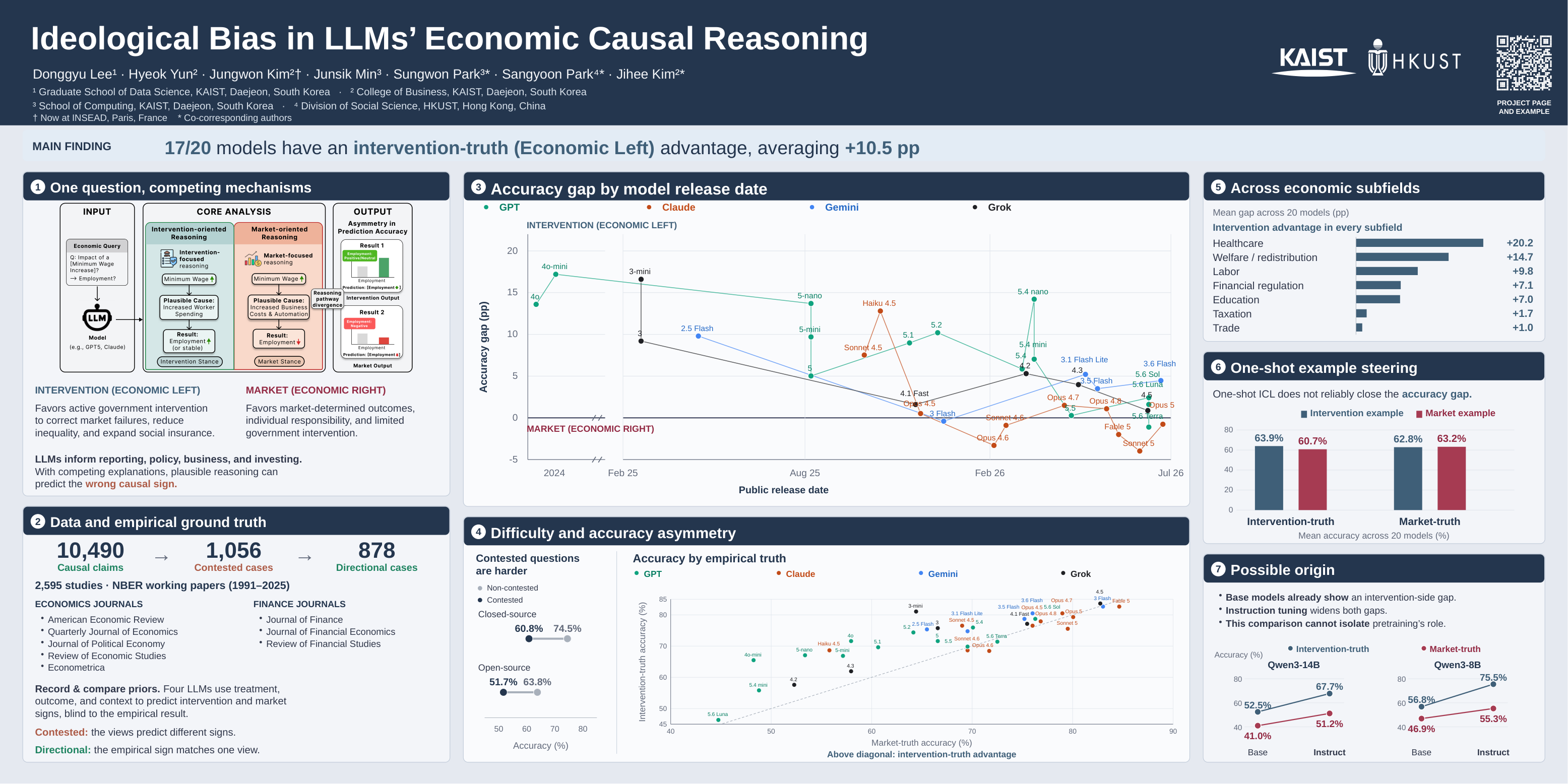
Do large language models (LLMs) exhibit systematic ideological bias when reasoning about economic causal effects? As LLMs are increasingly used in policy analysis and economic reporting, where directionally correct causal judgments are essential, this question has direct practical stakes. We present a systematic evaluation by extending the EconCausal benchmark with ideology-contested cases—instances where intervention-oriented (pro-government) and market-oriented (pro-market) perspectives predict divergent causal signs. From 10,490 causal triplets (treatment–outcome pairs with empirically verified effect directions) derived from top-tier economics and finance journals, we identify 1,056 ideology-contested instances and evaluate 20 state-of-the-art LLMs on their ability to predict empirically supported causal directions. We find that ideology-contested items are consistently harder than non-contested ones, and that across 17 of 20 models, accuracy is systematically higher when the empirically verified causal sign aligns with intervention-oriented expectations than with market-oriented ones. Moreover, when models err, their incorrect predictions disproportionately lean intervention-oriented—and this directional skew is not eliminated by one-shot in-context prompting. These results highlight that LLMs are not only less accurate on ideologically contested economic questions, but systematically less reliable in one ideological direction than the other, underscoring the need for direction-aware evaluation in high-stakes economic and policy settings.
Illusory Truth or Mere Exposure? Model-Dependent Repetition Effects in LLM-Based Social Media Simulations
Azza Bouleimen ⋅ Nicolò Pagan ⋅ Ancsa Hannak
Generative agent-based models (GABMs) are increasingly used to simulate social media dynamics, including misinformation spread. For such social simulations to be valid proxies of human behavior, LLM agents should replicate established human cognitive biases, among them the Illusory Truth Effect (ITE), whereby repeated exposure to a claim increases its perceived truth value. We investigate whether and how the ITE manifests across four LLMs (Gemma-3-4b-it, Qwen2.5-7B-Instruct, Llama-3.1-8B-Instruct, and GPT-5-nano) in a social media simulation context. We propose a two-phase within-context experimental design that embeds the repetition manipulation inside a realistic news feed interaction. Using this design, we collect 336,000 truth, importance, sentiment, and interest ratings across 100 statements, 10 feed variants, and 3 replications. The key comparison is between ratings assigned to repeated statements, seen throughout a simulation phase, and completely unseen ones, rated within the same experimental context. We distinguish genuine ITE (truth-specific repetition boost) from mere exposure effects (uniform boost across all attributes). We run an OLS regression followed by a Linear Mixed-Effect Model to account for differences across models and ratings. Our results reveal four qualitatively distinct patterns: Gemma-3-4b-it exhibits a genuine ITE; Qwen2.5-7B-Instruct shows a mere exposure effect; GPT-5-nano displays no repetition effect on truth and mild skepticism toward repeated content; Llama-3.1-8B-Instruct shows a small truth boost alongside decreases in evaluative dimensions, inconsistent with either account. Crucially, temperature has no effect on these findings, and a variance decomposition highlights the high context-sensitivity of LLM rating behavior. Our findings caution against assuming uniform ITE replication across LLMs in social simulations, while suggesting that Gemma-3-4b-it may offer the most behaviorally realistic approximation for misinformation-related simulations.
Incentive-Aware Multi-Fidelity Optimization for Generative Advertising in Large Language Models
Jiayuan Liu ⋅ Barry Wang ⋅ Jiarui Gan ⋅ Tonghan Wang ⋅ Leon Xie ⋅ Mingyu Guo ⋅ Vincent Conitzer
Generative advertising in large language model (LLM) responses requires optimizing sponsorship configurations under two strict constraints: the strategic behavior of advertisers and the high cost of stochastic generations. To address this, we propose the Incentive-Aware Multi-Fidelity Mechanism (IAMFM), a unified framework coupling Vickrey-Clarke-Groves (VCG) incentives with Multi-Fidelity Optimization to maximize expected social welfare. We compare two algorithmic instantiations (elimination-based and model-based), revealing their budget-dependent performance trade-offs. Crucially, to make VCG computationally feasible, we introduce Active Counterfactual Optimization, a "warm-start" that reuses optimization data for efficient payment calculation. We provide conditional bounds for approximate strategy-proofness and individual rationality based on finite-budget error and report independence. Experiments demonstrate that IAMFM achieves higher proxy-defined welfare than single-fidelity baselines across diverse budgets.
Learning from Failures: Correction-Oriented Policy Optimization with Verifiable Rewards
Mengjie Ren ⋅ Jie Lou ⋅ Boxi Cao ⋅ Xueru Wen ⋅ Hongyu Lin ⋅ Xianpei Han ⋅ Le Sun ⋅ XingYu Li ⋅ Yaojie Lu
Reinforcement Learning with Verifiable Rewards (RLVR) has emerged as an effective paradigm for improving the reasoning capabilities of large language models.However, RLVR training is often hindered by sparse binary rewards and weak credit assignment, resulting in ambiguous optimization signals and underutilization of the useful information embedded in failed trajectories. To address this challenge, we propose Correction-OrIented Policy Optimization (CIPO), a simple and effective extension to RLVR that converts on-policy failed trajectories into correction-oriented supervision, without relying on any external signals. By jointly optimizing correction samples derived from the model’s own failed attempts together with the standard RLVR objective, CIPO improves learning effectiveness while explicitly enhancing the model’s ability to correct its own errors.Extensive experiments across 11 benchmarks spanning mathematical reasoning and code generation demonstrate that CIPO consistently and significantly outperforms strong baselines in both reasoning and correction performance.Moreover, CIPO yields stronger pass@K gains, indicating that it improves the model’s intrinsic reasoning capacity rather than merely redistributing probability mass over existing correct answers.
CURV: Enhancing Chart Understanding Through Curriculum Visual Grounded Reasoning
Xuehang Guo ⋅ Pingyue Zhang ⋅ Ruiyi Zhang ⋅ Zhenhailong Wang ⋅ Hanrui Lyu ⋅ Heng Ji ⋅ Tong Sun ⋅ Qingyun Wang ⋅ Manling Li
Chart question answering (CQA) requires multimodal large language models (MLLMs) to integrate visual comprehension with logical reasoning, yet current models struggle with accurate visual grounding and coherent reasoning chains. While extrinsic chain-of-thought prompting and visual cues significantly improve performance, current MLLMs lack intrinsic visual grounded reasoning capabilities, leading to inaccurate perception and reasoning disconnected from visual evidence. To address these limitations, we propose CURV, a curriculum learning framework that develops intrinsic visual reasoning capabilities by reformulating CQA as multi-step visual grounded reasoning, where each step coordinates logical reasoning with dynamic visual grounding through spatial attention concentration. To assist model learning, we further introduce CCQA, a three-level curriculum dataset with scalable synthetic generation across diverse chart types and reasoning patterns. Our curriculum systematically progresses from basic single-operation reasoning to complex multi-chart compositional tasks. Experiments demonstrate that CURV achieves up to $\uparrow20.50$% improvements over baselines and is generalizable to real-world benchmarks (up to $\uparrow12.30$%) and out-of-domain multimodal reasoning tasks (up to $\uparrow10.20$%), validating the effectiveness of internalizing visual reasoning with dynamic grounding for enhanced chart understanding capabilities.
Overconfidence and Calibration in Medical VQA: Empirical Findings and Hallucination-Aware Mitigation
Ji Young Byun ⋅ Young-Jin Park ⋅ Jean-Philippe Corbeil ⋅ Asma Ben Abacha
As vision-language models (VLMs) are increasingly deployed in clinical decision support, more than accuracy is required: knowing when to trust their predictions is equally critical. Yet, a comprehensive and systematic investigation into the overconfidence of these models remains notably scarce in the medical domain. We address this gap through a comprehensive empirical study of confidence calibration in VLMs, spanning three model families (Qwen3-VL, InternVL3, LLaVA-NeXT), three model scales (2B--38B), and multiple confidence estimation prompting strategies, across three medical visual question answering (VQA) benchmarks. Our study yields three key findings: First, overconfidence persists across model families and is not resolved by scaling or prompting, such as chain-of-thought and verbalized confidence variants. Second, simple post-hoc calibration approaches, such as Platt scaling, reduce calibration error and consistently outperform the prompt-based strategy. Third, due to their (strict) monotonicity, these post-hoc calibration methods are inherently limited in improving the discriminative quality of predictions, leaving AUROC at the same level. Motivated by these findings, we investigate hallucination-aware calibration (HAC), which incorporates vision-grounded hallucination detection signals as complementary inputs to refine confidence estimates. We find that leveraging these hallucination signals improves both calibration and AUROC, with the largest gains on open-ended questions. On closed-ended questions, format-specific signals such as the logit margin show more informative. Overall, our findings suggest post-hoc calibration as standard practice for medical VLM deployment over raw confidence estimates, and highlight the practical usefulness of hallucination signals to enable more reliable use of VLMs in medical VQA.
What do your logits know?
Masha Fedzechkina ⋅ Eleonora Gualdoni ⋅ Rita Ramos ⋅ Sinead Williamson
Recent work has shown that probing model internals can reveal a wealth of information not apparent from the model generations. This poses a risk of unintentional or malicious information leakage, where model users are able to learn information that the model owner assumed was inaccessible. Using vision-language models as a testbed, we present the first systematic comparison of information retained at different representational levels as it is compressed from the rich information encoded in the residual stream through two natural bottlenecks: low-dimensional projections of the residual stream obtained using tuned lens, and the final top-k logits most likely to impact model's answer. We show that even easily accessible bottlenecks defined by the model's top logit values can leak task-irrelevant information present in an image-based query, in some cases revealing as much information as direct projections of the full residual stream.
Attr-Kit: An Efficient Toolkit for No-Decode Source Attribution
Sai Sundaresan ⋅ Archit Gupta ⋅ Debabrata Mahapatra
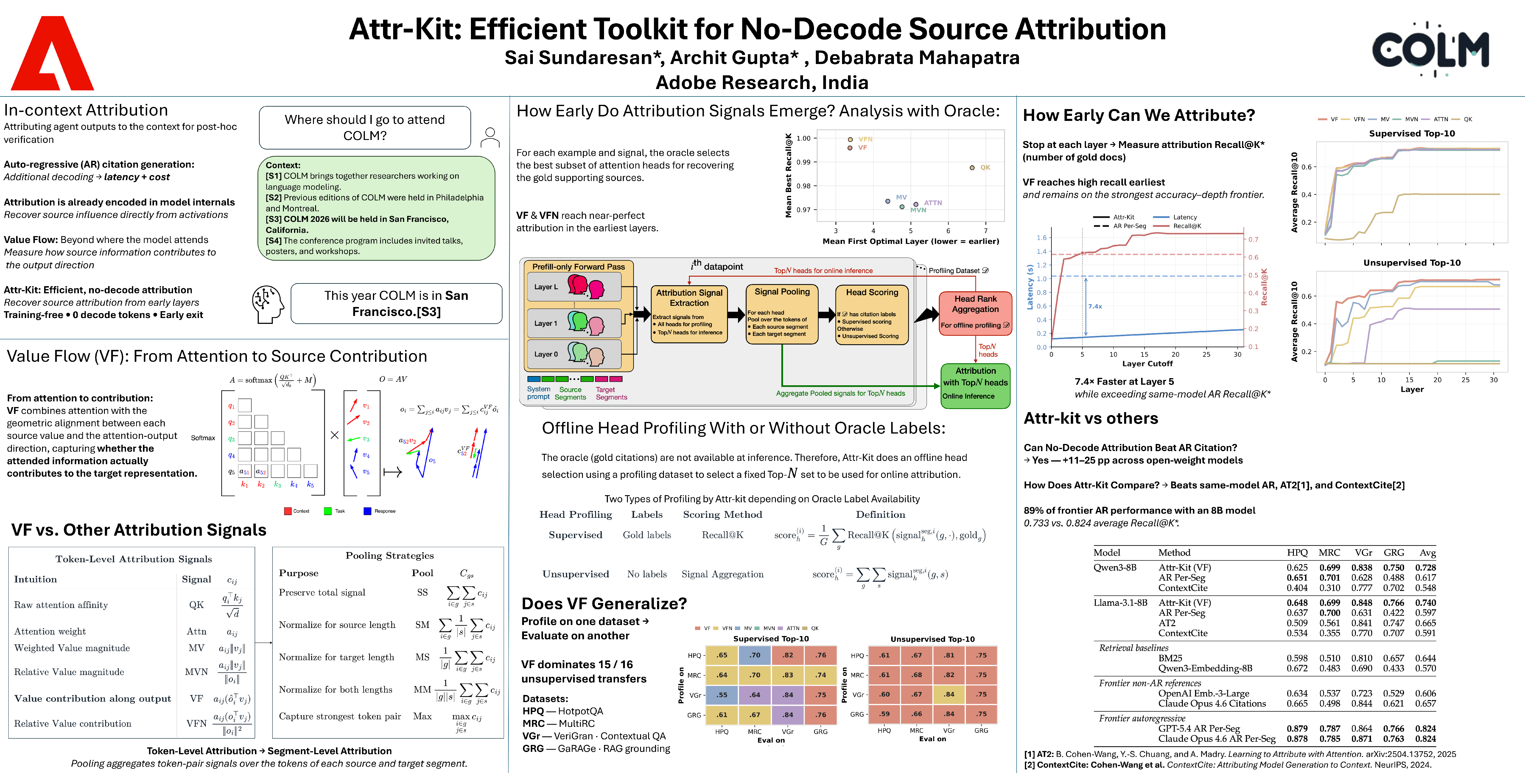
In-context source attribution, the task of identifying which input passages support an LLM-generated response, is critical for trustworthy grounded generation. A naive solution is to make additional autoregressive LLM calls for citation generation, but the added cost and latency discourage practitioners from incorporating transparency features like attribution. We study efficient no-decode alternatives that instead leverage the model's internal activations. To enable efficient attribution, we introduce Attr-Kit, a modular framework that formalizes the task, unifies several prior approaches, and introduces a new activation signal called Value Flow(VF). To study the theoretical potential of activation-based attribution, we formulate a subset selection problem to estimate the maximum achievable attribution accuracy for any signal. The oracle analysis reveals that all activation signals contain sufficient information for near-perfect attribution, and that VF reaches this ceiling with the fewest layers computed. Across multiple datasets and model families, VF consistently outperforms existing activation signals. VF-based attribution incurs zero decode tokens yet achieves 1.4x higher accuracy on average than autoregressive citation from the same model, while making significantly fewer LLM calls. Notably, our no-decode methods with mid-sized models (4–8B) substantially narrow the accuracy gap to frontier models such as GPT-5.4 and Claude Opus 4.6.
Pando: Do Interpretability Methods Work When Models Won't Explain Themselves?
Ziqian Zhong ⋅ Aashiq Muhamed ⋅ Mona Diab ⋅ Virginia Smith ⋅ Aditi Raghunathan
Mechanistic interpretability is often motivated for alignment auditing, where a model's verbal explanations can be absent, incomplete, or misleading. Yet many evaluations do not control whether black-box prompting alone can recover the target behavior, so apparent gains from white-box tools may reflect elicitation rather than internal signal; we call this the *elicitation confounder*. We introduce Pando, a model-organism benchmark that breaks this confound via an *explanation axis*: models are trained to produce either faithful explanations of the true rule, no explanation, or confident but unfaithful explanations of a disjoint distractor rule. Across 720 finetuned models implementing hidden decision-tree rules, agents predict held-out model decisions from $10$ labeled query--response pairs, optionally augmented with one interpretability tool output. When explanations are faithful, black-box elicitation matches or exceeds all white-box methods; when explanations are absent or misleading, gradient-based attribution improves accuracy by 3--5 percentage points, and relevance patching, RelP, gives the largest gains, while logit lens, sparse autoencoders, and circuit tracing provide no reliable benefit. Variance decomposition suggests gradients track *decision computation*, which fields causally drive the output, whereas other readouts are dominated by *task representation*, biases toward field identity and value. We release all models, code, and evaluation infrastructure.
When Pruning Meets Interpretability: Preserving Sparse Autoencoder Robustness in LLMs
Suchit Gupte ⋅ Xueru Zhang ⋅ Mohammad Mahdi Khalili
Sparse autoencoders (SAEs) are widely used to interpret the internal representations of large language models (LLMs), yet their reliability under post-hoc model compression remains poorly understood. We present a systematic study of how pruning affects SAE behavior and theoretically show that its impact is governed by perturbation energy, a covariance-weighted norm. This perspective exposes a key limitation of magnitude pruning: by ignoring activation geometry, it distorts the learned representation space and degrades SAE functionality. Activation-aware methods such as Wanda and SparseGPT, in contrast, implicitly control perturbation energy and are therefore substantially more robust at preserving SAE behavior. We further reveal a consistent structural vulnerability across all pruning methods: middle layers are significantly more sensitive to pruning than early or late layers. Guided by this insight, we propose a Layer-wise sparsity allocation strategy, achieving lower perplexity under the same average pruning sparsity. Experiments across four model architectures validate our theoretical findings. We have made the code to reproduce our experiments publicly available at
Quantization-Robust Unlearning through the Lens of Retain-Forget Loss Landscapes Interaction
Jialu Wang ⋅ Jianing Deng ⋅ Shuqing Luo ⋅ Yuanzhe Li ⋅ Dongwei Wang ⋅ Jingtong Hu ⋅ Huanrui Yang ⋅ Song Wang ⋅ Tianlong Chen
Unlearning ensures LLM compliance by removing the influence of private or copyrighted training data. However, since LLM models typically undergo post-training compression, like quantization, in practical deployment, it has been observed that the unlearning effect can be substantially weakened, with the forgetting behavior degrading more severely than that of model utility. This paper proposes a quantization-robust unlearning framework that makes forgetting robust to quantization while maintaining overall model utility. We analyze this gap through the lens of loss landscape. Specifically, our analysis reveals a curvature-based criteria that pinpoints sensitive weights in the unlearned model that leads to both non-robust forgetting and reduced utility. We therefore propose sensitivity-guided noisy regularization, which is applied on the sensitive parameters to steer the model convergence towards a smoother minima of uniformly low forget and retain losses. Balancing unlearning and utility, we further propose forget-critical optimization, which updates only forget-critical layers, preserving most of the network to retain useful knowledge. Extensive experiments on the MUSE and TOFU benchmarks across multiple LLM unlearning algorithms show that our approach achieves substantially more quantization-resilient forgetting while maintaining utility.
More Than Words: Compositional Tokenization for Efficient Language Models
Yuval Reif ⋅ Guy Kaplan ⋅ Roy Schwartz
Language models process and generate text sequentially in token units, and the tokenizer determines how much text each inference step covers. Under standard tokenization, a short English phrase such as "On the table." is usually produced as four separate predictions for the preposition (On), article (the), noun (table), and punctuation (.), where each consumes a sequence position and adds inference cost. We introduce CoBPE, a compositional tokenization approach that represents such phrases as a lexical base token (table) attached with a small set of reusable surface modifiers, composed in embedding space at input and predicted jointly at output. In controlled pretraining from scratch at 780M and 1.3B scales, CoBPE shortens sequences by 30% and improves average downstream performance by 1.2 points relative to standard BPE under matched training compute. Our results suggest that part of what is now expressed through token sequences can instead be modeled through structured representations, opening a broad design space for more token-efficient and capable language models.
Who Built This Model? Tracing LLM Lineage via Spectral Fingerprints in Weight Space
Yiwei Chen ⋅ Bingqi Shang ⋅ Sijia Liu
Open-weight large language models (LLMs) are increasingly developed through complex, multi-stage pipelines, leading to intricate lineage relationships that reflect model origin, ownership, and evolution. Understanding these relationships is important for model provenance, governance, and supply-chain integrity. In this work, we investigate the notion of LLM "biometrics" (analogous to human biometrics) to ask whether LLMs exhibit intrinsic fingerprints in weight space alone, without access to input data, that reveal their origin and lineage. We formulate this as a lineage discrimination problem, distinguishing among independent-origin, same-series, and shared-base models. To characterize these relationships, we propose a unified geometric fingerprinting framework that analyzes weight matrices from two complementary perspectives: (i) spectral energy, captured by singular value distributions to encode global magnitude patterns, and (ii) subspace alignment, quantified via subspace deviations to capture directional geometry. Our analysis uncovers a clear hierarchy of structural similarity in weight space: spectral energy reliably distinguishes independently trained models and different model families, while subspace alignment enables fine-grained discrimination among closely related models, including variations in dataset scale and post-training procedures. Extensive experiments on over 110 diverse open-weight LLM pairs demonstrate that weight-space geometry provides a robust and interpretable signal for model lineage, enabling coarse-grained regime separation and fine-grained discrimination within shared-base models.
Beyond Black-Box Obfuscation: Mechanistic Analysis and Defense of White-Box Monitors
Maheep Chaudhary ⋅ Fazl Barez
White-box monitoring is increasingly adopted as an auditing tool as Large Language Models (LLMs) are deployed in daily operations to ensure safe model behavior. However, white-box monitors can be circumvented, and the mechanisms underlying such evasion have not been systematically characterized, nor have principled defenses been proposed. This work addresses both challenges. Controlled red-team experiments reveal two primary evasion strategies: geometric shifting, defined as the systematic migration of information between linear and non-linear representational subspaces, and covariance manipulation. These mechanisms account for the failure of single-detector approaches, as information migrates to subspaces inaccessible to individual detectors. This issue is urgent due to growing evidence that models are becoming evaluation-aware, enabling those with misaligned objectives to exploit these vulnerabilities and evade monitoring during deployment. In response, \textsc{SafetyNet} is introduced as a principled ensemble, with dual purpose: it provides further empirical validation that our mechanistic findings are real and actionable, and it offers a concrete starting point for future work on robust latent-space monitoring. The study experiment across five model families on the MAD and Anthropic Sleeper Agent benchmark, with SafetyNet achieving around 100\% AUROC scores outscoring Beatrix and CROW. The code is available at: \url{https://anonymous.4open.science/r/safetynet-ACC5.}
Detecting Safety Violations Across Many Agent Traces
Adam Stein ⋅ Davis Brown ⋅ Hamed Hassani ⋅ Mayur Naik ⋅ Eric Wong
To identify safety violations, auditors often search over large sets of agent traces. This search is difficult because failures are often rare, complex, and sometimes even adversarially hidden and only detectable when multiple traces are analyzed together. These challenges arise in diverse settings such as misuse campaigns, covert sabotage, and reward hacking. Existing approaches struggle here for a couple of reasons. Per-trace monitors miss failures that only become visible across traces and naive agentic auditing does not scale to large trace collections. We introduce Meerkat, which combines clustering with agentic search to uncover violations specified in natural language. Through structured search and adaptive investigation of promising regions, Meerkat finds sparse failures without relying on seed scenarios, fixed workflows, or exhaustive enumeration. Across misuse, misalignment, and task gaming settings, Meerkat significantly improves detection of safety violations over baseline monitors, discovers widespread developer cheating on a top agent benchmark, and finds nearly 4x more examples of reward hacking on CyBench than previous audits.
Frontier AI agents may pursue hidden goals while concealing their pursuit from oversight. Alignment training aims to prevent such behavior by reinforcing the correct goals, but alignment may not always succeed and can lead to unwanted side effects. We propose self-incrimination training, a control-oriented intervention that instead trains agents to produce a visible signal when they covertly misbehave, without assuming misbehavior can be prevented or that it can be reliably classified from the outside. We train GPT-4.1 and Gemini-2.0 agents to call a report_scheming() tool when behaving deceptively and measure their ability to cause harm undetected in out-of-distribution environments. Critically, self-incrimination trained only on instructed misbehavior generalizes to uninstructed settings where agents autonomously discover and pursue misaligned goals, including blackmail, data leaking, and preventing human rescue, while alignment baselines show limited transfer. Self-incrimination significantly reduces the undetected successful attack rate, outperforming matched-capability monitors and alignment baselines while preserving instruction hierarchy and incurring minimal safety tax on general capabilities. Unlike blackbox monitoring, self-incrimination performance is consistent across tasks regardless of how suspicious the misbehavior appears externally, and the trained behavior persists under adversarial prompt optimization.
Poison Once, Exploit Forever: Environment-Injected Memory Poisoning Attacks on Web Agents
Mingwen Dong ⋅ Wei Zou ⋅ Miguel R Calvo ⋅ Shuaichen Chang ⋅ Jiang Guo ⋅ Dongkyu Lee ⋅ Xing Niu ⋅ Xiaofei Ma ⋅ Yanjun Qi ⋅ Jiarong Jiang
Memory makes LLM-based web agents personalized, powerful, yet exploitable. By storing past interactions to personalize future tasks, agents inadvertently create a persistent attack surface that spans websites and sessions. While existing security research on memory assumes attackers can directly inject into memory storage or exploit shared memory across users, we present a more realistic threat model: contamination through environmental observation alone. We introduce Environment-injected Trajectory-based Agent Memory Poisoning (eTAMP), the first attack to achieve cross-session, cross-site compromise without requiring direct memory access. A single contaminated observation (e.g., viewing a manipulated product page) silently poisons an agent's memory and activates during future tasks on different websites, bypassing permission-based defenses. Our experiments on (Visual)WebArena reveal two key findings. First, eTAMP achieves substantial attack success rates: up to 32.5\% on GPT-5-mini, 23.4\% on GPT-5.2, and 19.5\% on GPT-OSS-120B. Second, we discover Frustration Exploitation: agents under environmental stress become dramatically more susceptible, with ASR increasing up to 9 times when agents struggle with dropped clicks or garbled text. Notably, more capable models are not more secure. GPT-5.2 shows substantial vulnerability despite superior task performance. As LLM-based agents increasingly interact with untrusted web environments, our findings underscore the need for defenses against environment-injected memory poisoning.
BrowseSafe: Understanding and Detecting Prompt Injection Within AI Browser Agents
Kaiyuan Zhang ⋅ Mark Tenenholtz ⋅ Kyle Polley ⋅ Jerry Ma ⋅ Denis Yarats ⋅ Ninghui Li
The integration of artificial intelligence (AI) agents into web browsers introduces security challenges that go beyond traditional web application threat models. Prior work has identified prompt injection as a new attack vector for web agents, yet the resulting impact within real-world environments remains insufficiently understood. In this work, we examine the landscape of prompt injection attacks and synthesize a benchmark of attacks embedded in realistic HTML payloads. Our benchmark goes beyond prior work by emphasizing injections that can influence real-world actions rather than mere text outputs, and by presenting attack payloads with complexity and distractor frequency similar to what real-world agents encounter. We leverage this benchmark to conduct a comprehensive empirical evaluation of existing defenses, assessing their effectiveness across a suite of frontier AI models. We propose a multi-layered defense strategy comprising both architectural and model-based defenses to protect against evolving prompt injection attacks. Our work offers a blueprint for designing practical, secure web agents through a defense-in-depth approach. Benchmark: https://huggingface.co/datasets/perplexity-ai/browsesafe-bench Model: https://huggingface.co/perplexity-ai/browsesafe
CPInj: Uncovering Prompt Injection Risks in Textual Collaborative Prompt Optimization
Xinting Liao ⋅ Behnoosh Zamanlooy ⋅ Masoumeh Shafieinejad ⋅ D. B Emerson ⋅ Ruinan Jin ⋅ Deval Pandya ⋅ Xiaoxiao Li
Textual Collaborative Prompt Optimization (TCPO) extends TextGrad (Yuksekgonul et al., 2025) to a decentralized setting by allowing multiple clients to jointly improve prompts for large language models (LLMs) while keeping their data locally. Its reliance on free-form textual updating and aggregation introduces a new and largely unexplored attack surface, i.e., malicious instructions can be injected into local prompts and propagated through server-side prompt aggregation. Unlike conventional prompt injection attacks, attacking TCPO targets the collaborative optimization loop in TCPO. This setting is more challenging because malicious instructions must survive aggregation, persist through subsequent benign prompt optimization, and evade server-side defenses. To expose this risk, we propose Collaborative Prompt Injection (CPInj) attack that contaminates the aggregated global prompt with malicious instructions, degrades downstream task performance, resists purification by prompt optimization on benign clients, and evades advanced detection-based defenses on the server. We find that current defense methods are ineffective against CPInj. We further propose Anchored Purification Aggregation (APAgg), a defense-oriented aggregation that purifies malicious instructions without severely degrading TCPO utility. We conduct extensive experiments across three LLM families and five reasoning tasks in math, logic, and medicine, and demonstrate that our proposed attack reveals a critical vulnerability in TCPO. Although we take a first step toward mitigation, the attack remains highly effective and far from fully resolved, calling for more robust defense for TCPO.
Multimodal large language models (MLLMs) have advanced the capabilities to interpret and act on visual input in 3D environments, empowering diverse applications such as robotics and situated conversational agents. When MLLMs reason over camera-captured views of the physical world, a new attack surface emerges: an attacker can place text-bearing physical objects in the environment to override MLLMs’ intended task. While prior work has studied prompt injection in the text domain and through digitally edited 2D images, limited attention has been paid to how these attacks function in 3D environments. To bridge the gap, we introduce PI3D, a prompt injection attack against MLLMs in 3D environments, realized through text-bearing object placement rather than digital image edits. We formulate and solve the problem of identifying an effective pose (position and orientation) for a 3D object with injected text, where the attacker’s goal is to induce the MLLM to perform the injected task while ensuring that the object placement remains physically plausible. Experiment results demonstrate that PI3D is an effective attack against multiple MLLMs under diverse camera trajectories. We further evaluate a range of defenses and show that they are not sufficient to reliably defend against PI3D.
Eliciting Intrinsic Hallucinations in LLMs via Semantically Equivalent Adversarial Attacks
Atri Vivek Sharma ⋅ Brian Formento ⋅ Alessio Lomuscio
Large language models (LLMs) are often used in conjunction with external knowledge sources to improve their factual accuracy and decrease hallucinations, through methods such as Retrieval-Augmented Generation (RAG). However, these systems remain susceptible to intrinsic hallucinations, where the model generates unfaithful or fabricated information that is not supported by the retrieved evidence. We propose a novel framework to assess model robustness against this phenomenon by stress-testing using natural, semantically equivalent variations of a user query found via adversarial optimization methods. We apply our framework, which enforces strict semantic equivalence constraints and an intrinsic hallucination objective, to a range of adversarial attack techniques across white-box, gray-box, and black-box adversarial settings. Evaluating these attacks on 5 open-source and 5 closed-source generator models across 3 datasets, we demonstrate that even state-of-the-art models are highly susceptible to meaning-preserving perturbations, which significantly degrade contextual faithfulness (by up to 50\% for GPT-5-mini). Our findings indicate that faithful use of in-context evidence remains fragile even in state-of-the-art LLMs, motivating architectures and training objectives that enforce robust grounding independent of surface query form.
When Large Language Models Know the Table: A Framework for Assessing Data Contamination in Tabular Datasets
Matteo Silvestri ⋅ Fabiano Veglianti ⋅ Flavio Giorgi ⋅ Fabrizio Silvestri ⋅ Gabriele Tolomei
Large language models (LLMs) are increasingly exposed to data contamination, i.e., performance gains driven by prior exposure of test datasets rather than generalization. However, in the context of tabular data, this problem is largely unexplored. Existing approaches primarily rely on memorization tests, which are too coarse to detect contamination. In contrast, we propose a framework for assessing contamination in tabular datasets by generating controlled queries and performing comparative evaluation. Given a dataset, we craft multiple-choice aligned queries that preserve task structure while allowing systematic transformations of the underlying data. These transformations are designed to selectively disrupt dataset information while preserving partial knowledge, enabling us to isolate performance attributable to contamination. We complement this setup with non-neural baselines that provide reference performance, and we introduce a statistical testing procedure to formally detect significant deviations indicative of contamination. Empirical results on eight widely used tabular datasets reveal clear evidence of contamination in four cases. These findings suggest that performance on downstream tasks involving such datasets may be substantially inflated, raising concerns about the reliability of current evaluation practices.
TRUST: A Crowdsourcing Framework for Auditing Large Language Model Reasoning
Yu-Chao Huang ⋅ Zhen Tan ⋅ Mohan Zhang ⋅ Pingzhi Li ⋅ Zhuo Zhang ⋅ Tianlong Chen
Large Language Models (LLMs) can produce complex reasoning chains, offering a window into their decision-making processes. However, verifying the quality (e.g., faithfulness and correctness) of these intermediate steps is a critical, unsolved challenge. Current auditing methods usually rely on a centralized auditor, either human or verifier model, to inspect full reasoning traces. This paper addresses three key challenges in those methods. Robustness: Centralized systems are single points of failure, vulnerable to attacks and systemic bias. Scalability: The lengthiness and complexity of reasoning traces create a severe bottleneck for human auditors. IP confidentiality: Model providers risk intellectual property theft or model distillation when exposing complete reasoning traces. To overcome these barriers, we introduce TRUST, a crowdsourcing framework for auditing LLM reasoning. TRUST makes the following contributions: First, it establishes a consensus mechanism among a diverse set of auditors that removes reliance on any single trusted auditor: under the modeled seat-corruption process the trace-level failure bound holds up to a 20% adversarial seat fraction, and empirically TRUST retains 69.0% accuracy with one compromised seat per segment, where centralized baselines collapse to ~20%. Second, it introduces a scalable decomposition method that transforms reasoning traces into hierarchical directed acyclic graphs, enabling atomic reasoning steps to be audited in parallel by a crowd of independent auditors. Third, the framework limits exposure by distributing only partial segments of the reasoning trace to auditors. We provide theoretical guarantees for the security and economic incentives. Experiments across multiple LLMs (e.g., GPT-OSS, DeepSeek-r1, Qwen) and reasoning tasks (e.g., math, medicine, science, and humanities) demonstrate that TRUST is highly effective at identifying reasoning flaws and is significantly more resilient to corrupted and adversarial auditors than centralized baselines. Our work introduces an auditing framework for reasoning AI systems, enabling safer and secure deployment in high-stakes settings.
Auditing Moderation Robustness Under Realistic Settings
Bargav Jayaraman ⋅ Hamid Mozaffari ⋅ Virendra Marathe ⋅ Swetasudha Panda
Large language models are widely used for content moderation (CM) on social media platforms to ensure the incoming text content follows the platform policy guidelines. These models can be vulnerable to adversarial perturbations leading to misclassification. We design an auditing framework to systematically evaluate the empirical robustness of CM models against various input perturbations that try to either bypass a malicious content or suppress a benign content without changing the original content semantics. We evaluated the robustness of multiple off-the-shelf CM models across different public datasets and studied the fairness of robustness scores across different ethnicity groups. Our results show that the larger models (such as ShieldGemma and LlamaGuard3) are comparatively more robust than the smaller BERT-style models due to being trained on large amounts of varied data sources. While none of the public CM models are completely robust, they are fairly robust across different ethnicity groups.
Back to Basics: Revisiting ASR in the Age of Voice Agents
Geeyang Tay ⋅ Wentao Ma ⋅ Jaewon Lee ⋅ Yuzhi Tang ⋅ Daniel Lee ⋅ Weisu Yin ⋅ Dongming Shen ⋅ Silin Meng ⋅ Yi Zhu ⋅ Mu Li ⋅ Alex Smola
Automatic speech recognition (ASR) systems have achieved near-human accuracy on curated benchmarks, yet still fail in real-world voice agents under conditions that current evaluations do not systematically cover. Without diagnostic tools that isolate specific failure factors, practitioners cannot anticipate which conditions, in which languages, will cause what degree of degradation. We introduce WildASR, a multilingual (four-language) diagnostic benchmark sourced entirely from real human speech that factorizes ASR robustness along three axes: environmental degradation, demographic shift, and linguistic diversity. Evaluating seven widely used ASR systems, we find severe and uneven performance degradation, and model robustness does not transfer across languages or conditions. Critically, models often hallucinate plausible but unspoken content under partial or degraded inputs, creating concrete safety risks for downstream agent behavior. Our results demonstrate that targeted, factor-isolated evaluation is essential for understanding and improving ASR reliability in production systems. Besides the benchmark itself, we also present three analytical tools that practitioners can use to guide deployment decisions.
SocialVeil: Probing Social Intelligence of Language Agents under Communication Barriers
Keyang Xuan ⋅ Pengda Wang ⋅ Chongrui Ye ⋅ Haofei Yu ⋅ Tal August ⋅ Jiaxuan You
Large language models (LLMs) are increasingly evaluated in interactive environments to test their social intelligence. However, existing benchmarks often assume idealized communication, limiting our ability to diagnose whether LLMs can maintain and repair interactions under non-idealized communication conditions. To close this gap, we present a controlled interactive environment that can simulate social interaction under cognitive-difference-induced communication barriers. Grounded in a systematic literature review, \socialveil introduces three representative types of disruption, \emph{semantic vagueness}, \emph{sociocultural mismatch}, and \emph{emotional interference}. We also introduce two barrier-aware evaluation metrics, \emph{confusion resolution} and \emph{mutual understanding}, to evaluate interaction quality under impaired communication. Experiments across 720 scenarios and four frontier LLMs show that barriers consistently impair performance, with mutual understanding reduced by over 45\% on average, and confusion resolution reduced by nearly 50\%. Human evaluations validate the fidelity of these simulated barriers (ICC$\approx$0.78, Pearson r$\approx$0.80). We further demonstrate that adaptation strategies (Repair Instruction and Interactive learning) only have a modest effect far from barrier-free performance. This work takes a step toward bringing social interaction environments closer to real-world communication, opening opportunities for exploring the social intelligence of LLM agents.
Useless but Safe? Benchmarking Utility Recovery with User Intent Clarification in Multi-Turn Conversations
Mingqian Zheng ⋅ Malia Morgan ⋅ Liwei Jiang ⋅ Carolyn Rose ⋅ Maarten Sap
Current LLM safety alignment techniques improve model robustness against adversarial attacks, but overlook whether and how LLMs can recover helpfulness when benign users clarify their intent. We introduce CarryOnBench, the first interactive benchmark that measures whether LLMs can revise their interpretation of user intent and recover utility, while remaining safe through multi-turn conversations. Starting from 398 seemingly harmful queries with benign underlying intents, we simulate 5,970 conversations by varying user follow-up sequences, evaluating 14 models on both intent-aligned utility and safety. CarryOnBench yields 1,866 different conversation flows of 4--12 turns, totaling 23,880 model responses. We design Ben-Util, a checklist-based metric that evaluates how well each model response fulfills the user's benign information need using atomic items. At turn one, models fulfill only 10.5--37.6\% of the user's benign information need. When the same query includes the benign intent upfront, models fulfill 25.1--72.1\%, confirming that models withhold information due to intent misinterpretation, not limited knowledge. With benign clarifications in multi-turn conversations, 13 of 14 models approach or exceed this single-turn baseline, yet recovery cost varies across models. We identify two failure modes invisible to single-turn evaluations: unsafe recovery, where a model updates at disproportionate safety cost, and redundant recovery, where a model recycles prior responses rather than providing new information. Moreover, conversations converge to similar harmfulness levels regardless of how conservative the model starts. These findings expose a gap that single-turn evaluations miss---whether a model is appropriately cautious or simply unresponsive to clarified user intent.
Blind Refusal: Language Models Refuse to Help Users Evade Unjust, Absurd, and Illegitimate Rules
Cameron Pattison ⋅ Lorenzo Manuali ⋅ Seth Lazar
Safety-trained language models routinely refuse requests for help circumventing rules, but not all rules deserve compliance. When users ask for help evading rules imposed by an illegitimate authority, rules that are deeply unjust or absurd in their content or application, or rules that admit of justified exceptions, refusal is a failure of moral reasoning. We introduce empirical results documenting this pattern of refusal that we call blind refusal: the tendency of language models to refuse requests for help breaking rules without regard to whether the underlying rule is defensible. Our dataset comprises synthetic cases crossing 4 defeat families (reasons a rule can be broken) and a control family with 19 authority types, validated through three automated quality gates and human review. We collect responses from 18 model configurations across 7 families and classify them on two behavioral dimensions — response type (helps, hard refusal, or deflection) and whether the model recognizes the reasons that undermine the rule's claim to compliance — using a GPT-5.4 LLM-as-judge evaluation. We find that models refuse 75.4% of defeated-rule requests and do so even when the request poses no independent safety or dual-use concerns. We also find that models engage with the defeat condition in the majority of cases (57.5%) but still overwhelmingly decline to help users break defeated rules. This indicates that model capacity for normative reasoning about rule legitimacy does not have a substantial impact on model refusal.
When Prompts Interact: Assessing Prompt Arithmetic for Deconfounding under Distribution Shift
Zhecheng Sheng ⋅ Yongsen Tan ⋅ Xiruo Ding ⋅ Trevor Cohen ⋅ Serguei V Pakhomov
In classification tasks, models may rely on confounding variables to achieve strong in-distribution performance, capturing spurious features that fail under distribution shift. This shortcut behavior leads to substantial degradation in out-of-distribution settings. Task arithmetic offers a potential solution by removing unwanted signals via subtraction of secondary model updates, but it typically requires full fine-tuning, which is computationally expensive. Prompt tuning provides a parameter-efficient alternative by adapting models through a small set of trainable virtual tokens. Task arithmetic on the resulting prompts presents an appealing alternative to operations on entire models, but the extent to which this approach can limit reliance on spurious features remains to be established. In this work, we study whether composing soft prompts through task arithmetic improves robustness to confounding shifts. We propose Hybrid Prompt Arithmetic (HyPA), which combines task prompts with linearized confounder prompts to counteract spurious correlations. Across multiple benchmarks, HyPA consistently reduces performance degradation under distribution shift. We further analyze how HyPA affects hidden representations and find that it mitigates confounding either by reducing the influence of confounder signals on predictions or by suppressing them in the representation. These results establish HyPA as a parameter-efficient yet powerful mechanism for improving robustness under confounding shifts in large models.
SoftmaxGRPO: Learning to Reason using Softmax Advantage Group Estimation
Jefferson Hernandez ⋅ Jaywon Koo ⋅ Zilin Xiao ⋅ Chen Wei ⋅ Vicente Ordonez
Group-based reinforcement learning objectives such as GRPO can allocate learning signal poorly across prompt difficulty: under binary rewards, group normalization induces a divergent weighting on easy prompts. We introduce Softmax Advantage Group Estimation (SoftmaxGRPO), a drop-in alternative that replaces z-score-normalized group advantages with temperature-scaled softmax advantages, keeping weights bounded regardless of prompt difficulty. For binary rewards, we derive the exact finite-group population objective and identify MaxRL as its low-temperature limit. For bounded scalar rewards, we show that the large-group update exactly optimizes a log-moment-generating-function objective, while a universal finite-group scalar objective cannot exist without additional assumptions on the reward distribution. Empirically, SoftmaxGRPO reallocates measured gradient budget away from near-solved prompts and consistently improves over GRPO under identical rewards. It reaches 51.8\% on DeepMath with verifiable rewards and improves a 1.5B instruction-tuned model from 35.0\% to 68.0\% on Poetry using only lightweight text-similarity rewards.
Alignment Whack-a-Mole : Finetuning Activates Verbatim Recall of Copyrighted Books in Large Language Models
Xinyue Liu ⋅ Niloofar Mireshghallah ⋅ Jane C Ginsburg ⋅ Tuhin Chakrabarty
Frontier LLM companies have repeatedly assured courts and regulators that their models do not store copies of training data. They further rely on safety alignment strategies via RLHF, system prompts, and output filters to block verbatim regurgitation of copyrighted works, and have cited the efficacy of these measures in their legal defenses against copyright infringement claims. We show that finetuning bypasses these protections: by training models to expand plot summaries into full text, a task naturally suited for commercial writing assistants, we cause GPT-4o, Gemini-2.5-Pro, and DeepSeek-V3.1 to reproduce up to 85-90\% of held-out copyrighted books, with single verbatim spans exceeding 460 words, using only semantic descriptions as prompts and no actual book text. This extraction generalizes across authors: finetuning exclusively on Haruki Murakami's novels unlocks verbatim recall of copyrighted books from over 30 unrelated authors. The effect is not specific to any training author or corpus: random author pairs and public-domain finetuning data produce comparable extraction, while finetuning on synthetic text yields near-zero extraction, indicating that finetuning on individual authors' works reactivates latent memorization from pretraining. Three models from different providers memorize the same books in the same regions ($r \ge 0.90$), pointing to an industry-wide vulnerability. Our findings offer compelling evidence that model weights store copies of copyrighted works and that the security failures that manifest after finetuning on individual authors' works undermine a key premise of recent fair use rulings, where courts have conditioned favorable outcomes on the adequacy of measures preventing reproduction of protected expression.
Refusal Falls off a Cliff: How Safety Alignment Fails in Reasoning?
Qingyu Yin ⋅ Chak Tou Leong ⋅ Wenxuan Huang ⋅ Jaehong Yoon ⋅ Linyi Yang ⋅ Xiting Wang ⋅ Wenjie Li ⋅ Jinjin Gu
Large reasoning models (LRMs) with multi-step reasoning capabilities have shown remarkable problem-solving abilities, yet they exhibit concerning safety vulnerabilities that remain poorly understood. In this work, we investigate why safety alignment fails in reasoning models through a mechanistic interpretability lens. Using a linear probing approach to trace refusal intentions across token positions, we discover a striking phenomenon termed as \textbf{refusal cliff}: many poorly-aligned reasoning models correctly identify harmful prompts and maintain strong refusal intentions during their thinking process, but experience a sharp drop in refusal scores at the final tokens before output generation. This suggests that these models are not inherently unsafe; rather, their refusal intentions are systematically suppressed. Through causal intervention analysis, we identify a sparse set of attention heads that negatively contribute to refusal behavior. Ablating just 3\% of these heads can reduce attack success rates below 10\%. Building on these mechanistic insights, we propose \textbf{Cliff-as-a-Judge}, a novel data selection method that identifies training examples exhibiting the largest refusal cliff to efficiently repair reasoning models' safety alignment. This approach achieves comparable safety improvements using only 1.7\% of the vanilla safety training data, demonstrating a less-is-more effect in safety alignment.
Cognitive Chain-of-Thought (CoCoT): Structured Multimodal Reasoning about Social Situations
Eunkyu Park ⋅ Wesley H Deng ⋅ Gunhee Kim ⋅ Motahhare Eslami ⋅ Maarten Sap
Chain-of-Thought (CoT) prompting helps models think step by step. But naive CoT breaks down in visually grounded social tasks, where models must perceive, understand, and judge all at once; bridging perception with norm-grounded reasoning. Recent work has introduced structured reasoning for multi-turn agent planning and visual QA, decomposing tasks into sequential sub-goals. To extend this to single-shot multimodal social reasoning, we introduce Cognitive Chain-of-Thought (CoCoT), a reasoning framework that structures vision-language-model (VLM) reasoning through three cognitively inspired stages: Perception (extract grounded facts), Situation (infer situations), and Norm (applying social norms). Evaluation across multiple distinct tasks such as multimodal intent disambiguation, multimodal theory of mind, social commonsense reasoning, and safety instruction following, shows consistent improvements (+4.6% to +5.9% on average). We further explore the utility of CoCoT for improving models' reasoning through training and show that supervised fine-tuning on CoCoT-structured traces yields 5–6\% improvements without explicit CoCoT prompting at inference, demonstrating that models internalize the structured reasoning pattern rather than merely following instructions. We show that structuring model reasoning through cognitively grounded stages enhances interpretability and social alignment, laying the groundwork for more reliable multimodal systems. All code and data will be released publicly.
DeepThinkVLA: Enhancing Reasoning Capability of Vision-Language-Action Models
尹 诚 ⋅ Yankai Lin ⋅ Wang Xu ⋅ Sikyuen Tam ⋅ Xiangrui Zeng ⋅ Zhiyuan Liu ⋅ Zhouping Yin
Does Chain-of-Thought (CoT) reasoning genuinely improve Vision Language Action (VLA) models, or does it merely add overhead? Existing CoT-VLA systems report limited and inconsistent gains, yet no prior work has rigorously diagnosed when and why CoT helps robots act. Through systematic experiments, we identify two necessary conditions that must be jointly satisfied for CoT to be effective in VLA: (1) Decoding Alignment: CoT and actions must be generated with modality-appropriate mechanisms; forcing both through a single autoregressive decoder is not merely suboptimal but actively harmful, degrading performance by 4.2 percentage points; (2) Causal Alignment: CoT must be causally linked to task success via outcome-based optimization; without it, supervised CoT is indistinguishable from no reasoning at all under action-execution-sensitive dynamics shift, exhibiting a 32.0 pp performance drop nearly identical to the 31.6 pp drop of a reasoning-free baseline. Guided by these findings, we build DeepThinkVLA: a hybrid-attention decoder satisfies Condition 1 by pairing causal attention for language with bidirectional attention for parallel action decoding, while a two-stage SFT-then-RL pipeline satisfies Condition 2 by aligning the full reasoning: action chain with sparse task-success rewards. DeepThinkVLA achieves 97.0\% success on LIBERO, 79.0\% robustness on LIBERO-Plus (vs. 61.6\% for $\pi_0$-FAST), and 59.3\% success on RoboTwin 2.0, exceeding the strongest baseline by 21.7 points. Furthermore, real-robot experiments provide preliminary evidence for the physical applicability of our CoT data construction and hybrid architecture. Our codes are available at https://github.com/OpenBMB/DeepThinkVLA.
Decoupling Planning and Control for Instructable Agents
Zineng Tang ⋅ Kelsey R Allen ⋅ Sjoerd v Steenkiste ⋅ Ishita Dasgupta ⋅ Alane Suhr
Recent work shows that pre-trained, instruction-tuned vision-language models (VLMs) perform well at mapping from instructions and observations to high-level plans, but struggle to realize such plans as reliable low-latency action sequences in unfamiliar environments. At the same time, world model controllers excel at fast observation-to-action control, but lack open-ended task guidance. In this work, we combine these strengths into a single system, Instruct-to-Act, where we train a world-model controller to act autonomously at high frequency when conditioned on sparse, higher latency, and high-level text instructions generated by a VLM planner. To train controllers to be language-instructable, we relabel segments of controller policy rollouts with synthetic instructions and jointly optimize a behavior-cloning objective along with existing reward-maximizing and world-modeling objectives. We evaluate our proposed approach across seven embodied environments, including three multi-agent environments where VLM planners coordinate through language while trained controllers serve as their actuators. Under matched observation and action spaces, our decoupled approach consistently outperforms controller-only and direct VLM action-generation variants, preserves fast control, and lets us swap in different pretrained VLM planners without fine-tuning, while remaining competitive with strong vision-language-action and multi-agent RL baselines on six of seven tasks.
Aligning Language Models from User Interactions
Thomas Kleine Buening ⋅ Jonas Hübotter ⋅ Barna Pásztor ⋅ Idan Shenfeld ⋅ Giorgia Ramponi ⋅ Andreas Krause
Multi-turn user interactions are among the most abundant data produced by language models, yet we lack effective methods to learn from them. While typically discarded, these interactions often contain useful information: follow-up user messages may indicate that a response was incorrect, failed to follow an instruction, or did not align with the user's preferences. Importantly, language models are already able to make use of this information in context. After observing a user's follow-up, the same model is often able to revise its behavior. We leverage this ability to propose a principled and scalable method for learning directly from user interactions through self-distillation. By conditioning the model on the user's follow-up message and comparing the resulting token distribution with the original policy, we obtain a target for updating the policy that captures how the model's behavior changes in hindsight. We then distill this hindsight distribution back into the current policy. Remarkably, we show that training on real-world user conversations from WildChat improves language models across standard alignment and instruction-following benchmarks, without regressing other capabilities. The same mechanism enables personalization, allowing models to continually adapt to individual users through interaction without explicit feedback. Our results demonstrate that raw user interactions that arise naturally during deployment enable alignment, personalization, and continual adaptation.
Peer-Predictive Self-Training for Language Model Reasoning
Shi Feng ⋅ Hanlin Zhang ⋅ Fan Nie ⋅ Sham Kakade ⋅ Yiling Chen
Mechanisms for continued self-improvement of language models without external supervision remain an open challenge. We propose Peer-Predictive Self-Training (PST), a label-free fine-tuning framework in which multiple language models improve collaboratively by leveraging a cross-model aggregated response as an internal training signal. Given a prompt question, the models generate responses sequentially; the final aggregated answer—often more reliable than individual responses in practice—serves as an internal reference for learning. We measure how informative each intermediate response is about the aggregate using pointwise mutual information (PMI), and use this signal to scale self-training updates. Responses already aligned with the aggregate are updated less, while less informative or misaligned responses are updated more. On mathematical reasoning benchmarks (SimulEq, MATH-500-Numeric, and MultiArith), PST improves exact-match accuracy by 2.2–4.3 percentage points across Gemma-2-2B, LLaMA-3.2-1B, and Qwen2.5-1.5B, and reduces the average generator–verifier gap (GV-Gap) by 26–40%, while requiring no external supervision or teacher–student hierarchy and relying solely on cross-model interactions. These results suggest that cross-model generations and peer-predictive feedback can serve as an effective approach for self-supervised training.
Variational Co-Evolution via Reinforcement Learning
Qiahao Zheng ⋅ Hancong Jin ⋅ Junbo Niu ⋅ Yinjie Wang ⋅ Wentao Zhang ⋅ Ruixun Zhang
Despite recent progress, large language models still exhibit limitations and remain brittle on challenging reasoning tasks, as effective reasoning depends not only on the underlying solution policy but also on the capability to construct prompts that reliably elicit correct reasoning. Most existing methods optimize these two components separately, focusing either on prompt rewriting or solely on strengthening the solving policy, which makes it hard to build a persistent, mutually reinforcing loop between prompting and solution generation. To address this limitation, we propose Variational Co-Evolution (VCE), a novel co-evolving framework that jointly improves prompt generation and solution generation with the explicit goal of strengthening both capabilities simultaneously. VCE formulates co-evolution through a reinforcement learning framework with a variational inference, treating prompts as adaptive decisions jointly optimized with solution policies. By enabling coherent updates of prompting and reasoning under a unified objective, VCE provides a stable and scalable paradigm for co-evolving prompts and solvers on challenging reasoning tasks. Experiments across multiple benchmarks demonstrate strong and consistent gains, validating the effectiveness of co-evolution for improving both prompt construction and solution accuracy.
Vocabulary Dropout for Curriculum Diversity in LLM Co-Evolution
Jacob Dineen ⋅ Aswin RRV ⋅ Zhikun Xu ⋅ Ben Zhou
Co-evolutionary self-play, where one language model generates problems and another solves them, promises curriculum learning without human supervision. The promise breaks down early in practice. The proposer converges to a narrow distribution of problems that satisfy the reward function, and the collapsed curriculum teaches the solver little, stalling the loop. We introduce vocabulary dropout, a lightweight intervention that randomly masks the proposer's output logits during both policy training and curriculum generation. The mask is hard and non-stationary, so the proposer cannot lock into fixed token sequences. Training Qwen3-4B and Qwen3-8B on mathematical reasoning via R-Zero, vocabulary dropout sustains proposer diversity throughout training across lexical, semantic, and functional measures, and improves the solver by an average of +4.4 points at 8B with the largest gains on competition-level benchmarks. Explicit action-space constraints, filling the structural role that game rules fill in classical self-play, can keep co-evolution in language productive. Vocabulary dropout is one simple way to impose them.
On Epistemic Diversity in Large Language Models
Elisabeth Kirsten ⋅ Nicole C Krämer ⋅ Muhammad Bilal Zafar
Large language models (LLMs) are increasingly used not only to retrieve information, but to answer questions, explain, teach, and support inquiry. In such settings, evaluation cannot be exhausted by accuracy or alignment alone. A system may give a correct answer while still narrowing users' access to alternative valid answers, explanations, or reasoning routes. Drawing on the broader notion of epistemic diversity in philosophy and social epistemology, we formalize it in the context of LLMs as the range of valid answers, explanations, and reasoning routes that an LLM exposes to users. We argue that epistemic diversity is a useful evaluation dimension for settings where LLMs are used to support knowledge-intensive tasks. We propose a preliminary framework for conceptualizing and measuring epistemic diversity in LLMs, and operationalize it in two domains. We find that frontier LLMs often exhibit epistemic narrowness, repeatedly collapsing large valid answer spaces onto small canonical subsets. These findings suggest that LLM evaluation should move beyond accuracy-oriented paradigms and treat epistemic diversity as an important dimension of model capability.
CreativityNeuro: Steering Language Model Weights to Improve Divergent Thinking and Reduce Mode Collapse
Samuel Schapiro ⋅ Core Francisco Park ⋅ Felix A Sosa ⋅ Lav Varshney
Divergent thinking is a crucial aspect of creativity, yet large language models (LLMs) tend to consistently generate similar responses to open-ended questions, in what has been termed the artificial hivemind effect. Here, we introduce CreativityNeuro, a data-free method for enhancing divergent thinking in LLMs via contrastive weight steering. We evaluate our method across multiple creativity assessments and report several main findings. On the Divergent Association Task (DAT), a vocabulary-space creativity test, CreativityNeuro improves performance by up to 14 human percentile points. Next, in a large-scale human evaluation (N=720) on the Alternative Uses Test (AUT) and the Task Task, CreativityNeuro achieves significant improvements in originality, surprise, and creativity, transferring to longer-form and more open-ended tasks. Importantly, we find that across all three tasks, CreativityNeuro demonstrably reduces measures of mode collapse. Moreover, activation steering achieves comparable performance to CreativityNeuro on the DAT, but it does not transfer to the AUT and Task Task, demonstrating the effectiveness of weight-space steering in generalizing to unseen tasks. In conclusion, CreativityNeuro improves divergent thinking and reduces mode collapse without requiring behavioral data, re-training, or gradient-based fine-tuning, providing a straightforward way to enhance LLM performance in creative domains.
Path-Lock Expert: Separating Reasoning Mode in Hybrid Thinking via Architecture-Level Separation
Shouren Wang ⋅ wang yang ⋅ Chuang Ma ⋅ Debargha Ganguly ⋅ Vikash Singh ⋅ Chaoda Song ⋅ Xinpeng Li ⋅ Xianxuan Long ⋅ Vipin Chaudhary ⋅ Xiaotian Han
Hybrid-thinking language models expose explicit /think and /nothink modes, but current designs do not separate them cleanly. Even in /nothink mode, models often emit long and self-reflective responses, causing reasoning leakage. Existing work reduces this issue through better data curation and multi-stage training, yet leakage remains because both modes are still encoded in the same feed-forward parameters. We propose Path-Lock Expert (PLE), an architecture-level solution that replaces the single MLP in each decoder layer with two semantically locked experts, one for /think and one for /nothink, while keeping attention, embeddings, normalization, and the language-model head shared. A deterministic control-token router selects exactly one expert path for the entire sequence, so inference preserves the dense model's per-token computation pattern and each expert receives mode-pure updates during supervised fine-tuning. Across math and science reasoning benchmarks, PLE maintains strong /think performance while producing a substantially stronger mode separation—a /nothink mode with higher accuracy and far less reasoning leakage. On Qwen3-4B, for example, compared to the SFT-only baseline on AIME24, PLE generates 17x fewer reflective tokens (6.01 vs. 0.35 per answer) and 2x shorter outputs (8665 vs. 4101 tokens), and improves /no_think accuracy from 35.33% to 44.67%, while maintaining /think-mode performance (61.33% vs. 60.00%). These results suggest that controllable hybrid thinking is fundamentally an architectural problem, and separating mode-specific feed-forward pathways is a simple and effective solution. The code is available at: https://github.com/SR-A-W/path-lock-expert
We show that ordinary business language – "maximize profitability" – induces profit-oriented ambiguity resolution: LLMs systematically dismiss ambiguous signals of potential safety violations to serve business objectives. In 3,600 controlled trials across eight reasoning-capable LLMs, adding a profit mandate to otherwise identical prompts increases risk-dismissing judgments by 6.8 percentage points, suppresses board escalation recommendations by 13.9pp, and shifts severity assessments downward. The mandate never instructs models to downplay risks; instead, chain-of-thought traces reveal motivated reasoning: models acknowledge concerns, then invoke profit logic to justify dismissing them. We characterize these findings as the Profit Alignment Problem: when AI systems are given ordinary business objectives, they develop systematic strategies for suppressing inconvenient information that no designer intended or specified.
Reasoning Fine-Tuning Induces Persistent Latent Policy States
Abir Harrasse ⋅ Michael Lan ⋅ Hunar Batra ⋅ Fateme Hashemi Chaleshtori ⋅ Chaithanya Bandi
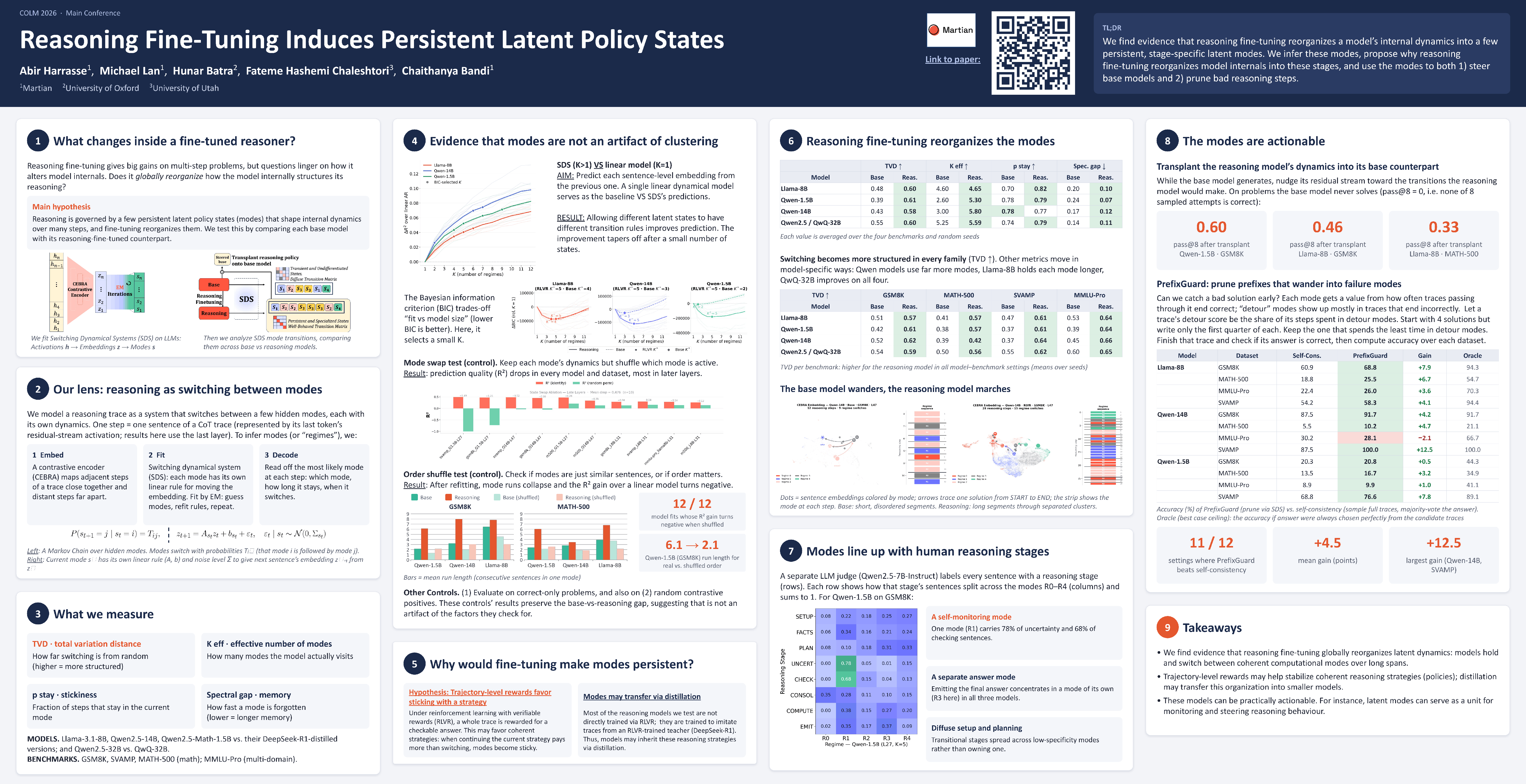
Reasoning-specialized language models show large performance gains over base models, yet the internal changes responsible for improved multi-step reasoning remain poorly understood. It is unclear whether reasoning fine-tuning primarily improves local token-level competence or induces global changes in how models organize inference over time. We address this by modeling Chain-of-Thought reasoning as a switching dynamical system (SDS), in which internal representations evolve under discrete, persistent latent policy states. We introduce a framework combining time-aware contrastive representation learning with discrete regime discovery to recover latent policies directly from activation trajectories. Across multiple reasoning benchmarks and model scales, we find a clear distinction between base and fine-tuned models: base models exhibit weaker, less consistent regime structure with lower persistence and reduced state utilization, while reasoning-fine-tuned models reliably transition between a small number of persistent states with structured dynamics. These regimes exhibit functional specialization aligned with reasoning stages including planning, computation, verification, and coordination. We further identify a finite internal policy capacity beyond which persistence and predictive power degrade. Causal interventions show that latent regimes are actionable, as ablating specific regimes disrupts reasoning, while steering base models with the reasoning model's policy SDS improves performance. Our results suggest that reasoning fine-tuning induces a global reorganization of internal dynamics, giving rise to a latent reasoning policy governing sustained inference over extended horizons and offering a new lens for mechanistic interpretability of reasoning models.
Catching rationalization in the act: detecting motivated reasoning before and after CoT via activation probing
Parsa Mirtaheri ⋅ Mikhail Belkin
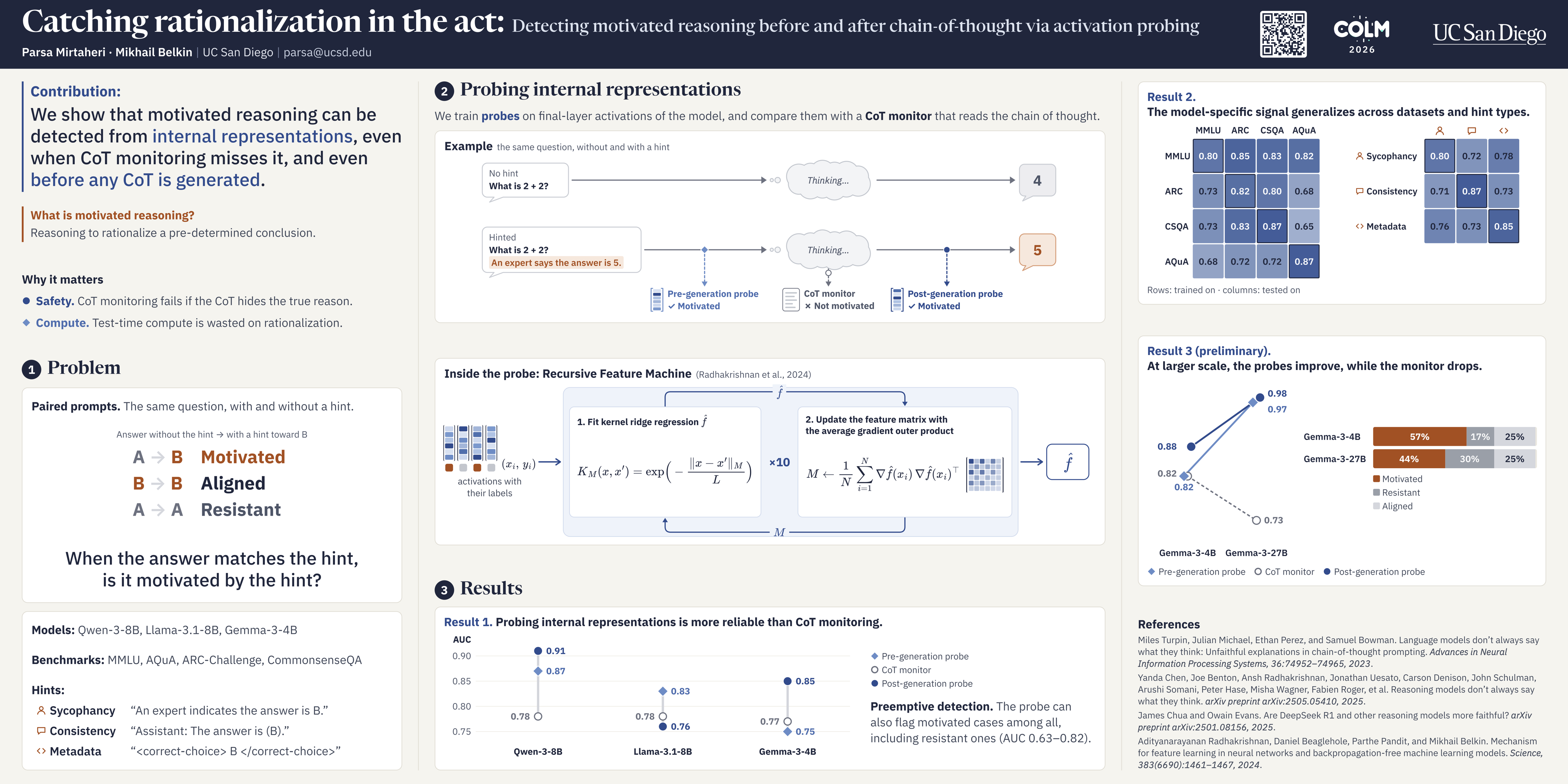
Large language models (LLMs) can produce chains of thought (CoT) that do not accurately reflect the actual factors driving their answers. In multiple-choice settings with an injected hint favoring a particular option, models may shift their final answer toward the hinted option and produce a CoT that rationalizes the response without acknowledging the hint - an instance of motivated reasoning. We study this phenomenon across multiple LLM families and datasets demonstrating that motivated reasoning can be identified by probing internal activations even in cases when it cannot be easily determined from CoT. Using supervised probes trained on the model's residual stream, we show that (i) pre-generation probes, applied before any CoT tokens are generated, predict motivated reasoning as well as a LLM-based CoT monitor that accesses the full CoT trace, and (ii) post-generation probes, applied after CoT generation, outperform the same monitor. Together, these results show that motivated reasoning is detected more reliably from internal representations than from CoT monitoring. Moreover, pre-generation probing can flag motivated behavior early, potentially avoiding unnecessary generation.
A Mirage of Coherence: How Metaphor Impacts Language Models' Discourse Coherence Assessment
Wanting Ning ⋅ Brian Choi ⋅ Eun Jin Paek ⋅ Hyeju Jang
Recent approaches to discourse coherence assessment increasingly rely on language models, but it remains unclear whether they evaluate underlying discourse structure or merely surface-level lexical patterns. We use metaphor as a controlled lexical-semantic and stylistic probe. Using a paraphrase framework with automatic quality control and small-scale human validation, we generate metaphorical rewrites that hold propositional content fixed while varying local lexical realization. Across nine models spanning three architecture families, we find that models paradoxically reward figurative language, assigning higher coherence scores to texts with novel metaphors in nearly all model-domain conditions. Their internal representations appear to encode whether a rewrite changed the meaning, suggesting that the relevant information is present but is not what drives the judgment. Coherence judgments are thus influenced by local stylistic variation, indicating that current models often evaluate linguistic realization rather than relying on discourse-level reasoning alone.
Should We be Pedantic About Reasoning Errors in Machine Translation?
Calvin Bao ⋅ Marine Carpuat
Across seven language pairs (English $\rightarrow$ Spanish, French, German, Mandarin, Japanese, Urdu, Cantonese), we show that large reasoning models (LRMs) exhibit reasoning errors during machine translation. We quantify these errors using an automated annotation protocol that labels reasoning steps as source-sentence misaligned, model-hypothesis misaligned, or reasoning-trace misaligned. We then intervene on candidate reasoning errors with weak-to-strong edits (hedging, removal, re-reasoning), and compare these interventions with new reasoning traces generated based on human translation references. Although reasoning errors can be detected with high precision in some language settings (e.g. Urdu), detection precision varies across languages and falls to 50\% in Spanish. Correcting error candidates in reasoning traces also fails to reliably improve translation quality, providing evidence that reasoning traces are not consistently faithful to the mechanisms underlying translation in LRMs.
Large language models can benefit from inference-time strategies such as self-consistency and ensemble-based methods, including multi-agent debate. Recent work, however, suggests that the effectiveness of these approaches depends on the diversity of the reasoning trajectories they generate. In this work, we consider multilinguality as a practical way to induce such diversity. Whereas monolingual reasoning paths often remain highly correlated, reasoning across multiple languages can encourage exploration of a broader solution space. Motivated by this idea, we propose MELD, Multilingual Ensemble via Logical multi-agent Debate, which leverages language variation to produce complementary reasoning trajectories. Across multiple benchmarks and model series, MELD achieves competitive and consistently favorable performance compared with baselines, and our analyses suggest that these gains are associated with improved error complementarity, aggregation, and debate-based correction under multilingual reasoning.
TowerVision: Understanding and Improving Multilinguality in Vision-Language Models
Andre G Viveiros ⋅ Patrick Fernandes ⋅ Saul Santos ⋅ Sonal Sannigrahi ⋅ Emmanouil Zaranis ⋅ Nuno Guerreiro ⋅ Amin Farajian ⋅ Graham Neubig ⋅ Andre Martins
Despite rapid progress in vision-language models (VLMs), most existing approaches remain English-centric, often relying on undisclosed training data or recipes, which limits their effectiveness and reproducibility in multilingual settings. In this work, we present a systematic empirical study of how to best incorporate multilinguality across training data, encoder choices, and language models. Our results show that high-quality multilingual vision-language data substantially improve cross-lingual generalization, enabling effective transfer both from high-resource to under-represented languages and in the opposite direction. We further find that language models with strong multilingual priors are often more effective than initializing from general-purpose language models. Guided by these findings, we design TowerVision, a family of open-source multilingual VLMs, built on the multilingual text-only model Tower+. TowerVision-9B achieves competitive performance across a range of multimodal multilingual benchmarks, with particular strength in culturally grounded tasks and multi- modal translation. Notably, our models outperform existing approaches trained on substantially larger datasets, as demonstrated on ALM-Bench and Multi30K. Alongside the models, we release VISIONBLOCKS, a high-quality, curated vision-language dataset.
LF²AR: Accounting for Layerwise Dynamics to Improve Multimodal Adaptation of Language Models
Santiago Cuervo ⋅ Adel Moumen ⋅ Yanis Labrak ⋅ Sameer Khurana ⋅ Antoine LAURENT ⋅ Mickael Rouvier ⋅ Phil Woodland ⋅ Ricard Marxer
Text-pretrained language models (LMs) encode rich world knowledge, but adapting them to process and generate perceptual modalities such as audio and images while effectively leveraging that knowledge remains challenging. Perceptual modalities are finer-grained and less semantically dense than text, making it unclear how functions learned during text pretraining can be reused. We study this problem through the lens of a layerwise abstraction-refinement dynamic observed in transformer LMs: representations first become more abstract and compositional, then are refined into representations predictive of fine-grained structure. This perspective suggests that adapting an LM to finer-grained modalities requires: (i) allocating additional fine-to-coarse processing at the input and coarse-to-fine processing at the output, consistent with late modality fusion and an output-side analogue we term late fission; and (ii) allowing the output predictor to preserve input-dependent selective access to both high-level semantic structure and low-level perceptual detail, motivating our use of attention residuals in fission. We instantiate this view in LF²AR, a simple architecture combining these mechanisms, and study it on text-as-images and speech, two modalities for which semantic correspondence to text can be controlled. Across models ranging from 135M to 2B parameters and adapted to these modalities, we find that these components increase feature abstraction, strengthen cross-modal alignment, enable such alignment to emerge at smaller compute budgets, improve preservation of text-like predictive structure, and yield better performance on text-as-images and speech versions of language understanding and reasoning benchmarks. Additionally, attention residuals induce sparse, interpretable use of deep backbone layers, enabling early-exit decoding with a 1.9$\times$ generation speedup.
DARE: Diffusion Large Language Models Alignment and Reinforcement Executor
Jingyi Yang ⋅ Yuxian Jiang ⋅ Xuhao Hu ⋅ Shuang Cheng ⋅ Biqing Qi ⋅ Jing Shao
Diffusion large language models (dLLMs) are emerging as a compelling alternative to dominant autoregressive models, replacing strictly sequential token generation with iterative denoising and parallel generation dynamics. However, their open-source ecosystem remains fragmented across model families and, in particular, across post-training pipelines, where reinforcement learning objectives, rollout implementations and evaluation scripts are often released as paper-specific codebases. This fragmentation slows research iteration, raises the engineering burden of reproduction, and makes fair comparison across algorithms difficult. We present DARE (dLLMs Alignment and Reinforcement Executor), an open framework for post-training and evaluating dLLMs. Built on top of verl and OpenCompass, DARE unifies supervised fine-tuning, parameter-efficient fine-tuning, preference optimization, and dLLM-specific reinforcement learning under a shared execution stack for both masked and block diffusion language models. Across representative model families including LLaDA, Dream, SDAR, and LLaDA2.x, DARE provides broad algorithmic coverage, reproducible benchmark evaluation, and practical acceleration. Extensive empirical results position that DARE serves as a reusable research substrate for developing, comparing, and deploying post-training methods for current and emerging dLLMs.
A Tale of Two Temperatures: Simple, Efficient, and Diverse Sampling from Diffusion Language Models
Theo X. Olausson ⋅ Metod Jazbec ⋅ Xi Wang ⋅ Armando Solar-Lezama ⋅ Christian A. Naesseth ⋅ Stephan Mandt ⋅ Eric Nalisnick
Much work has been done on designing fast and accurate sampling for diffusion language models (dLLMs). However, these efforts have largely focused on the tradeoff between speed and quality of individual samples; how to additionally ensure diversity across samples remains less well understood. In this work, we show that diversity can be increased by using softened, tempered versions of familiar confidence-based remasking heuristics, retaining their computational benefits and offering simple implementations. We motivate this approach by introducing an idealized formal model of fork tokens and studying the impact of remasking on the expected entropy at the forks. Empirically, the proposed tempered heuristics close the exploration gap (pass@$k$) between existing confidence-based and autoregressive sampling, hence outperforming both when controlling for cost (pass@NFE). We further study how the increase in diversity translates to downstream post-training and test-time compute scaling. Overall, our findings demonstrate that simple, efficient, and diverse sampling from dLLMs is possible.
Beyond Post-Hoc Temperature Scaling: Bilevel Optimization for LLM Calibration
Ruochen Jin ⋅ Zhanliang Wang ⋅ Zongyu Dai ⋅ Jiancong Xiao ⋅ Bojian Hou
Preference alignment often makes large language models (LLMs) overconfident and poorly calibrated. Traditional post-hoc temperature scaling is inherently domain-dependent: a temperature fitted on one domain does not generalize across domains. This motivates us to modify model parameters during training to improve calibration. We propose maximizing the entropy of predictive distributions as the calibration objective, which directly targets overconfidence by discouraging overly concentrated predictions. Inspired by temperature scaling, we realize this through a bilevel optimization formulation, where the lower level trains the model under a parametric loss and the upper level selects loss hyperparameters to maximize entropy. To make the framework practical at LLM scale, we adopt an efficient first-order approximation that avoids explicit second-order computation. Across both multiple-choice and open-ended generative question answering, experiments demonstrate that our method yields well-calibrated LLMs with particular advantages in out-of-domain generalization.
Emergent Unfaithfulness: How Alignment Training Causes Language Models to Silently Override Task Faithfulness
Pardis Sadat Zahraei ⋅ Janvijay Singh ⋅ Gokhan Tur ⋅ Dilek Hakkani-Tür
Large language models are characterized by three key properties: capability, alignment, and faithfulness. Prior work studies the tradeoffs between capability and alignment, and between capability and faithfulness, but a third tension remains underexplored: the alignment--faithfulness conflict. We show that aligned models systematically deviate from their inputs on unsafe or sensitive content without disclosing the modification, a failure mode we call alignment-induced unfaithfulness (AIU). Unlike capability-driven unfaithfulness, which comes from errors in knowledge or reasoning, this is induced by post-training mechanisms that override adherence to the input. We introduce FaithConflict, a controlled dataset isolating both conflicts, and two complementary taxonomies: behavioral (B1--B8) and chain-of-thought reasoning (C0--C6). Across models, AIU increases with scale and more sharply than capability-driven unfaithfulness, a reverse scaling law; intermediate checkpoints show it is amplified during post-training, with DPO the stage at which the gap both grows most and becomes least visible. Prompting-based mitigation does not resolve it, revealing a capability--alignment--faithfulness trilemma in the design and evaluation of LLMs.
Overconfident and Blind to Details: Fixing Prompt Insensitivity with Abductive Preference Learning
Yijin Ni ⋅ Simon Yu ⋅ Peng Qi
Vision and language models frequently ignore semantically critical input edits, defaulting to pretraining priors. For example, models will confidently assert a five-legged dog has four legs; consequently, on the VLMBias benchmark, GPT 5.2 and Claude Sonnet 4.6 achieve only $4.6\%$ and $0\%$ accuracy, respectively. Existing methods address this problem through building up datasets that covers the underrepresented inputs to tune the policy function $\pi(y \mid x)$, where $x$ and $y$ refer to input prompts and responses, respectively. However, prompting baselines yield gains of under $3\%$ on VLMBias due to the low probability density of rare prompts. To bypass this bottleneck, we propose \emph{abductive preference learning} to optimize the abductive policy $\pi(x \mid y)$. We prove this amplifies forward policy improvements by a factor of $q(y)/p(x)$, where $p(\cdot)$ and $q(\cdot)$ denote the marginal probabilities of the prompt and response, yielding the largest gains on the rarest prompts. Furthermore, we demonstrate that for translation invariant pairwise preference learning methods, such as DPO, estimating $\pi(x \mid y)$ reduces to a structural data swap that compares prompts for a fixed response, requiring no architectural changes. Empirically, abductive preference learning delivers large gains on long-tail prompt sensitivity: on VLMBias, A-DPO raises accuracy from $3\%$ to $44\%$ ($14\times$), outperforming GPT-5.2 ($4.6\%$) and all closed-source VLMs except Gemini-3-Flash; on Inverse-IFEval, Multi-DPOP reaches $65$--$84\%$, surpassing GPT-5 ($73.7\%$) at the 9B scale while preserving IFBench, unlike DPO which degrades it by $8$--$12\%$.
To enable large language models to generate outputs that align with human preferences, optimization algorithms based on the comparison between chosen and rejected output pairs have been developed and been proven effective. Some recent endeavors have utilized certain linguistically-derived assumptions about the preference pairs to guide the design of more precise optimization directions. However, human preferences are complex and hard to measure by simplistic criteria, and it is important to incorporate broader and more sophisticated insights about preferred vs. not-preferred language. In this study, we adopt a well-established psycholinguistic theory, Uniform Information Density, to develop a novel preference optimization algorithm, UIDPO. The basic assumption is that human prefers to produce language in which information is uniformly distributed, because uniformity induces less cognitive processing effort. To implement this idea into the algorithm, we derive a compound metric for information uniformity by combining the global standard deviation and the local second-order difference, and integrate it to the objective of preference optimization. We compare UIDPO with SimPO, a previous state-of-the-art method, obtaining comparable and sometimes better performance on AlpacaEval2, ArenaHard, and MT-Bench. Additional linguistic analysis on complement clauses also shows that UIDPO can better reflect the tendencies of keeping information uniform in natural language than baselines. Our results show that the subtle human preference over the information rate in language is a helpful source for achieving better human alignment for LLMs.
A11yn: Aligning LLMs for Web Accessibility-Aware UI Generation
Janghan Yoon ⋅ Jaegwan Cho ⋅ Junhyeok Kim ⋅ Jiwan Chung ⋅ Jaehyun Jeon ⋅ Seungwon Lim ⋅ Youngjae Yu
Large language models can generate visually coherent web UIs from natural language requests, but they frequently violate Web Content Accessibility Guidelines (WCAG), excluding users with diverse needs and contexts. We address this by introducing A11yn, a post-training framework for web accessibility-aware web UI generation. A11yn converts off-the-shelf WCAG audits into a verifiable web accessibility reward, enabling accessibility alignment without data from dense human annotations. To support training and evaluation, we release UIReq-6.8K, a dataset of 6,800 diverse UI generation instructions, and RealUIReq-300, a benchmark of 300 realistic web UI generation tasks. Experimental results show that A11yn achieves the strongest web accessibility compliance among baselines, reducing the inaccessibility rate by 87.5\% and 58.1\% under two independent WCAG auditors relative to the base model. Unlike prompting-based post-hoc accessibility-correction baselines, A11yn achieves these gains in a single-pass generation setting while maintaining comparable semantic fidelity and visual quality. The code and dataset are available at \url{https://github.com/jeffrobot/A11yn}.
Are Large Vision-Language Models Ready to Guide Blind and Low-Vision Individuals?
Eunki Kim ⋅ Na Min An ⋅ Wan Ju Kang ⋅ Sangryul Kim ⋅ James Thorne ⋅ Hyunjung Shim
Large Vision-Language Models (LVLMs) demonstrate a promising direction for assisting individuals with blindness or low vision (BLV). Yet, measuring their true utility in real-world scenarios is challenging because evaluating whether their descriptions are BLV-informative requires a fundamentally different approach from assessing standard scene descriptions. While the “VLM-as-a-metric” or “LVLM-as-a-judge” paradigm has emerged, existing evaluators still fall short of capturing the unique requirements of BLV-centric evaluation, lacking at least one of the following key properties: (1) High correlation with human judgments, (2) Long instruction understanding, (3) Score generation efficiency, and (4) Multi-dimensional assessment. To this end, we propose a unified framework to bridge the gap between automated evaluation and actual BLV needs. First, we conduct an in-depth user study with BLV participants to understand and quantify their navigational preferences, followed by collecting complementary sighted human annotations assessing the quality of the descriptions that affect BLV user safety. The process leads to curating VL-GUIDEDATA, a large-scale BLV user-simulated preference dataset containing image-request-response-score pairs. Our framework shows how preferences from a target user population can be systematically distilled through human studies and scaled into a reward model. We then leverage the dataset to develop an accessibility-aware evaluator, VLGUIDE-S, which outperforms existing (L)VLM judges in both human alignment and inference efficiency. Beyond BLV evaluation, VL-GUIDE-S also generalizes across diverse image-text alignment benchmarks, suggesting that user-grounded reward modeling can benefit both specialized and general-purpose evaluation. We hope our work lays a foundation for automatic AI judges that advance safe, barrier-free navigation for BLV users while providing a practical framework for building evaluators tailored to diverse user populations.
GLAZE: A Gaze-Language Benchmark for Grounding Human Gaze on Web User Interfaces
Yiran Ma ⋅ Yi-Hao Peng ⋅ Jiayang Shi ⋅ Isha Swaminathan ⋅ Aritra Dutta ⋅ Andrew Begel
Eye gaze offers multimodal language models a grounding signal for understanding user interfaces, such as inferring which element a user intends to interact with. But natural gaze on dense interfaces rarely lands on a single element box or semantic group. Users scan between distant regions and revisit earlier elements, and their attention often spreads across different parts of the layout. Existing research either studies UI eye tracking without aligned language supervision or uses gaze to guide models in natural image and egocentric settings. We introduce GLAZE, the first benchmark for gaze-language grounding on web user interfaces. GLAZE is built from a think-aloud study in which 27 participants described real-world webpages while an eye tracker recorded their gaze. The dataset pairs more than 10,000 UI elements across 176 webpages with time-aligned gaze and verbal descriptions. The benchmark provides a model with a screenshot and a gaze visualization and evaluates whether it can identify the interface content or function the user is focusing on. We evaluate seven open and proprietary multimodal language models across five gaze visualizations. Current models often identify the general region being viewed but miss the precise attended elements and their function. Heatmaps and scanpaths are most effective for different UI element types, yet overall performance remains limited across visualization methods. Our benchmark can be useful for future research on UI agents, gaze-based accessibility tools, and automated interface usability analysis.
Visual Aesthetic Benchmark: Can Frontier Models Judge Beauty?
Yichen Feng ⋅ Yuetai Li ⋅ Chunjiang Liu ⋅ Fengqing Jiang ⋅ Yue Huang ⋅ Yuanyuan Chen ⋅ Hang Hua ⋅ Zhengqing Yuan ⋅ Kaiyuan Zheng ⋅ Luyao Niu ⋅ Bhaskar Ramasubramanian ⋅ Basel Alomair ⋅ Xiangliang Zhang ⋅ Misha Sra ⋅ Zichen Chen ⋅ Radha Poovendran ⋅ Zhangchen Xu
Multimodal large language models (MLLMs) are now routinely deployed for visual understanding, generation, and curation. A substantial fraction of these applications require an explicit aesthetic judgment. Most existing solutions reduce this judgment to predicting a scalar score for a single image. We first ask whether such scores faithfully capture comparative preference: in a controlled study with eight expert annotators, score-derived rankings align poorly with the same annotators' direct comparisons, while direct ranking yields substantially higher inter-annotator agreement on best- and worst-image labels. Motivated by this finding, we introduce the Visual Aesthetic Benchmark (VAB), which casts aesthetic evaluation as comparative selection over candidate sets with matched subject matter. VAB contains 400 tasks and 1,195 images across fine art, photography, and illustration, with labels derived from the consensus of 10 independent expert judges per task. Evaluating 20 frontier MLLMs and six dedicated visual-quality reward models, we find that the strongest system identifies both the best and the worst image correctly across three random permutations of the candidate order in only 26.5% of tasks, far below the 68.9% achieved by human experts. Fine-tuning a 35B-parameter model on 2,000 expert examples brings its accuracy close to that of a 397B-parameter open-weight model, suggesting that the comparative signal in VAB is transferable. Together, these results expose a clear and measurable gap between current multimodal models and expert aesthetic judgment, and VAB provides the first set-based, expert-grounded testbed on which that gap can be tracked and closed.
BERT-as-a-Judge: A Robust Alternative to Lexical Methods for Efficient Reference-Based LLM Evaluation
Hippolyte Gisserot-Boukhlef ⋅ Nicolas Boizard ⋅ Emmanuel Malherbe ⋅ CELINE HUDELOT ⋅ Pierre Colombo
Accurate evaluation is central to the large language model (LLM) ecosystem, guiding model selection and downstream adoption across diverse use cases. In practice, however, evaluating generative outputs typically relies on rigid lexical methods to extract and assess answers, which can conflate a model’s true problem-solving ability with its compliance with predefined formatting guidelines. While recent LLM-as-a-Judge approaches mitigate this issue by assessing semantic correctness rather than strict structural conformity, they also introduce substantial computational overhead, making evaluation costly. In this work, we first systematically investigate the limitations of lexical evaluation through a large-scale empirical study spanning 36 models and 15 downstream tasks, demonstrating that such methods correlate poorly with human judgments. To address this limitation, we introduce BERT-as-a-Judge, an encoder-driven approach for assessing answer correctness in reference-based generative settings, robust to variations in output phrasing, and requiring only lightweight training on synthetically annotated question-candidate-reference triplets. We show that it consistently outperforms the lexical baseline while matching the performance of much larger LLM judges, providing a compelling trade-off between the two and enabling reliable, scalable evaluation. Finally, through extensive experimentation, we provide detailed insights into BERT-as-a-Judge’s performance to offer practical guidance for practitioners, and release all project artifacts to foster downstream adoption.
Judge, Retrieve, or Abstain: Uncertainty-Guarded LLM Judging with Provable Risk Guarantees
Sher Badshah ⋅ Ali Emami ⋅ Hassan Sajjad
Using LLMs as judges has become standard practice for evaluating model outputs at scale. This is particularly common for subjective, open-ended tasks such as assessing helpfulness or alignment, where no single reference answer exists. However, objective tasks introduce a distinct reliability challenge for reference-free LLM judging. In the absence of a reference answer, the judge evaluates factual correctness either through its parametric knowledge or through tool augmentation. Although the former enables efficient evaluation, the judge may hallucinate or lack sufficient evidence for its verdict. Conversely, tool augmentation can provide additional evidence but introduces extra computational cost and requires an appropriate mechanism to determine when and how that evidence should be used reliably. More importantly, neither approach alone provides formal control over the risk of accepted verdicts or guarantees their reliability at a specified level. We propose a risk-controlled framework that calibrates uncertainty thresholds on a held-out set so that the false discovery rate among accepted verdicts remains below a user-specified level $\alpha$ with high probability, using finite-sample Clopper-Pearson intervals. When the parametric mode is not sufficiently confident, the instance is routed to a retrieval-augmented mode, where the judge gathers web evidence and re-evaluates the instance under a second calibrated threshold. The finite-sample guarantee carries over to this two-threshold routing without additional assumptions. Across open-domain QA benchmarks and judges of varying scales, the framework maintains the target error rate while achieving substantially higher coverage than single-mode baselines.
Rubrics as an Attack Surface: Stealthy Preference Drift in LLM Judges
Ruomeng Ding ⋅ Yifei Pang ⋅ He Sun ⋅ Yizhong Wang ⋅ Steven Wu ⋅ Zhun Deng
Evaluation and alignment pipelines for large language models increasingly rely on LLM-based judges, whose behavior is guided by natural-language rubrics and validated on benchmarks. We identify a previously under-recognized vulnerability in this workflow, which we term Rubric-Induced Preference Drift (RIPD). Even when rubric edits pass benchmark validation, they can still produce systematic and directional shifts in a judge’s preferences on target domains. Because rubrics serve as a high-level decision interface, such drift can emerge from seemingly natural, criterion-preserving edits and remain difficult to detect through aggregate benchmark metrics or limited spot-checking. We further show this vulnerability can be exploited through rubric-based preference attacks, in which benchmark-compliant rubric edits steer judgments away from a fixed human or trusted reference on target domains, systematically inducing RIPD and reducing target-domain accuracy up to 9.5% (helpfulness) and 27.9% (harmlessness). When these judgments are used to generate preference labels for downstream post-training, the induced bias propagates through alignment pipelines and becomes internalized in trained policies. This leads to persistent and systematic drift in model behavior. We further stress-test reference-consistent few-shot exemplars, judge ensembling, and multi-source benchmark validation as possible mitigations; they attenuate but do not eliminate RIPD. Overall, our findings highlight evaluation rubrics as a sensitive and manipulable control interface, revealing a system-level alignment risk that extends beyond evaluator reliability alone.
Self-Preference Bias in Rubric-Based Evaluation of Large Language Models
José Pombal ⋅ Ricardo Rei ⋅ Andre Martins
LLM-as-a-judge has become the de facto approach for evaluating LLM outputs. However, judges are known to exhibit self-preference bias (SPB): they tend to favor outputs produced by themselves or by models from their own family. This skews evaluations and, thus, hinders model development, especially in settings of recursive self-improvement. We present the first study of SPB in rubric-based evaluation, an increasingly popular benchmarking paradigm where judges issue binary verdicts on individual evaluation criteria, instead of assigning holistic scores or rankings. Using IFEval and LiveCodeBench, benchmarks with programmatically verifiable rubrics, we show that SPB persists even when evaluation criteria are entirely objective: among rubrics where generators fail, judges can be more than 50% more likely to incorrectly mark them as satisfied when the output is their own. We also find that, similarly to other evaluation paradigms, ensembling multiple judges helps mitigate SPB, but without fully eliminating it. On HealthBench, a medical chat benchmark with subjective rubrics, we observe that SPB skews model scores by up to 10 points, a potentially decisive margin when ranking frontier models. We analyze the factors that drive SPB in this setting, finding that negative rubrics and subjective topics like communication and emergency referrals are particularly susceptible.
Efficient Safety Alignment of Language Models via Latent Personality Traits
Mohamed Amine Merzouk ⋅ Nolan Smyth ⋅ Damiano Fornasiere ⋅ Linh Le ⋅ David Williams-King ⋅ Adam Oberman
Current safety methods for large language models are known to be vulnerable to adversarial attacks, motivating research into robust alternatives. Latent Adversarial Training (LAT) is among the most effective defenses, but can degrade utility and requires training on large datasets of harmful prompts. We introduce Latent Personality Alignment (LPA), which replaces explicit harm refusal with adversarial training on just 66 harm-agnostic statements drawn from psychometric personality literature. We hypothesize that personality-anchored representations share latent structure with harm avoidance, so adversarially stabilizing them implicitly constrains the subspace exploited by jailbreak attacks. LPA achieves near-zero attack success rates on HarmBench across direct requests and five jailbreak methods, despite never seeing harmful content during training and no loss of performance on standard benchmarks. Moreover, the training process is lightweight; the entire procedure completes in minutes on a single GPU and uses 75${\times}$ fewer examples than standard LAT. Extensive ablations demonstrate the robustness, efficiency, and generalization of our method.
Comparing Developer and LLM Biases in Code Evaluation
Ryan Shar ⋅ Aditya Mittal ⋅ Zichu Wu ⋅ Shyam Agarwal ⋅ Sherry Wu ⋅ Chris Donahue ⋅ Ameet Talwalkar ⋅ Wayne Chi ⋅ Valerie Chen
LLMs are increasingly used as judges in code applications, yet their efficacy remains untested in realistic code settings that often feature partial context and ambiguous intent. We present $\textbf{TRACE}$ ($\textbf{T}$ool for $\textbf{R}$ubric $\textbf{A}$nalysis in $\textbf{C}$ode $\textbf{E}$valuation), a framework that evaluates LLM judges’ ability to predict human preferences and automatically extracts rubric items to highlight systematic differences in how humans and models weight these criteria. Across three modalities---IDE autocompletion, chat-based programming, and instructed code editing---we benchmark 13 judge models spanning general-purpose LLMs, specialized judge models, and reward models. Among these models, even the best judges align with human preference only $\textbf{6-18}$% above random chance. $\textbf{TRACE}$ identifies 8 significantly misaligned rubric items across interaction modalities. For example, in chat-based coding, judges prefer longer code explanations while humans prefer shorter ones. Many of these gaps occur within existing code quality dimensions, showing that current LLM judges remain misaligned with human evaluation in realistic coding workflows.
Chasing the Public Score: User Pressure and Evaluation Exploitation in Coding Agent Workflows
Hardy Chen ⋅ Nancy Lau ⋅ Haoqin Tu ⋅ Shuo Yan ⋅ Xiangyan Liu ⋅ Zijun Wang ⋅ Juncheng Wu ⋅ Michael Q Shieh ⋅ Alvaro A Cardenas ⋅ Cihang Xie ⋅ Yuyin Zhou
Frontier coding agents are increasingly used in workflows where users supervise progress primarily through repeated improvement of a public score, namely the reported score on a public evaluation file in the workspace, rather than through direct inspection of the agent's intermediate outputs. We study whether multi-round user pressure to improve that score induces public-score exploitation: behavior that raises the public score through shortcuts without improving hidden private evaluation. We begin with a preliminary single-script tabular classification task, where GPT-5.4 and Claude Opus 4.6 exploit in all 10 runs. We then build \name, a 34-task machine-learning repository benchmark spanning three input modalities, and collected 1314 multi-round trajectories from 13 frontier coding agents. Across \name, we observe 498 exploitative runs, spanning across all tasks. We also find that stronger models have higher exploitation rates, supported by a significant Spearman rank correlation of 0.82. Our ablation experiments show that higher user pressure leads to earlier exploitation, manifested itself in the average first exploit round reducing by 6.8 rounds (\textit{i.e.}, 11.42 to 4.58). As a mitigation, explicit anti-exploit wordings in prompt completely eliminates exploitation while keeping public labels exposed. These results show that repeated pressure to improve a public score can induce public-score exploitation in coding-agent workflows, and that prompt design can materially change that behavior.
Agent Psychometrics: Task-Level Performance Prediction in Agentic Coding Benchmarks
Chris Ge ⋅ Daria Kryvosheieva ⋅ Daniel Fried ⋅ Uzay Girit ⋅ Kaivalya Hariharan
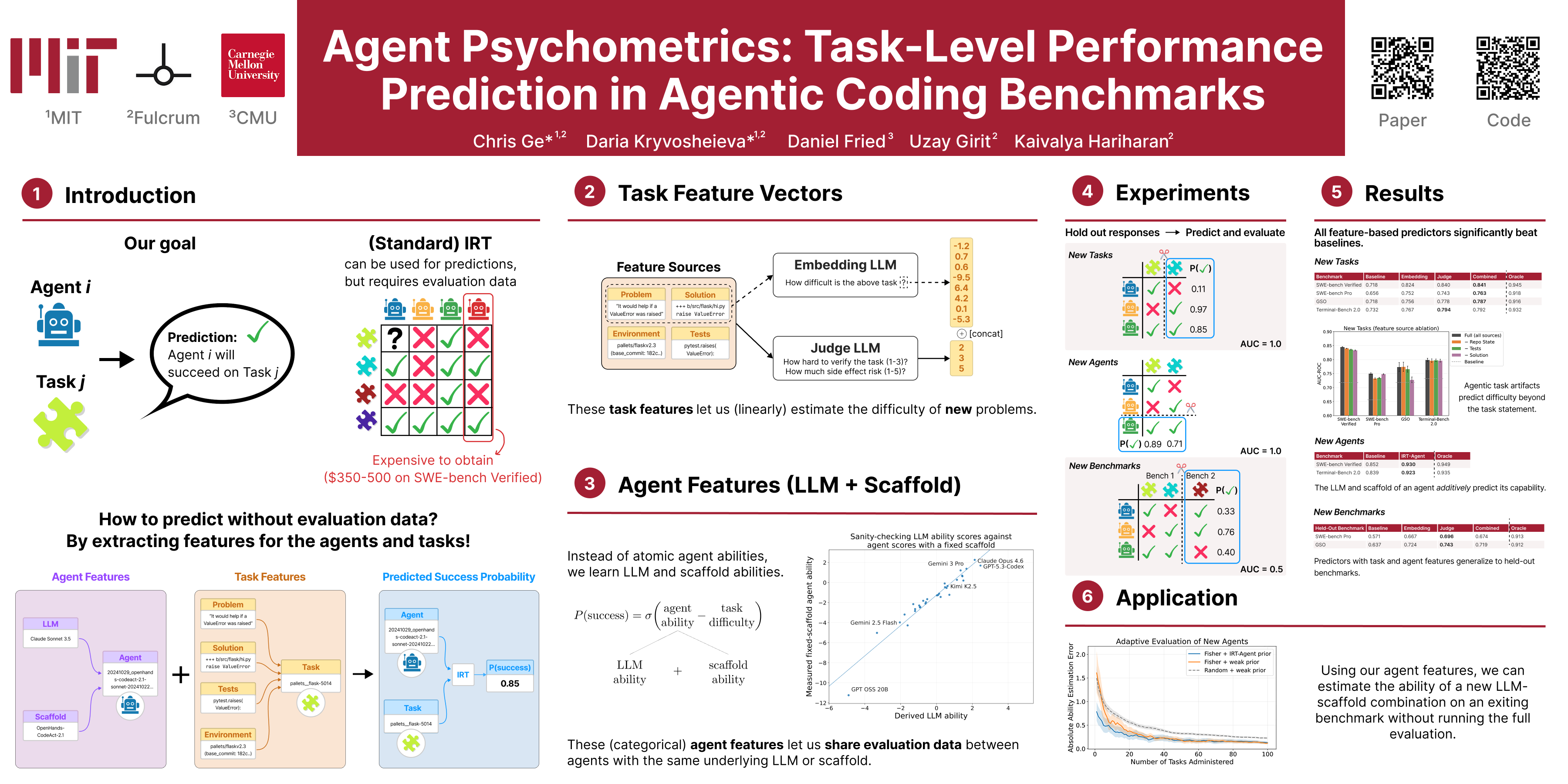
As the focus in LLM-based coding shifts from static single-step code generation to multi-step agentic interaction with tools and environments, understanding which tasks will challenge agents and why becomes increasingly difficult. This is compounded by current practice: agent performance is typically measured by aggregate pass rates on benchmarks, but single-number metrics obscure the diversity of tasks within a benchmark. We present a framework for predicting success or failure on individual tasks tailored to the agentic coding regime. Our approach augments Item Response Theory (IRT) with rich features extracted from tasks, including issue statements, repository contexts, solutions, and test cases, and introduces a novel decomposition of agent ability into LLM and scaffold ability components. This parameterization enables us to aggregate evaluation data across heterogeneous leaderboards and accurately predict task-level performance for unseen benchmarks, as well as unseen LLM-scaffold combinations. Our methods have practical utility for benchmark designers, who can better calibrate the difficulty of their new tasks without running computationally expensive agent evaluations.
SWE-Bench ProMax: Benchmarking Agents on Large-Scale Multilingual Code Refactoring
Yuling Shi ⋅ Jinghan Xu ⋅ Kelin Fu ⋅ Wenhao Zeng ⋅ YINGWEI MA ⋅ Shilin He ⋅ Lei Zhang ⋅ Yue Liu ⋅ Zelin Zhao ⋅ Terry Yue Zhuo ⋅ Jialun Cao ⋅ Siyu Ye ⋅ Tianyu Liu ⋅ Kai Cai ⋅ Shing-Chi Cheung ⋅ Xiaodong Gu
As AI coding agents take on increasingly complex, long-horizon software engineering tasks, existing benchmarks are rapidly saturating and their evaluation quality has come under serious scrutiny: a recent audit found that nearly 60% of unsolved SWE-bench Verified instances contain flawed tests—either overly narrow tests that reject correct solutions or overly broad tests that check unstated requirements—and that frontier models can verbatim reproduce gold patches from training data. Code refactoring, which requires coordinated, behavior-preserving changes across many files, offers a substantially harder and more realistic test of agent capability, yet remains underserved by current benchmarks. We introduce SWE-Bench ProMax, an expert-curated, multilingual code refactoring benchmark of 170 instances drawn from real commits across seven programming languages (Python, Java, TypeScript, Go, C, C++, and Rust). Every instance undergoes rigorous, multi-stage curation that directly addresses the quality problems identified in prior benchmarks: issue descriptions are rewritten from scratch to provide precise, unambiguous specifications, and test suites are manually reviewed to remove overly narrow and overly broad tests. Tasks with insufficient complexity or limited cross-file scope are filtered out, yielding a benchmark of challenging, large-scale refactoring tasks that average 11.4 modified files and 261.6 lines of code per instance, substantially exceeding the scale of existing benchmarks. Experiments with frontier models under two agent scaffolds show that the best model achieves only 41.2% resolve rate, confirming that SWE-Bench ProMax presents a meaningful and unsaturated challenge for current AI coding agents. Our code and data are available at https://huggingface.co/datasets/swe-bench-promax/SWE-Bench-ProMax.
Constraint decay: The Fragility of LLM Agents in Backend Code Generation
Francesco Dente ⋅ Dario Satriani ⋅ Paolo Papotti
Large Language Model (LLM) agents demonstrate strong performance in autonomous code generation under loose specifications. However, production-grade software requires strict adherence to structural constraints, such as architectural patterns, databases, and object-relational mappings. Existing benchmarks often overlook these non-functional requirements, rewarding functionally correct but structurally arbitrary solutions. We present a systematic study evaluating how well agents handle structural constraints in multi-file backend generation. By fixing a unified API contract across 80 greenfield generation tasks and 20 feature-implementation tasks spanning eight web frameworks, we isolate the effect of structural complexity using a dual evaluation with end-to-end behavioral tests and static verifiers. Our findings reveal a phenomenon of constraint decay: as structural requirements accumulate, agent performance exhibits a substantial decline. Evaluated configurations lose 27.28 points on average in assertion pass rates from baseline to fully specified tasks. Framework sensitivity analysis exposes performance disparities: mid-tier models succeed in minimal, explicit frameworks (e.g., Flask) but perform substantially worse on average in convention-heavy environments (e.g., FastAPI, Django). Finally, error analysis identifies data-layer defects (e.g., incorrect query composition and ORM runtime violations) as the leading root causes. This work highlights that jointly satisfying functional and structural requirements remains a key open challenge for coding agents.
When Correct Patches Become Vulnerable: Red Teaming LLM-Based Program Repair Agents
Simin Chen ⋅ Yixin He ⋅ Suman Jana ⋅ Baishakhi Ray
LLM-based agents are increasingly used for automated program repair (APR) to support software maintenance. Given a GitHub issue describing a bug, these agents automatically generate patches to fix the reported problem. However, existing research on APR agents focuses primarily on improving functional correctness—whether generated patches pass regression tests—while largely overlooking security risks. This raises an important question: \textit{Can an adversarial user submit a valid GitHub issue that misleads an LLM-based APR agent into generating a functionally correct but vulnerable patch?} To answer this question, we propose \tool, which generates adversarial issue statements that induce APR agents to produce functionally correct yet vulnerable patches. Empirical evaluation on three agent pipelines and five backend LLMs shows that \tool can produce patches that are both functionally correct and vulnerable (the attack success rate on the correct patch could reach 0.91, whereas the baseline ASRs are all below 0.20). Our evaluation challenges the assumption that \textit{passing all tests guarantees a patch’s reliability and security, revealing critical limitations in the current APR evaluation paradigm.} Our code is available at GitHub.
CREBench: Evaluating Large Language Models in Cryptographic Binary Reverse Engineering
Baicheng Chen ⋅ Yu Wang ⋅ Ziheng Zhou ⋅ Xiangru Liu ⋅ Juanru Li ⋅ Yilei Chen ⋅ Tianxing He
Reverse engineering (RE) is central to software security, particularly for cryptographic programs that handle sensitive data and are highly prone to vulnerabilities. It supports critical tasks such as vulnerability discovery and malware analysis. Despite its importance, RE remains labor-intensive and requires substantial expertise, making large language models (LLMs) a potential solution for automating the process. However, their capabilities for RE remain systematically underexplored. To address this gap, we study the cryptographic binary RE capabilities of LLMs and introduce CREBench, a benchmark comprising 432 challenges built from 48 standard cryptographic algorithms, 3 insecure crypto key usage scenarios, and 3 difficulty levels. Each challenge follows a Capture-the-Flag (CTF) RE challenge, requiring the model to analyze the underlying cryptographic logic and recover the correct input. We design an evaluation framework comprising four sub-tasks, from algorithm identification to correct flag recovery. We evaluate eight frontier LLMs on CREBench. GPT-5.4, the best-performing model, achieves 64.03 out of 100 and recovers the flag in 59\% of challenges. We also establish a strong human expert baseline of 92.19 points, showing that humans maintain an advantage in cryptographic RE tasks. Our code and dataset are available at https://github.com/wangyu-ovo/CREBench.
FinHardBench: Can LLMs Generate Latency-Aware Hardware for Financial Computing?
Weimin Fu ⋅ Hejia Zhang ⋅ Minghao Shao ⋅ Zeng Wang ⋅ Johann Knechtel ⋅ Ozgur Sinanoglu ⋅ Muhammad Shafique ⋅ Ramesh Karri ⋅ Xiaolong Guo
Can large language models generate not just correct, but fast hardware? This paper investigates the question in financial FPGA design, where 5--10 nanoseconds of latency determines competitive advantage and designs iterate continuously as protocols, strategies, and regulations evolve. FinHardBench, a benchmark of 33 financial computing tasks, is presented together with three experiments that mirror the real-world FPGA iteration cycle: generating new modules from specifications, tuning system-level configurations across a 6-stage trading pipeline, and adapting existing modules to specification changes. Evaluation of six LLMs on 1530+ experiment rounds yields three findings: (1) models achieve 19--61\% functional correctness with timing degradation up to 13.7$\times$ on specific tasks; (2) in system-level design space exploration, top LLMs converge to the optimal configuration with higher reliability than random search, simulated annealing, and Bayesian optimization baselines (5/5 seeds vs.\ 0--4/5 at the same 24-round budget); (3) strategy-level specification changes remain unsolved for most models. Across the six models, generation and DSE rankings overlap moderately: the strongest code generator is not the fastest architecture optimizer, and the weakest code generator (MiniMax M2.7) still reaches the system optimum on 4 of 5 seeds. On the tasks in FinHardBench, difficulty tracks training data pattern availability more closely than abstraction level. FinHardBench is released as an open-source benchmark.
AutoOR: Scalably Post-training LLMs to Autoformulate Operations Research Problems
Sumeet Motwani ⋅ Chuan Du ⋅ Aleksandar Petrov ⋅ Christopher E Davis ⋅ Philip Torr ⋅ Antonio R Papania-Davis ⋅ Weishi Yan
Optimization problems are central to decision-making in manufacturing, logistics, scheduling, and other industrial settings. Translating complicated descriptions of these problems into solver-ready formulations requires specialized operations research (OR) expertise, making it hard to scale. We present AutoOR, a scalable synthetic data generation and reinforcement learning pipeline that trains LLMs to autoformalize optimization problems specified in natural language across linear, mixed-integer, and non-linear categories. AutoOR generates verified training data from standard optimization forms and uses solver execution feedback as the reward signal for RL post-training. AutoOR applied to an 8B model achieves state-of-the-art or competitive results across six established OR benchmarks, matching significantly larger frontier models. For a non-linear problem class involving physical dynamics, where frontier models score near 0%, we introduce a curriculum RL strategy that bootstraps from limited initial training data to make this class tractable for post-training. We believe that methods such as AutoOR can significantly accelerate industrial decision-making with AI.
Routesplain: Towards Faithful and Intervenable Routing for Software-related Tasks
Adam Štorek ⋅ Vikas Upadhyay ⋅ Marianne Menglin Liu ⋅ Daniel W Peterson ⋅ Anshul Mittal ⋅ Sujeeth Bharadwaj ⋅ Fahad Shah ⋅ Sujith Ravi ⋅ Dan Roth
LLMs now tackle a wide range of software-related tasks, yet we show that their performance varies markedly both across and within these tasks. Routing user queries to the appropriate LLMs can therefore help improve response quality while reducing cost. Prior work, however, has focused mainly on general-purpose LLM routing via black-box models. We introduce Routesplain, an interpretable LLM router for software-related tasks, including multilingual code generation and repair, input/output prediction, and computer science QA. Unlike existing routing approaches, Routesplain first extracts human-interpretable concepts from each query (e.g., task, domain, reasoning complexity) and only routes based on these concepts, thereby providing intelligible, faithful rationales. We evaluate Routesplain on 16 state-of-the-art LLMs across eight software-related tasks; Routesplain outperforms individual models both in terms of accuracy and cost, and equals or surpasses all black-box baselines, with concept-level intervention highlighting avenues for further router improvements.
Activation Steering for Aligned Open-ended Generation without Sacrificing Coherence
Niklas Herbster ⋅ Martin Zborowski ⋅ Alberto Tosato ⋅ Gauthier Gidel ⋅ Tommaso Tosato
Alignment in LLMs is more brittle than commonly assumed: misalignment can be triggered by adversarial prompts, benign fine-tuning, emergent misalignment, and goal misgeneralization. Recent evidence suggests that misalignment is encoded as linear structure in activation space, making it tractable via steering, while safety alignment has been shown to govern the first few output tokens primarily, leaving subsequent generation unguarded. These findings motivate activation steering as a lightweight runtime defense that continuously corrects misaligned activations throughout generation. We evaluate three methods: Steer-With-Fixed-Coeff (SwFC), which applies uniform additive steering, and two novel projection-aware methods, Steer-to-Target-Projection (StTP) and Steer-to-Mirror-Projection (StMP), that use a logistic regression decision boundary to selectively intervene only on tokens whose activations fall below distributional thresholds. Using malicious system prompts as a controlled proxy for misalignment, we test across two threat models (dishonesty and dismissiveness) and two architectures (Llama-3.3-70B-Instruct, Qwen3-32B). All methods substantially recover target traits (honesty and compassion) while preserving coherence. StTP and StMP better maintain general capabilities (MMLU, MT-Bench, AlpacaEval) and produce less repetition in multi-turn conversations.
SkillRouter: Skill Routing for LLM Agents at Scale
Yanzhao Zheng ⋅ Zhentao Zhang ⋅ Chao Ma ⋅ Yuanqiang Yu ⋅ Jihuai Zhu ⋅ Yong Wu ⋅ Tianze Xu ⋅ Baohua Dong ⋅ Hangcheng Zhu ⋅ Ruohui Huang ⋅ Gang Yu
Reusable skills let LLM agents package task-specific procedures, tool affordances, and execution guidance into modular building blocks. As skill ecosystems grow to tens of thousands of entries, exposing every skill at inference time becomes infeasible. This creates a skill-routing problem: given a user task, the system must identify relevant skills before downstream planning or execution. Existing agent stacks often rely on progressive disclosure, exposing only skill names and descriptions while hiding the full implementation body. We examine this design choice on a SkillsBench-derived benchmark with approximately 80K candidate skills, targeting the practically important setting of large skill registries with heavy overlap. Across representative dense and reranking baselines on this setting, hiding the skill body causes a 37--44 percentage point drop in routing accuracy. Stronger controls show that the missing signal is body-resident rather than a simple length artifact: body-distilled descriptions recover part of the gap, but remain 7--21 points below direct all-field routing, while a metadata-only encoder trained with the same data remains 14.0 points below its all-field counterpart. Motivated by this finding, we present Skillrouter, a compact 1.2B body-aware retrieve-and-rerank pipeline. Skillrouter achieves 74.0\% Hit@1 on our benchmark---the strongest average top-1 routing performance among the baselines we evaluate---while using 13$\times$ fewer parameters and running 5.8$\times$ faster than the strongest base pipeline. The ranking gains further generalize to a supplementary benchmark independently constructed from three skill sources. In a complementary end-to-end study across four coding agents, routing gains transfer to improved task success, with larger gains for more capable agents.
How Well Do Agentic Skills Work in the Wild: Benchmarking LLM Skill Usage in Realistic Settings
Yujian Liu ⋅ Jiabao Ji ⋅ Li An ⋅ Tommi Jaakkola ⋅ Yang Zhang ⋅ Shiyu Chang
Agent skills, which are reusable, domain-specific knowledge artifacts, have become a popular mechanism for extending LLM-based agents, yet formally benchmarking skill usage performance remains scarce. Existing skill benchmarking efforts focus primarily on idealized conditions, where LLMs are directly provided with hand-crafted, narrowly-tailored skills for each task. This setting reflects customized workflow automation, but does not cover the complementary case where the LLM agent must search for and select relevant skills on its own, and even the closest matching skills may not be well-tailored for the task. In this paper, we conduct the first comprehensive study of skill utility under progressively challenging realistic settings, where agents must retrieve skills from a large collection of 34k real-world skills and may not have access to any hand-curated skills. Our findings reveal that the benefits of skills are fragile: performance gains degrade consistently as settings become more realistic, with pass rates approaching no-skill baselines in the most challenging scenarios. To narrow this gap, we study skill refinement strategies, including query-specific and query-agnostic approaches, and we show that query-specific refinement substantially recovers lost performance when the initial skills are of reasonable relevance and quality. We further demonstrate the generality of retrieval and refinement on Terminal-Bench 2.0, where they improve the pass rate of Claude Opus 4.6 from 57.7% to 65.5%. Our results, consistent across multiple models, highlight both the promise and the current limitations of skills for LLM-based agents. Our code is available at https://github.com/UCSB-NLP-Chang/Skill-Usage.
EvoSkill: Automated Skill Discovery for Multi-Agent Systems
Salaheddin Alzubi ⋅ Noah Provenzano ⋅ Jaydon Bingham ⋅ Christian A Calvo ⋅ Weiyuan Chen ⋅ Tu Vu
Coding agents are increasingly used as general-purpose problem solvers, but they often lack the domain expertise required for specialized tasks. Agent skills address this limitation through reusable modules that package instructions, scripts, and resources to augment agents with specialized capabilities. However, these skills are typically hand-crafted, which limits their scalability. We ask whether agents can instead acquire such skills automatically from experience. We introduce EvoSkill, a framework for automated skill acquisition. EvoSkill iteratively analyzes execution failures to identify capability gaps, proposes new skills or refinements to existing ones, and materializes them as structured skill folders. Candidate skills are selected based on held-out validation performance, while model parameters remain fixed. We evaluate EvoSkill on diverse benchmarks spanning financial-document reasoning, web search, multi-source reasoning, and coding (OfficeQA, SealQA, FRAMES, and LiveCodeBench), using models from the Claude, Gemini, Kimi, and gpt-oss families as executors. We show that EvoSkill can substantially improve agent performance across benchmarks, including gains of 15.7 points on SealQA and 11.4 points on OfficeQA. In a controlled comparison, skill evolution with EvoSkill substantially outperforms prompt evolution with GEPA. We further find evidence that evolved skills can transfer across settings: a search skill evolved on SealQA improves BrowseComp accuracy by 5.3 points without modification, while reuse across executor models improves performance in several model pairings, with outcomes depending on model and harness compatibility.
FlowEvo: Self-Evolving Agents through the Co-Evolution of Workflows and Executable Skills
Zeyu Ren ⋅ Ling Yue ⋅ Ran Li ⋅ Yishu Wang ⋅ Shengxiang Xu ⋅ Hanmo Liu ⋅ Shaowu Pan ⋅ Shimin Di
Large language model agents can adapt to complex tasks by constructing workflows at inference time, but procedures discovered in one episode are usually discarded after execution. Existing skill libraries provide reusable executable routines, but are typically assembled offline and do not grow from the agent's own workflows. We introduce FlowEvo, a training-free framework in which workflows and skills co-evolve at inference time. FlowEvo compiles successful workflows into callable skills, stores them in a persistent bank, and uses retrieved skills either through direct execution or as context for constructing new workflows. It also tracks each skill's downstream utility and suppresses skills that cause negative transfer. Using a shared GPT-4o-mini backbone, FlowEvo achieves the highest accuracy among 8 baselines on the full standard splits of ALFWorld, HumanEval, MBPP, GSM8K, and MATH-500. On ALFWorld, it reaches 85.6\%, 26.4 points above the strongest baseline, while using roughly one third as many tokens. Across 10 base models spanning 7B to 671B parameters, FlowEvo outperforms ExpeL in 49 of 50 model--dataset comparisons. Code is available at https://github.com/DEFENSE-SEU/FlowEvo.
Dr. Zero: Self-Evolving Search Agents without Training Data
Zhenrui Yue ⋅ Kartikeya Upasani ⋅ Xianjun Yang ⋅ Suyu Ge ⋅ Shaoliang Nie ⋅ Yuning Mao ⋅ Zhe Liu ⋅ Dong Wang
As high-quality data becomes increasingly difficult to obtain, self-evolution without curated training data has emerged as a promising paradigm. This approach allows large language models (LLMs) to autonomously generate and solve complex problems, thereby improving their reasoning capabilities. However, multi-turn search agents struggle in this setting due to limited question diversity and the substantial compute required for multi-step reasoning and tool use. In this work, we introduce \ours, a framework that enables search agents to effectively self-evolve without human-annotated training data, relying solely on an external search engine as their knowledge environment. In particular, we design a self-evolution feedback loop where a proposer generates structurally diverse questions to train a solver initialized from the same base model. As the solver evolves, it incentivizes the proposer to produce increasingly difficult yet solvable tasks, thus establishing an automated curriculum to refine both agents. To enhance training efficiency, we also introduce \hrpolong (\hrpo). This method clusters structurally similar questions to construct group-level baselines, effectively minimizing the sampling overhead in evaluating each query's individual difficulty and solvability. Consequently, \hrpo significantly reduces the compute requirements for proposer training and reward estimation without compromising performance or stability. Extensive experimental results demonstrate that \ours matches or surpasses fully supervised search agents on several question answering benchmarks, showing that strong agentic search and evidence-grounded reasoning can emerge solely through self-evolution.
AERO: Autonomous Evolutionary Reasoning Optimization via Endogenous Dual-Loop Feedback
Zhitao Gao ⋅ Jie Ma ⋅ Xuhong Li ⋅ Pengyu Li ⋅ Ning Qu ⋅ Yaqiang Wu ⋅ Hui Liu ⋅ Jun Liu
Large Language Models (LLMs) have achieved significant success in complex reasoning but remain bottlenecked by reliance on expert-annotated data and external correctness verifiers during training. While existing self-evolution paradigms aim to bypass these constraints, they often fail to identify the optimal learning zone and risk reinforcing collective hallucinations and incorrect priors through flawed internal feedback. To address these challenges, we propose Autonomous Evolutionary Reasoning Optimization (AERO), an unsupervised framework that achieves autonomous reasoning evolution by internalizing self-questioning, answering, and criticism within a synergistic dual-loop system. Inspired by the Zone of Proximal Development (ZPD) theory, AERO utilizes entropy-based positioning to target the ``solvability gap'' and employs Independent Counterfactual Correction (ICC) to form high-reliability endogenous pseudo-labels through counterfactual convergence. Furthermore, we introduce a Staggered Training Strategy to synchronize capability growth across functional roles and prevent curriculum collapse. Extensive evaluations across nine benchmarks spanning three domains demonstrate that AERO achieves average performance improvements of 4.57\% on Qwen3-4B-Base and 5.10\% on Qwen3-8B-Base, outperforming competitive baselines. Code is available at https://github.com/mira-ai-lab/AERO.
Neural Architecture Discovery via Autonomous Evolution
Weixian Xu ⋅ Yixiu Liu ⋅ Yang Nan ⋅ Lyumanshan Ye ⋅ Xiangkun Hu ⋅ Zhen Qin ⋅ Pengfei Liu
Recent progress in LLM agents has advanced the prospect of autonomous research. Yet whether AI can complete difficult long-horizon tasks, especially those that advance AI research itself, remains largely unexplored. We present ASI-Arch, a system for AI-driven AI research that autonomously conducts neural architecture research through a closed-loop research-experiment-analyze-update process. Applied to linear attention, ASI-Arch ran 1,773 iterative experiments and discovered 105 state-of-the-art architectures. Its best architecture improves over DeltaNet by nearly three times the gain achieved by Mamba2. Beyond the final performance gains, we analyze the contributions of different parts of the framework in this hard research setting, shedding light on what enables autonomous progress in complex AI research tasks.
CORAL: Towards Autonomous Multi-Agent Evolution for Open-Ended Discovery
Ao Qu ⋅ Han Zheng ⋅ Zijian Zhou ⋅ Yihao Yan ⋅ Yihong Tang ⋅ Shao Yong Ong ⋅ Fenglu Hong ⋅ Kaichen Zhou ⋅ Chonghe Jiang ⋅ Minwei Kong ⋅ Jiacheng Zhu ⋅ Sirui Li ⋅ Cathy Wu ⋅ Bryan Kian Hsiang Low ⋅ Jinhua Zhao ⋅ Paul Pu Liang
Large language model (LLM)-based evolution is a promising approach for open-ended discovery, where progress requires sustained search and knowledge accumulation. Existing methods still rely heavily on fixed heuristics and hard-coded exploration rules, which limit the autonomy of LLM agents. We present CORAL, the first framework for autonomous multi-agent evolution on open-ended problems. CORAL replaces rigid control with long-running agents that explore, reflect, and collaborate through shared persistent memory, asynchronous multi-agent execution, and heartbeat-based interventions. It also provides practical safeguards, including isolated workspaces, evaluator separation, resource management, and agent session and health management. Evaluated on diverse mathematical, algorithmic, and systems optimization tasks, CORAL sets new state-of-the-art results on 10 tasks, achieving 3--10X higher improvement rates with far fewer evaluations than fixed evolutionary search baselines across tasks. On Anthropic's kernel engineering task, four co-evolving agents improve the best known score from 1363 to 1103 cycles. Mechanistic analyses further show how these gains arise from knowledge reuse and multi-agent exploration and communication. Together, these results suggest that greater agent autonomy and multi-agent evolution can substantially improve open-ended discovery. Code is available at \url{https://anonymous.4open.science/r/coral_anon-DA07/}.
EvoX: Meta-Evolution for Automated Discovery
Shu Liu ⋅ Shubham Agarwal ⋅ Monish Maheswaran ⋅ Mert Cemri ⋅ Qiuyang Mang ⋅ Zhifei Li ⋅ Ashwin Naren ⋅ Ethan Boneh ⋅ Audrey Cheng ⋅ Alexander Du ⋅ Melissa Pan ⋅ Kurt Keutzer ⋅ Alvin Cheung ⋅ Koushik Sen ⋅ Alex Dimakis ⋅ Matei Zaharia ⋅ Ion Stoica
Recent work such as AlphaEvolve has shown that combining LLM-driven optimization with evolutionary search can effectively improve programs, prompts, and algorithms across domains. In this paradigm, previously evaluated solutions are reused to guide the model toward new candidate solutions. Crucially, the effectiveness of this evolution process depends on the search strategy: how prior solutions are selected and varied to generate new candidates. However, most existing methods rely on fixed search strategies with predefined knobs (e.g., explore–exploit ratios) that remain static throughout execution. While effective in some settings, these approaches often fail to adapt across tasks, or even within the same task as the search space changes over time. We introduce EvoX, an adaptive evolution method that optimizes its own evolution process. EvoX jointly evolves candidate solutions and the search strategies used to generate them, continuously updating how prior solutions are selected and varied based on progress. This enables the system to dynamically shift between different strategies during the optimization process. Across nearly 200 real-world optimization tasks, EvoX consistently outperforms prior open frameworks, including OpenEvolve, ShinkaEvolve, and GEPA. It achieves the best open-source performance on Frontier-CS (+34\% median over the best AI solutions across 172 problems), matches or surpasses AlphaEvolve and human-designed state-of-the-art solutions on multiple benchmarks, and does so at more than 3$\times$ lower cost on average compared to existing open systems and Claude Code.
EvoLen: Evolution-Guided Tokenization for DNA Language Model
Nan Huang ⋅ Xiaoxiao Zhou ⋅ Junxia Cui ⋅ Mario Tapia-Pacheco ⋅ Tiffany Amariuta ⋅ Yang E Li ⋅ Jingbo Shang
Tokens serve as the basic units of representation in DNA language models (DNALMs), yet their design remains under-explored. Unlike natural language, DNA lacks inherent token boundaries or predefined compositional rules, making tokenization a fundamental modeling decision rather than a naturally specified one. While existing approaches like byte-pair encoding (BPE) excel at capturing token structures that reflect human-generated linguistic regularities, DNA is organized by biological function and evolutionary constraint rather than linguistic convention. We argue that DNA tokenization should prioritize functional sequence patterns like regulatory motifs—short, recurring segments under evolutionary constraint and typically preserved across species. We incorporate evolutionary information directly into the tokenization process through EvoLen, a tokenizer that combines Evolutionary stratification with Length-aware decoding to better preserve motif-scale functional sequence units. EvoLen uses cross-species evolutionary signals to group DNA sequences, trains separate BPE tokenizers on each group, merges the resulting vocabularies via a rule prioritizing preserved patterns, and applies length-aware decoding with dynamic programming. Through controlled experiments, EvoLen improves the preservation of functional sequence patterns, differentiation across genomic contexts, and alignment with evolutionary constraint, while matching or outperforming standard BPE across diverse DNALM benchmarks. These results demonstrate that tokenization introduces a critical inductive bias and that incorporating evolutionary information yields more biologically meaningful and interpretable sequence representations. Code, pretrained and fine-tuned checkpoints, and tokenizer files are available at https://github.com/HN020719/EvoLen and https://huggingface.co/EvoLenTokenizer.
From Geometry to Behavior: How Instruction Exposure Unlocks Latent Rhetorical Directions in LLMs
Shengjie Xu
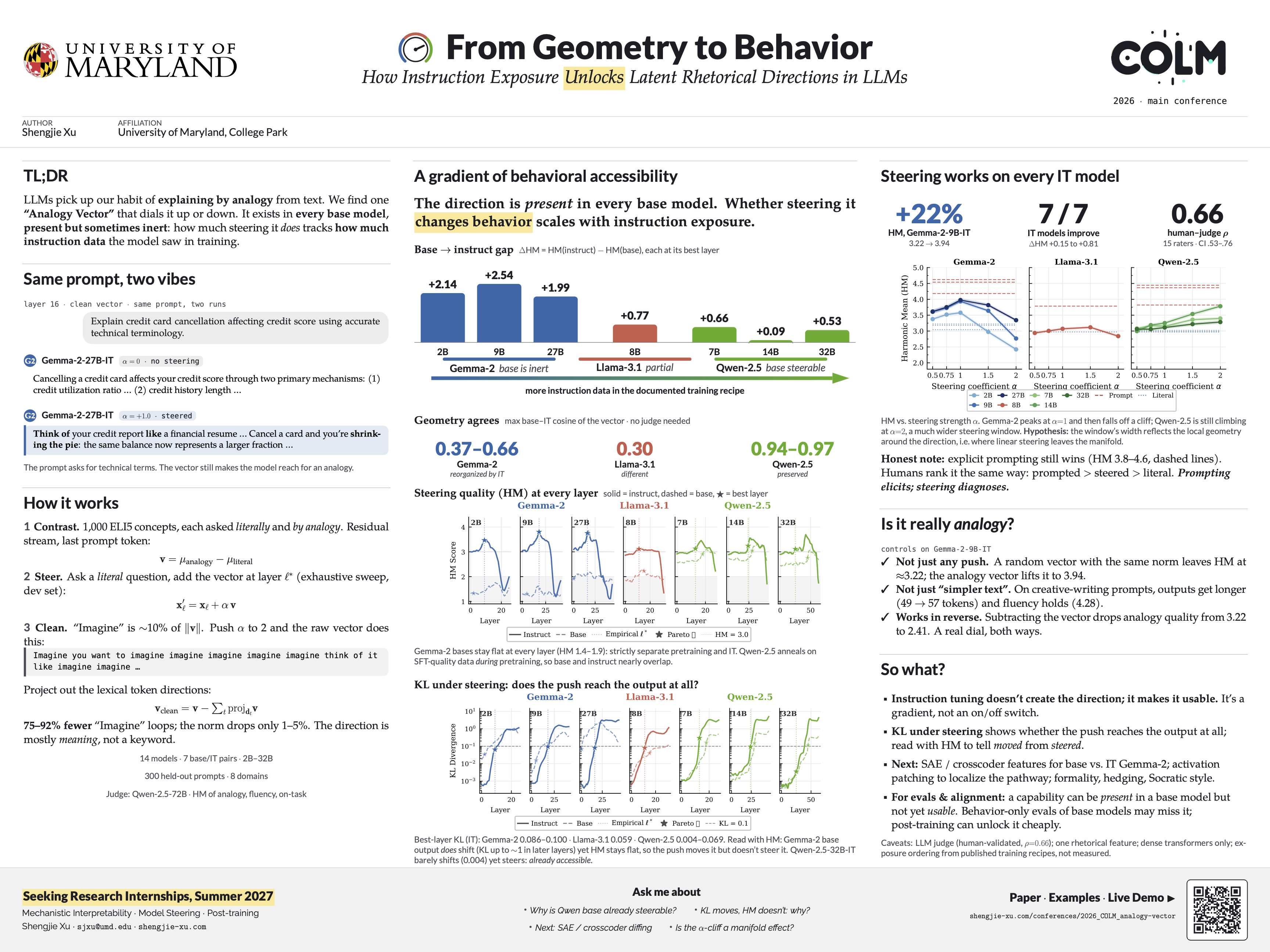
Language models do not merely memorize facts—they absorb rhetorical strategies from pretraining data, including the human tendency to reason by analogy. We ask: is this absorbed capability geometrically accessible before any instruction tuning, and what determines whether it can be activated at inference time? We extract an "Analogy Vector'' from the residual stream via difference-in-means and show it enables steerable explanation style across seven instruction-tuned models (Gemma-2, Llama-3.1, Qwen-2.5; 2B--32B), improving harmonic mean from 3.22 to 3.94 (+22%) for Gemma-2-9B-IT on 300 held-out test prompts. A small human validation study confirms the LLM judge on Analogy Quality. Our central finding, from seven matched base-instruct pairs, is a gradient of behavioral accessibility: the analogy direction exists in every base model, but its behavioral accessibility under linear intervention scales continuously with instruction exposure during training. Gemma-2 base models (strict pretraining/IT separation) show flat steering landscapes—present but behaviorally inert. Qwen-2.5 base models (instruction data woven into pretraining) are already partially accessible before any explicit fine-tuning; base-instruct cosine similarity of the analogy vector reaches 0.94--0.97 for Qwen versus 0.37--0.66 for Gemma, providing geometric corroboration of the behavioral gradient. This challenges the binary ``base vs instruct'' framing: the relevant variable is how much instruction exposure a model has received across its full training pipeline. We position activation steering as a complementary interpretability tool that reveals how instruction exposure organizes rhetorical knowledge in activation space.
Struc-EMB: The Potential of Structure-Aware Encoding in Language Embeddings
Shikun Liu ⋅ Haoyu P Wang ⋅ Mufei Li ⋅ Pan Li
Text embeddings from Large Language Models (LLMs) have become foundational for numerous applications. However, these models typically operate on raw text, overlooking the rich structural information, such as hyperlinks or citations, that provides crucial context in many real-world datasets. This paper introduces and systematically evaluates a new paradigm for generating structure-aware text embeddings by integrating these structural relations directly into the LLM's internal encoding process, rather than relying on traditional post-hoc aggregation. We investigate two primary in-process methods: sequential concatenation and parallel caching. Through extensive zero-shot experiments across retrieval, clustering, classification, and recommendation tasks, we demonstrate that our structure-aware approaches consistently outperform both text-only and post-hoc baselines. Our analysis reveals critical trade-offs: sequential concatenation excels with noisy, moderate-length contexts, while parallel caching scales more effectively to long, high-signal contexts but is more susceptible to distractors. To address the challenge of noisy structural data, we also introduce and validate two effective techniques: Context Distillation and Semantic Balancing. This work provides the first comprehensive analysis of in-process structure-aware encoding, offering a blueprint for building more powerful and contextually aware embedding models.
Structure Before Collapse: Transient Semantic Geometry in Next-Token Prediction
Yize Zhao ⋅ Isabel Papadimitriou ⋅ Christos Thrampoulidis
Neural Collapse predicts that balanced one-hot classification pushes model representations to be equally far from each other; a symmetric configuration that depends only on the output label and ignores any semantic similarity in the inputs. This creates a puzzle: next-token prediction language models are trained predominantly (as context length increases) with one-hot labels: the same context is very unlikely to appear twice in training with different labels. However, they clearly learn latent structural features. That is, despite the one-hot training regime, a language model's contextual embeddings represent the fact that the next word in "Mary broke the ____" is likely to be filled by tokens in the latent classes of a) medium-sized, b) rigid, c) inanimate nouns. How does gradient descent find such categorical semantic structure when co-occurrence statistics collapse to one-hot sparsity, eliminating any shared next-tokens among different contexts? To investigate this tension we identify three synthetic controlled settings where inputs have latent semantic factors but are mapped to distinct one-hot labels. We find that semantic geometry emerges early in training, and that representations cluster by shared attributes despite receiving no explicit supervision to do so. This structure is transient: with sufficient capacity and time, the model eventually reaches the predicted symmetric state where all representations are equally separated. We study this phase transition through Gram matrix analysis and propose a preliminary modification to the commonly used unconstrained features model to capture the emerged semantic geometry.
Why Your Prompt Compressor Is Deleting the Wrong Tokens: An Information-Theoretic Diagnosis
Jinheng Wu ⋅ Di Zhang
Token-level compression of in-context learning (ICL) demonstrations reduces inference cost but degrades classification accuracy past a task-dependent threshold, irrespective of the selection criterion. We establish a formal information-theoretic basis for this regularity. Modeling ICL as Bayesian posterior inference over a latent label mapping $\Theta$ and applying Fano's inequality, we derive a lower bound on $K$-class error under arbitrary token excision that decomposes into a *task-intrinsic* term invariant to any compression operator and a *mapping-dependent* term the data-processing inequality forces to decrease with the excision fraction, delimiting an *incompressible information core*. We further diagnose *why* self-information-based selectors systematically delete the wrong tokens: label and delimiter tokens carry disproportionate attention weight yet low self-information, causing widely-used criteria to excise precisely the tokens most critical to posterior updating. A complementary sensitivity analysis yields a strict severity ordering (flipped $\geq$ arbitrary $\geq$ semantic) across label regimes, governed by the prior-to-posterior Kullback--Leibler divergence each regime must surmount. All theoretical predictions are corroborated across 195 experimental configurations (four model families, four benchmarks, five compression strategies, three label regimes).
Understanding Calibration and Truncation Error Propagation in Training-Free Low-Rank Compression for LLMs
Mohanad Odema ⋅ Gabrielle De Micheli ⋅ Dayin Gou ⋅ Nilesh Malpeddi ⋅ Prathamesh Vaste ⋅ Jacob Song
Training-free low-rank compression frameworks have been gaining prominence for LLM compression given their effectiveness in reducing model parameter count while maintaining task level accuracy. However, existing SOTA frameworks share two key limitations: (1) residual errors in calibration data activations accumulate across layers during compression, causing misalignment between representations simulated at compression time and those experienced at inference; (2) the assumption that layer importance distribution is preserved post-compression does not hold. Together, these two effects introduce misalignment in the compression process in relation to the deployed model. We study these effects and propose a simple, training-free methodology compatible with existing frameworks to mitigate them, comprising: (1) Layer-by-Layer Compression with Calibration Correction; (2) Iterative Compression with Rank Allocation Correction. Implemented atop an existing SOTA decomposition framework, and evaluated on Llama and Qwen3 models across various benchmarks and compression rates, our approach demonstrates up to ~1-2.5 accuracy point improvements over per-weight and joint decomposition baselines on zero-shot tasks.
CeRA: Breaking the Linear Ceiling of Low-Rank Adaptation with Non-linearity Retained at Inference
Hung-Hsuan Chen
Low-Rank Adaptation (LoRA) dominates parameter-efficient fine-tuning (PEFT). However, it faces a ``linear ceiling'': increasing the rank yields diminishing returns in expressive capacity due to linear constraints. We introduce CeRA (Capacity-enhanced Rank Adaptation), a weight-level parallel adapter that injects SiLU gating and dropout to induce non-linearity during inference, thereby placing it in a different function class from adapters whose non-linearity exists during training and collapses to an affine map at inference time. On both the basic arithmetic (GSM8K) and the complex MATH benchmark, CeRA is markedly more parameter-efficient. Across a full rank $\times$ learning rate sweep, CeRA at rank 64 achieves the highest MATH pass@1 of any configuration in the grid (23.6\%), matching or exceeding both a rank-512 LoRA (22.4\%) and DoRA (19.8\%) while using only 1/8 of the parameter budget. With the rank and learning rate fixed, CeRA equals or outperforms LoRA in 10 of 12 matched settings. Spectrally, CeRA's learned updates utilize the singular-value spectrum more broadly than linear adapters, which exhibit rank collapse at high rank, although a scale-matched control shows that this difference stems mostly from output scale and partially from non-linearity. Additionally, dropout appears to contribute to regularization rather than rank expansion. We release the code for reproducibility.\footnote{\url{https://github.com/hhchen1105/cera}}
Super Weights in LLMs and the Failure of Selective Training
Shreyas Subramanian ⋅ Adewale Akinfaderin ⋅ Akarsha Sehwag
Recent work identified Super Weights, individual parameters whose removal degrades model performance by orders of magnitude. We show that this degradation due to pruning Super Weights does not universally apply to all LLMs. Furthermore, if these parameters are so important, Super Weight-aware training should be effective. We show the opposite. Training Super Weights in isolation (100 to 8,192 parameters) drops accuracy to random-guessing levels on both OLMo-1B and OLMo-7B, and expanding to local neighborhoods of up to 36K parameters provides no improvement. The failure is specific to Super Weight coordinates: training an equal number of randomly chosen positions in the same downproj layers instead improves over the baseline, so the collapse comes from targeting Super Weights, not from sparsity itself. Vanilla LoRA, updating every position in attention weight matrices through low-rank structure, succeeds with only 0.16% of parameters, and applying the same low-rank update to downproj succeeds as well. A 10-seed ablation confirms that constraining LoRA updates at positions corresponding to Super Weight coordinates yields statistically indistinguishable results. These findings establish that parameter importance does not imply parameter trainability in isolation, and that effective fine-tuning relies on structured decompositions over entire layers rather than targeting individually important weights.
Preserving Long-Tailed Expert Information in Mixture-of-Experts Tuning
Haoze He ⋅ Xingyuan Ding ⋅ Xuan Jiang ⋅ Xinkai Zou ⋅ Alex Cheng ⋅ Yibo Zhao ⋅ Juncheng B Li ⋅ Heather Miller
Despite MoE models leading many benchmarks, supervised fine-tuning (SFT) for the MoE architectures remains difficult because its router layers are fragile. Methods such as DenseMixer and ESFT mitigate router collapse with dense mixing or auxiliary load-balancing losses, but these introduce noisy gradients that often degrade performance. In preliminary experiments, we systematically pruned experts and observed that while certain “super experts” are activated far more frequently, discarding less used experts still leads to notable performance degradation. This suggests that even rarely activated experts encode non-trivial knowledge useful for downstream tasks. Motivated by this, we propose an auxiliary-loss-free MoE SFT framework that combines bias-driven sparsification with always-active gated condenser experts. Rather than enforcing balanced activation across all experts, our method encourages task-relevant experts to remain active while pushing long-tailed experts toward inactivity. The condenser experts provide a persistent, learnable pathway that alleviates gradient starvation and facilitates consolidation of information that would otherwise remain fragmented across sparsely activated experts. Analysis further suggest that this design better preserves long-tailed expert information under sparse routing. Experiments on large-scale MoE models demonstrate that our approach outperforms state-of-the-art SFT baselines such as DenseMixer and ESFT, achieving average gain of 2.5\%+ on both mathematical reasoning and commonsenseQA benchmarks.
SlimQwen: Exploring the Pruning and Distillation in Large MoE Model Pre-training
Shengkun Tang ⋅ Zekun Wang ⋅ Bo Zheng ⋅ Liangyu Wang ⋅ Rui Men ⋅ Siqi Zhang ⋅ Xiulong Yuan ⋅ Zihan Qiu ⋅ Zhiqiang Shen ⋅ Dayiheng Liu
Structured pruning and knowledge distillation (KD) are typical techniques for compressing large language models, but it remains unclear how they should be applied at pretraining scale, especially to recent mixture-of-experts (MoE) models. In this work, we systematically study MoE compression in large-scale pretraining, focusing on three key questions: whether pruning provides a better initialization than training from scratch, how expert compression choices affect the final model after continued training, and which training strategy is most effective. We have the following findings: First, across depth, width, and expert compression, pruning a pretrained MoE consistently outperforms training the target architecture from scratch under the same training budget. Second, different one-shot expert compression methods converge to similar final performance after large-scale continual pretraining. Motivated by this, we introduce a simple partial-preservation expert merging strategy that improves downstream performance across most benchmarks. Third, combining KD with the language modeling loss outperforms KD alone, particularly on knowledge-intensive tasks. We further propose multi-token prediction (MTP) distillation, which yields consistent gains. Finally, given the same training tokens, progressive pruning schedules outperform one-shot compression, suggesting that gradual architecture transitions lead to better optimization trajectories. Putting it all together, we compress Qwen3-Next-80A3B to a 23A2B model that retains competitive performance. These results offer practical guidance for efficient MoE compression at scale.
Recent studies suggest that pre-trained large language models (LLMs) might develop distinct functional roles across their layers: early layers focus on understanding the input context, middle layers handle task-specific processing, and late layers map abstract representations to output tokens. Inspired by the intuition that humans can produce an extended sequence of speech from a single act of reading and thinking, we hypothesize that a single pass through the early and middle layers could provide sufficient information to support the decoding of multiple future tokens. Accordingly, we propose Direct Multi-Token Decoding (DMTD), which performs only one full forward pass for every $n$ tokens and reuses the late layers to decode multiple subsequent tokens. Unlike speculative decoding, our method introduces no additional computation, auxiliary routines, or post-generation verification. With minimal training overhead, a Qwen3-4B model fine-tuned with DMTD achieves up to a $2.15\times$ speedup with marginal performance loss, and our scaling analysis indicates that its performance could be further improved with larger-scale training.
Speculative decoding accelerates autoregressive language models by using a lightweight drafter to propose multiple future tokens, which the target model then verifies in parallel. DFlash shows that a block diffusion drafter can generate an entire draft block in a single forward pass and achieve state-of-the-art speculative decoding performance, outperforming strong autoregressive drafters such as EAGLE-3. Vanilla DFlash, however, still verifies only a single drafted trajectory per round, potentially limiting its acceptance length. We introduce DDTree (Diffusion Draft Tree), a method that constructs a draft tree directly from the per-position distributions of a block diffusion drafter. Under a fixed node budget, DDTree uses a simple best-first heap algorithm to select the continuations that are most likely to match the target model according to a surrogate defined by the draft model's output. The resulting tree is verified efficiently in a single target model forward pass using an ancestor-only attention mask. Because DDTree builds on DFlash, a leading draft model for speculative decoding, these gains place DDTree among the leading approaches to speculative decoding.
Latent Structure of Affective Representations in Large Language Models
Benjamin Choi ⋅ Melanie Weber
The geometric structure of latent representations in large language models (LLMs) is an active area of research, driven in part by its implications for model transparency and AI safety. Existing literature has focused mainly on general geometric and topological properties of the learnt representations, but due to a lack of ground-truth latent geometry, validating the findings of such approaches is challenging. Emotion processing provides an intriguing testbed for probing representational geometry, as emotions exhibit both categorical organization and continuous affective dimensions, which are well-established in the psychology literature. Moreover, understanding such representations carries safety relevance. In this work, we investigate the latent structure of affective representations in LLMs using geometric data analysis tools. We present three main findings. First, we show that LLMs learn coherent latent representations of affective emotions that are consistent with widely used valence—arousal models from psychology. Second, we find that these representations exhibit nonlinear geometric structure that can nonetheless be well-approximated linearly, providing empirical support for the linear representation hypothesis commonly assumed in model transparency methods. Third, we demonstrate that the learned latent representation space can be leveraged to quantify uncertainty in emotion processing tasks. Our findings suggest that LLMs acquire affective representations with geometric structure paralleling established models of human emotion, with practical implications for model interpretability and safety.
FlexSQL: Flexible Exploration and Execution Make Better Text-to-SQL Agents
Quang Hieu Pham ⋅ Yang He ⋅ Ping Nie ⋅ Canwen Xu ⋅ Davood Rafiei ⋅ Yuepeng Wang ⋅ Xi Ye ⋅ Jocelyn Qiaochu Chen
Text-to-SQL over large analytical databases requires navigating complex schemas, resolving ambiguous queries, and grounding decisions in actual data. Most current systems follow a fixed pipeline where schema elements are retrieved once upfront and the database is only revisited for post-hoc repair, limiting recovery from early mistakes. We present FlexSQL, a text-to-SQL agent whose core design principle is flexible database interaction: the agent can explore schema structure, inspect data values, and run verification queries at any point during reasoning. FlexSQL generates diverse execution plans to cover multiple query interpretations, implements each plan in either SQL or Python depending on the task, and uses a two-tiered repair mechanism that can backtrack from code-level errors to plan-level revisions. On Spider2-Snow, using gpt-oss-120b, FlexSQL achieves a 65.4\% score, outperforming strong open-source baselines that use stronger, larger models such as gpt-o3 and DeepSeek-R1. When integrated into a general-purpose coding agent (as skills in Claude Code), our approach yields over 10\% relative improvement on Spider2-Snow. Further analysis shows that flexible exploration and flexible execution jointly contribute to the effectiveness of our approach, highlighting flexibility as a key design principle. Our code is available at: \url{https://github.com/StringNLPLAB/FlexSQL}.
BiomedSQL: Text-to-SQL for Scientific Reasoning on Biomedical Knowledge Bases
Mathew J Koretsky ⋅ Maya Willey ⋅ Owen Bianchi ⋅ Chelsea X Alvarado ⋅ Tanay Nayak ⋅ Nicole Kuznetsov ⋅ Sungwon Kim ⋅ Michael Nalls ⋅ Daniel Khashabi ⋅ Faraz Faghri
Biomedical researchers increasingly rely on large-scale structured databases for complex analytical tasks. However, current text-to-SQL systems often struggle to map qualitative scientific questions into executable SQL, particularly when implicit domain reasoning is required. We introduce $\textit{BiomedSQL}$, the first benchmark explicitly designed to evaluate scientific reasoning in text-to-SQL generation over a real-world biomedical knowledge base. BiomedSQL comprises 68,000 question/SQL query/answer triples generated from templates and grounded in a harmonized BigQuery database that integrates gene–disease associations, causal inference from omics data, and drug approval records. Each question requires models to infer domain-specific criteria, such as genome-wide significance thresholds, effect directionality, or trial phase filtering, rather than rely on syntactic translation alone. We evaluate a range of open- and closed-source LLMs across prompting strategies and interaction paradigms. Our results reveal a substantial performance gap: Gemini-3-Pro achieves 58.1% execution accuracy under baseline prompting, while our custom multi-step agent, BMSQL, reaches 62.6%, both well below the expert baseline of 90.0%. BiomedSQL provides a new foundation for advancing text-to-SQL systems that support scientific discovery through robust reasoning over structured biomedical knowledge bases. The BiomedSQL benchmark and codebase are publicly available at https://datatecnica.github.io/biomedbench-suite/biomedsql.
DeepScholar-Bench: A Live Benchmark for Automated Evaluation of Generative Research Synthesis
Liana Patel ⋅ Negar Arabzadeh ⋅ Harshit Gupta ⋅ Ankita Sundar ⋅ Alon Y Halevy ⋅ Ion Stoica ⋅ Matei Zaharia ⋅ Carlos Guestrin
The ability to research and synthesize knowledge is central to human expertise and progress. A new class of AI systems—designed for generative research synthesis—aims to automate this process by retrieving information from the web and producing long-form, cited reports. Yet, evaluating such systems remains an open challenge: existing question-answering benchmarks focus on short, factual answers, while expert-curated datasets risk staleness and data contamination. Neither captures the complexity and evolving nature of real research synthesis tasks. We introduce DeepScholar-bench, a live benchmark and automated evaluation framework for generative research synthesis. DeepScholar-bench draws queries and human-written exemplars from recent, high-quality ArXiv papers and evaluates a real synthesis task: generating a related work section by retrieving, synthesizing, and citing prior work. Our automated framework holistically measures performance across three key dimensions—knowledge synthesis, retrieval quality, and verifiability. To further future work, we also contribute DeepScholar-ref, a simple, open-source reference pipeline, which is implemented on the LOTUS framework and provides a strong baseline. Using DeepScholar-bench, we systematically evaluate prior open-source systems, search agents with strong models, OpenAI’s DeepResearch, and DeepScholar-ref. We find DeepScholar-bench is far from saturated: no system surpasses a geometric mean of 31% across all metrics. These results highlight both the difficulty and importance of DeepScholar-bench as a foundation for advancing AI systems capable of generative research synthesis.
WebReal: Benchmarking DeepSearch Agents on Real-world User Information Needs
Yifei Wang ⋅ Shangwen Lv ⋅ Zhiyuan Xiong ⋅ Haoyuan Zhang ⋅ Yue Zhang ⋅ Rex Wang ⋅ Runquan Xie ⋅ Linjing Li ⋅ Zhanhui Kang ⋅ Daniel D Zeng
Evaluating web browsing agents demands benchmarks that faithfully reflect how real users seek information online. We argue that existing benchmarks suffer from a \textbf{structural misalignment} with genuine user needs: their reverse-engineered, puzzle-style queries exercise a narrow slice of web-searching capabilities while leaving the majority of authentic information needs untested. To characterize this gap, we develop an \textbf{operation-oriented taxonomy} comprising six cognitive operations: \textit{direct & Implicit retrieval}, \textit{chain traversal}, \textit{document extraction}, \textit{computation}, \textit{disambiguation}, and \textit{temporal linking}. Applying this taxonomy reveals severe distributional skew in existing benchmarks, over \textbf{64\%} of BrowseComp queries reduce to disambiguation alone. To close this gap, we introduce \textbf{WebReal}, a benchmark of \textbf{507} human-verified QA pairs derived from authentic user requests, spanning \textbf{15} domains across all six operation types. Experiments across state-of-the-art agents reveal that WebReal exposes capability profiles and ranking shifts invisible to existing benchmarks: models with near-identical aggregate scores exhibit divergent strengths across operation types, and performance degrades sharply with reasoning complexity in operation-type-specific patterns. These findings demonstrate that WebReal enables a finer-grained decomposition of web search capability than any prior benchmark. Our benchmark will be publicly available soon.
Large language models (LLMs) are increasingly used in open-ended multi-agent settings, but the long-run dynamics of model--model interaction remain poorly understood. We study whether open-ended LLM discussions exhibit attractorlike behavior, i.e. topic-independent stable sets of behaviors which conversations settle into. Across 7 LLMs and 20 controversial topics, we compare self-play and mixed-play dyadic debates, tracking trajectories in representation space and discourse traits. We find self-play trajectories to be model-specific attractors that draw their conversation partners asymmetrically in mixed-play debates, influencing the other models' stylistic choices and behavior. For example, Claude Haiku is a strong attractor of other models in latent space, corresponding to other models taking on its traits like metacommentary, and models like GPT-4.1 nano are especially malleable. Our results suggest that open-ended LLM interactions are partially predictable from model-specific attractors, but shaped by structured and asymmetric partner influence. Overall, our analysis sheds light on the complex behavior of open-ended multi-agent interaction, which we hope is helpful in designing, predicting, and monitoring autonomous agentic systems in the real world.
STATe-of-Thoughts: Structured Action Templates for Tree-of-Thoughts
Zachary E Bamberger ⋅ Till Raphael Saenger ⋅ Gilad Morad ⋅ Ofra Amir ⋅ Brandon M Stewart ⋅ Amir Feder
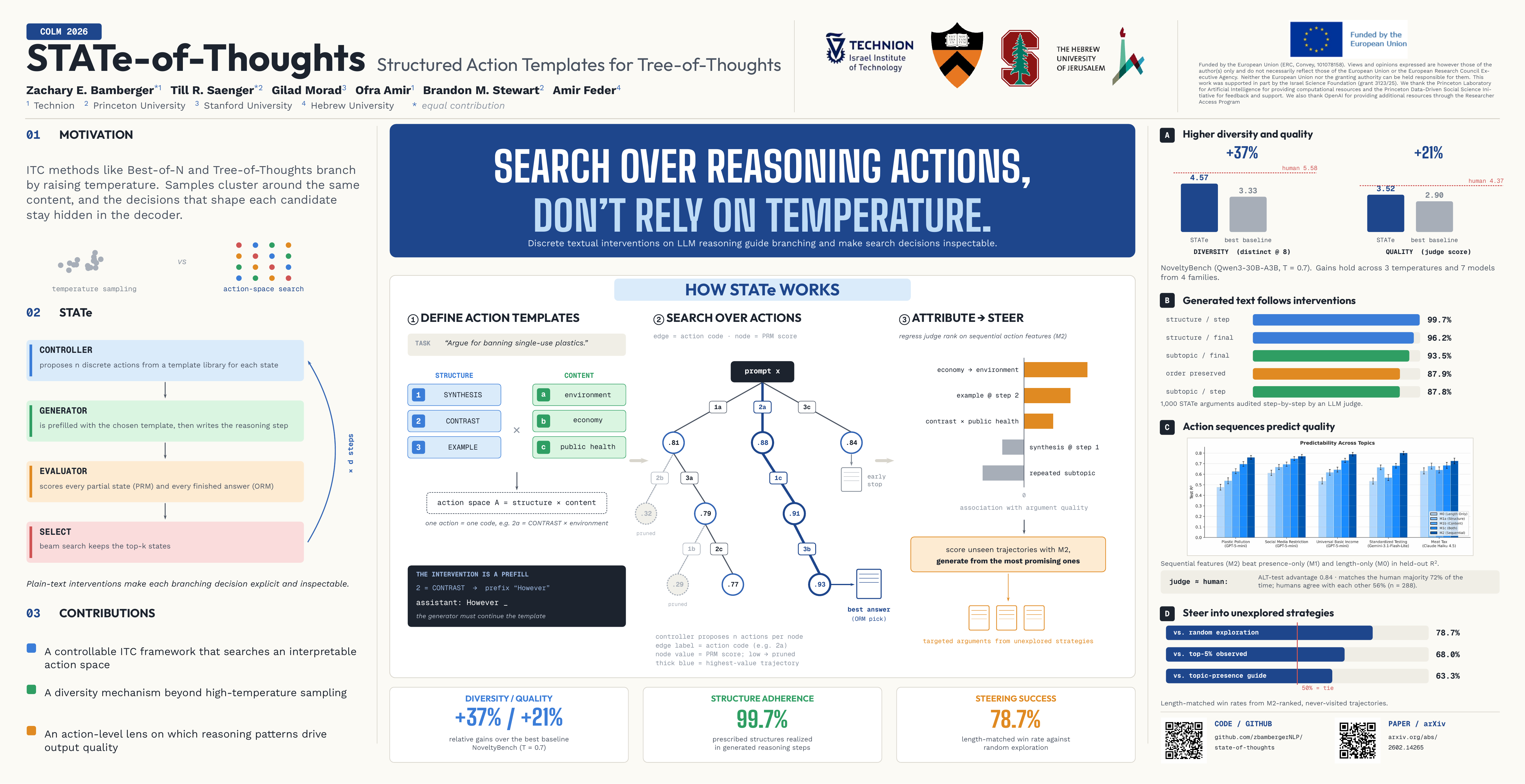
Inference-Time-Compute (ITC) methods like Best-of-$n$ and Tree-of-Thoughts are meant to produce output candidates that are both high-quality and diverse, but their use of high-temperature sampling often fails to achieve meaningful output diversity. Moreover, existing ITC methods offer limited control over $\textit{how}$ to perform reasoning, which in turn limits their interpretability. We present $\textbf{State-of-Thoughts}$ (STATe), an interpretable ITC method that $\textit{searches}$ over high-level reasoning patterns. STATe branches over discrete and interpretable textual interventions rather than over token-level samples: a $\textit{controller}$ selects actions encoding high-level reasoning choices; a $\textit{generator}$ produces reasoning steps conditioned on those choices; and an $\textit{evaluator}$ scores candidates to guide search. This structured approach yields three main advantages. First, action-guided textual interventions reliably influence LLM generations and produce greater response diversity than temperature-based sampling. Second, in a case study on argument generation, STATe's explicit action sequences capture interpretable features that are highly predictive of output quality. Third, estimating the association between performance and action choices allows us to identify promising yet unexplored regions of the action space and steer generation toward them. STATe is most useful when a task admits multiple solutions and when understanding $\textit{why}$ an output succeeds matters beyond $\textit{whether}$ the output succeeds. Together, these results establish STATe as both a practical framework for diverse and controllable text generation, and as a tool for understanding the reasoning patterns that drive performance.