
Imperial Ballroom (#1-73), Franciscan A (#74-80), Franciscan B (#81-90), Franciscan C (#91-100), Grand Ballroom (#101-145)
Autonomy Reshapes How Personalization Affects Privacy Concerns and Trust in LLM Agents
Zhiping Zhang ⋅ Yi E Zhang ⋅ Freda Shi ⋅ Tianshi Li
LLM agents require personal information for personalization in order to effectively act on users' behalf, but this raises privacy concerns that can discourage data sharing, limiting both the autonomy levels at which agents can operate and the effectiveness of personalization. Yet the expanded design space of agent autonomy also presents opportunities to shape these effects, which remain underexplored. We conducted a $3\times3$ between-subjects experiment ($N=450$) to study how agent autonomy level influences personalization's effects on users' privacy concerns, trust, and willingness to use, as well as the underlying psychological processes. We find that risk-contingent autonomy, where the agent delegates control back to users upon detecting potential privacy leakage, improves users' perceived control. This in turn attenuates personalization's adverse effects: privacy concerns rise less and trust declines less. Our results suggest that designing $\textbf{agent's autonomy}$ that supports $\textbf{human autonomy}$ (both perceived control and oversight effectiveness) helps users benefit from personalization without being deterred by growing privacy concerns. This positions aligning decision authority between users and agents ($\textbf{autonomy alignment}$) as an important opportunity and challenge for trustworthy human-agent interaction.
Playing Along: Learning a Double-Agent Defender for Belief Steering via Theory of Mind
Hanqi Xiao ⋅ Vaidehi Patil ⋅ Zaid Khan ⋅ Hyunji Lee ⋅ Elias Stengel-Eskin ⋅ Mohit Bansal
As large language models (LLMs) become the engine behind conversational systems, their ability to reason about the intentions and states of their dialogue partners (i.e., form a theory-of-mind, or ToM) becomes increasingly critical for safe interaction with potentially adversarial partners. We propose a novel privacy-themed ToM challenge, ToM for Steering Beliefs (ToM-SB), in which a defender must act as a Double Agent to steer the beliefs of an attacker with partial prior knowledge. To succeed on ToM-SB, the defender must engage with and form a ToM of the attacker, with a goal of fooling the attacker into believing they have succeeded in extracting sensitive information. On ToM-SB scenarios with a shared attacker-defender universe, we find that a strong frontier model like Gemini3-Pro struggles with ToM-SB, often failing to fool attackers in hard scenarios with partial attacker prior knowledge even when prompted to reason about the attacker’s beliefs. To close this gap, we train models on ToM-SB using reinforcement learning, testing both fooling and ToM rewards. Notably, we first find a bidirectionally emergent relationship between ToM and attacker-fooling: rewarding fooling success alone improves ToM, and rewarding ToM alone improves fooling. Across four attackers with different strengths, six defender methods, and both in-distribution and OOD evaluation, we find that gains in ToM and attacker-fooling are well-correlated, highlighting belief modeling as a key driver of success on ToM-SB. Combining both ToM and fooling rewards into unified AI Double Agents yields the strongest fooling and ToM performance, outperforming Gemini3-Pro with ToM prompting on hard scenarios. We also show that ToM-SB and AI Double Agents can be extended to stronger attackers, demonstrating generalization to OOD settings and the upgradability of our task.
Context-based normative simulacra from narrative fiction
Matt Franchi ⋅ Madiha Zahrah Choksi ⋅ Harold Triedman ⋅ Helen Nissenbaum
Information handling practices of LLM agents are broadly misaligned with privacy expectations, raising urgent questions as these systems, increasingly autonomous, proliferate. Contextual Integrity (CI), which defines privacy as appropriate information flows, provides a principled framework for addressing these questions. Although other work has drawn on CI, existing approaches double inference cost via supervisor-assistant architectures, or fine-tune on narrow task-specific data. Here, we offer an approach for learning context-specific privacy reasoning, demonstrating its efficacy in a surprising application to narrative fiction: we fine-tune LLMs (SFT, then RL) on normative simulacra (structured representations of norms and information flows) that we extract from public-domain novels. We also introduce normative grounding, where information flows are evaluated in terms of relevant, retrieved informational norms. We evaluate on five CI-aligned benchmarks spanning distinct societal contexts and conduct ablations to isolate the contributions of reinforcement learning and normative grounding.
Do LLMs Know What Is Private Internally? Probing and Steering Contextual Privacy Norms in Large Language Model Representations
Haoran Wang ⋅ Li Xiong ⋅ Kai Shu
Large language models (LLMs) are increasingly deployed in high-stakes settings, yet they frequently violate contextual privacy by disclosing private information in situations where humans would exercise discretion. This raises a fundamental question: do LLMs internally encode contextual privacy norms, and if so, why do violations persist? We present the first systematic study of contextual privacy as a structured latent representation in LLMs, grounded in contextual integrity (CI) theory. Probing multiple models, we find that the three norm-determining CI parameters (information type, recipient, and transmission principle) are encoded as linearly separable and functionally independent directions in activation space. Despite this internal structure, models still leak private information in practice, revealing a clear gap between concept representation and model behavior. To bridge this gap, we introduce CI-parametric steering, which independently intervenes along each CI dimension. This structured control reduces privacy violations more effectively and predictably than monolithic steering. Our results demonstrate that contextual privacy failures arise from misalignment between representation and behavior rather than missing awareness, and that leveraging the compositional structure of CI enables more reliable contextual privacy control, shedding light on potential improvement of contextual privacy in LLMs.
Subliminal learning describes a student language model inheriting a behavioral bias by fine-tuning on seemingly innocuous data generated by a biased teacher model. Prior work has begun to characterize this phenomenon but leaves open questions about the scope of signals it can transfer, the mechanisms that explain it, and the precision with which a bias can be encoded. We tackle these problems by introducing \textbf{subliminal steering}, a variant of subliminal learning in which the teacher's bias is implemented not via a system prompt, as in prior work, but through a steering vector trained to maximize the likelihood of a set of target samples. First, we show that subliminal steering transfers complex multi-word biases, whereas prior work focused on single-word preferences—demonstrating a large scope of subliminally transferable signals. Moreover, the transfer is reliable enough to appear in settings previously thought not to exhibit subliminal learning, including plain SGD (not just Adam), full fine-tuning (not just LoRA), and models such as Llama and Phi. Second, we provide mechanistic evidence that subliminal learning transfers not only the target behavioral bias, but also the steering vector itself, localized to the layers at which the teacher was steered. Finally, we show that the bias is encoded with such precision that a new steering vector trained on the subliminally-laden dataset attains high cosine similarity with the original vector.
Manifold Steering Reveals the Shared Geometry of Neural Network Representation and Behavior
Daniel Wurgaft ⋅ Can Rager ⋅ Matthew Kowal ⋅ Sheridan Feucht ⋅ Usha Bhalla ⋅ Tal Haklay ⋅ Eric Bigelow ⋅ Raphaël Sarfati ⋅ Jack Merullo ⋅ Noah Goodman ⋅ Thomas Fel ⋅ Atticus Geiger ⋅ Ekdeep Singh Lubana
Neural representations carry rich geometric structure; but does that structure causally shape behavior? To address this question, we intervene along paths through activation space defined by different geometries, and measure the behavioral trajectories they induce. In particular, we test whether interventions that respect the geometry of activation space will yield behaviors close to those the model exhibits naturally. Concretely, we first fit an activation manifold $M_h$ to representations and a behavior manifold $M_y$ to output probability distributions. We then test the link $M_h \leftrightarrow M_y$ via interventions: we find that steering along $M_h$, which we term \textit{manifold steering}, yields behavioral trajectories that follow $M_y$, while linear steering---which assumes a Euclidean geometry---cuts through off-manifold regions and hence produces unnatural outputs. Moreover, optimizing interventions in activation space to produce paths along $M_y$ recovers activation trajectories that trace the curvature of $M_h$. We demonstrate this bidirectional relationship between the geometry of representation and behavior across tasks and modalities. In language models, we use reasoning tasks with cyclic and sequential geometries as well as in-context learning tasks with more complex graph geometries. In a video world model, we use a task with geometry corresponding to physical dynamics. Overall, our work shows that geometry in neural representation is not merely incidental, but is in fact the proper object for enabling principled control via intervention on internals. This recasts the core problem of steering from finding the right *direction* to finding the right *geometry*.
Activation Steering via Generative Causal Mediation
Aruna Sankaranarayanan ⋅ Amir Zur ⋅ Atticus Geiger ⋅ Dylan Hadfield-Menell
A central goal of interpretability research is to isolate model components that are responsible for specific behaviors. In practice, localization methods rely on the likelihood of a single token or the likelihood differences between matched tokens in otherwise identical responses. This limits the range of behaviors these methods can study. To overcome this limitation, we introduce Generative Causal Mediation (GCM), which extends localization methods to free-form responses. GCM uses a dataset of contrastive prompt pairs and the associated unconstrained responses to identify model components whose activations best explain the difference in the responses. We apply GCM to localize refusal, sycophancy, and style transfer in OLMo, Qwen, and SOLAR LMs. Compared to linear probe and random baselines, GCM-ranked attention heads reach a given steering success rate while intervening on fewer heads, and generalize better to unseen prompts. A linear approximation of GCM based on attribution patching performs comparably at a fraction of the compute. Our results extend the range of behaviors that can be studied with causal mediation.
Steering LLMs for Culturally Localized Generation
Simran Khanuja ⋅ Hongbin Liu ⋅ Shujian Zhang ⋅ John Lambert ⋅ Mingqing Chen ⋅ Rajiv Mathews ⋅ Lun Wang
LLMs are deployed globally, yet produce responses biased towards cultures with abundant training data. Existing cultural localization approaches such as prompting or post-training alignment are black-box, hard to control, and do not reveal whether failures reflect missing knowledge or poor elicitation. In this paper, we address these gaps using mechanistic interpretability to uncover and manipulate cultural representations in LLMs. Leveraging sparse autoencoders (SAEs), we identify interpretable features that encode culturally salient information and aggregate them into $\textbf{Cu}$ltural $\textbf{E}$mbeddings ($\textit{CuE}$). We use $\textit{CuE}$ both to analyze implicit cultural biases given underspecified prompts, and to construct white-box interventions to steer responses towards a target culture. Using $\textit{CuE}$, we find that $\textbf{60\%}$ of the responses for $\textit{Gemma-2-9B}$ default to the United States (U.S.) and United Kingdom (U.K.). Across multiple models, we show that $\textit{CuE}$-based steering increases cultural faithfulness (win rates of $\textbf{48\%}$ vs. 24\% in pairwise comparisons) and elicits significantly rarer, long-tail cultural concepts than prompting alone (win rates of $\textbf{53\%}$ vs. 17\%). Notably, $\textit{CuE}$-based steering is complementary to black-box localization methods, offering gains when applied on top of prompt-augmented inputs. This also suggests that models can benefit by better elicitation strategies, and don't necessarily need to be fine-tuned with more data, though this varies across cultures.
MET: Theory-Grounded and Culture-Aware Multilingual Moral Reasoning
Ayoung Lee ⋅ Ryan Kwon ⋅ Yunxiang Zhang ⋅ Yuxuan Liu ⋅ Peter Railton ⋅ Lu Wang
Language models are increasingly used for moral decision-making across diverse linguistic and cultural contexts, yet existing work overlooks multilinguality on three aspects: 1) multilingual evaluation benchmarks use direct translation, failing to adapt culture-specific items; 2) inference-time methods for moral reasoning rely on static, English-centric scaffolds and lack grounding in moral theory; 3) training methods for moral decision-making typically require expensive supervision from stronger models or human annotators. We address these gaps with three contributions. First, we introduce MCLASH, a multilingual moral decision-making benchmark to capture culturally situated moral intuitions and social norms across languages. Second, we propose MET (Multilingual Ethics with Theory-grounded reasoning), a two-step prompting method built on expert-curated, theory-based grounds drawn from psychology and philosophy: the model first selects situation- and culture-specific grounds, then reasons over them in the native language of the user. Third, we introduce MET-D (MET-Distillation), which enhances the second step through a self-distillation training stage that requires no external supervision. MET-D improves macro-F1 over the base model on all three models of different sizes and families (Qwen3-4B, Qwen3-8B, Gemma3-4B), by an average of 3.71 points on MCLASH and 4.23 on MMoralExceptQA, with a peak MCLASH gain of 12.94 points for Malay on Qwen3-8B. We further reveal that MET-D increases native-language reasoning by 62.13 points on average, and that beneficial grounds differ systematically across cultures. Together, these contributions open the path for culture-aligned, theory-grounded multilingual moral reasoning.
Evaluating and Mitigating Misgendering in English-to-Hindi Machine Translation
Shreyas Gantayet ⋅ Chavi Gupta ⋅ Samyak Savi ⋅ Tanay Sodha ⋅ Dhruv Kumar
Machine translation between gender-neutral languages (those lacking grammatical gender on verbs and adjectives, such as English) and gender-marked Indian languages poses a fundamental challenge: systems must infer and realize grammatical gender in the target language, yet often default to masculine forms, rely on occupational stereotypes, or produce grammatically valid translations that obscure gender altogether. While gender bias in machine translation has been studied extensively for European languages, Indian language models remain under-evaluated, and existing benchmarks do not adequately capture the linguistic and cultural phenomena relevant to Indian settings. We introduce a 37,345-instance evaluation benchmark for English-Hindi gender bias spanning twelve linguistically motivated categories covering a broad range of gender-signaling phenomena, from stereotype inference and name-based disambiguation to cross-sentence gender tracking and Winograd-style coreference. Paired with a grammar-aware Hindi gender classifier combining rule-based morphological analysis with LLM fallback, the benchmark enables evaluation of six translation systems: three specialized MT models (Helsinki Opus-MT, NLLB-200, IndicTrans2) and three general-purpose LLMs (Sarvam AI, GPT-4o-mini, Claude Haiku 4.5). Across all six systems, we observe a consistent tendency to neutralize gender through Hindi's ergative construction, a grammatical pattern in which the subject takes the postposition ne and the verb agrees with the object, erasing subject gender. In our benchmark, 63% to 76% of translations use such syntax even when source-side gender is unambiguous, causing downstream gender classification accuracy to fall to just 17%–31% on sentences where gender should be recoverable. Accuracy ranges from 48.0% for Helsinki Opus-MT to 59.2% for Claude Haiku 4.5 at baseline. A cross-model prompting sweep across six strategies shows that prompting reduces overt masculine defaulting without eliminating ergative neutralization, with Haiku 4.5 reaching 74.6% at the strongest prompting level. Combining prompting with in-translation reranking further mitigates ergative neutralization, raising accuracy to 88.2% for Haiku 4.5 and 74.5% for GPT-4o-mini; candidate-selection reranking yields consistent gains for the specialized MT models. These findings position Hindi as a qualitatively distinct setting for gender bias evaluation and motivate targeting ergative syntax directly as the primary mitigation lever.
MMMG: A Comprehensive and Reliable Benchmark for Multitask Multimodal Generation
Jihan Yao ⋅ Yushi Hu ⋅ Wenyuan Wang ⋅ Bin Han ⋅ Guang Yang ⋅ Yujie Yi ⋅ Shangbin Feng ⋅ Bingbing Wen ⋅ Ranjay Krishna ⋅ Lucy Lu Wang ⋅ Yulia Tsvetkov ⋅ Noah Smith ⋅ Banghua Zhu
Automatically evaluating multimodal generation presents a significant challenge, as automated metrics often struggle to align with human evaluation, especially for complex tasks that involve multiple modalities. To address this, we present MMMG, a comprehensive and human-aligned benchmark for multimodal generation across 4 modality combinations (image, audio, interleaved text and image, interleaved text and audio), with a focus on tasks that present significant challenges for generation models, while still enabling reliable automatic evaluation through a combination of models and programs. MMMG encompasses 55 tasks (including 31 newly developed ones), each with a carefully designed evaluation pipeline, and 1288 instructions to systematically assess reasoning, controllability, and other key capabilities of multimodal generation models. Extensive validation demonstrates that MMMG is highly aligned with human judgment, achieving an average agreement of 94.4%. Benchmarking results on 29 models reveal that even though the state-of-the-art model, GPT Image, achieves 70.7% accuracy for image generation, it falls short on interleaved generation. Furthermore, results suggest considerable improvement space in audio generation, highlighting an important future direction.
SynthDocBench: Controlled Benchmark for Long-Context Visual Document Understanding
Abhigya Verma ⋅ Khyati Mahajan ⋅ Amit Kumar Saha ⋅ Shruthan Radhakrishna ⋅ Sagar Davasam ⋅ Vikas Yadav ⋅ Sai Rajeswar Mudumba
Multimodal large language models (MLLMs) have achieved strong performance on visual document understanding benchmarks such as DocVQA, ChartQA, and MMLongBench-Doc. However, real-world documents combine multiple factors such as length, layout complexity, modality, and question difficulty, which makes it difficult to attribute model failures to specific causes. We introduce SynthDocBench, a fully synthetic benchmark for long-context visual document understanding that systematically controls factors including document length, layout structure, modality composition, and question type. The benchmark is constructed using a combinatorial design, each factor is varied independently across generated documents, enabling controlled analysis of model behavior. Documents are generated end to end using an LLM pipeline across six layout archetypes, with a 40 percent random override to prevent models from exploiting spurious correlations. Additionally, SynthDocBench spans long-context documents with substantially greater length and structural diversity than existing benchmarks. Evaluating frontier VLMs, we uncover three failure modes that existing benchmarks cannot surface: sharp degradation with document length, positional bias toward early content, and breakdown of chart comprehension in long-document settings. These results suggest that current models may be overfitting to benchmark artifacts rather than achieving robust long-context visual document understanding.
Oolong: Evaluating Long Context Reasoning and Aggregation Capabilities
Amanda Bertsch ⋅ Adithya Pratapa ⋅ Teruko Mitamura ⋅ Graham Neubig ⋅ Matthew R Gormley
Many important applications of long-context models require reasoning over large collections of items—summarizing trends across thousands of customer interactions, identifying patterns in research corpora, or analyzing behavioral data at scale. Evaluating whether models can analyze items atomically and aggregate findings requires information-dense tasks that make use of the full context, like writing a summary or describing trends across a collection. Yet these types of tasks often result in long-form outputs which are challenging to evaluate; as a result, current long-context benchmarks predominantly test retrieval-style tasks, where the correct answer depends on a small fraction of tokens and the rest is noise. We introduce OOLONG, a benchmark of distributional reasoning tasks that require analyzing individual chunks of text atomically and aggregating results. OOLONG includes synthetic tasks (OOLONG-synth) that enables controlled ablation of reasoning components, and a downstream setting (OOLONG-real) that requires reasoning over realistic conversational data. Tasks involve classification, counting, filtering by metadata, and temporal reasoning. Even frontier models struggle at this task at moderate context lengths, suggesting OOLONG captures capabilities not yet addressed by scale alone. We release the data and evaluation harness for OOLONG to enable further development of models that can reason over large quantities of text.
Valley3: Scaling Omni Foundation Models for E-commerce
Zeyu Chen ⋅ Guanghao Zhou ⋅ Min Yang ⋅ Qixiang Yin ⋅ Ziwang Zhao ⋅ Huanjin Yao ⋅ Pengjiu Xia ⋅ Cen Chen ⋅ Minghui Qiu
In this work, we present Valley3, an omni multimodal large language model (MLLM) developed for diverse global e-commerce tasks, with unified understanding and reasoning capabilities across text, images, video, and audio. A key feature of Valley3 is its native multilingual audio capability for e-commerce, developed by extending vision-language models to better support crucial audio-visual tasks, particularly in short-video scenarios. To achieve this, we carefully design a four-stage omni e-commerce continued pre-training pipeline, through which Valley3 progressively acquires audio understanding, cross-modal instruction-following, e-commerce domain knowledge, and long-context reasoning capabilities, ultimately evolving into an omni model for diverse e-commerce scenarios. Then, we further improve Valley3 through post-training to encourage long-chain reasoning with controllable reasoning modes, enabling one non-thinking mode and three distinct levels of thinking, thereby balancing inference efficiency in simple scenarios with deep reasoning for complex applications. Moreover, we equip Valley3 with agentic search capabilities to proactively invoke search tools and acquire task-relevant information for e-commerce deep research tasks. To comprehensively assess the capabilities of Valley3, we construct an omni e-commerce benchmark spanning 6 tasks. Experimental results show that Valley3 consistently outperforms strong baselines on our in-house and open-source e-commerce benchmarks, while remaining competitive on general-domain benchmarks. Our code and model weights are available at https://github.com/bytedance/Valley.
TSRouter: Dynamic Modality-Model Selection for Time Series Reasoning
Fangxu Yu ⋅ Tao Feng ⋅ Dehai Min ⋅ Lu Cheng ⋅ Ge Liu ⋅ Tianyi Zhou
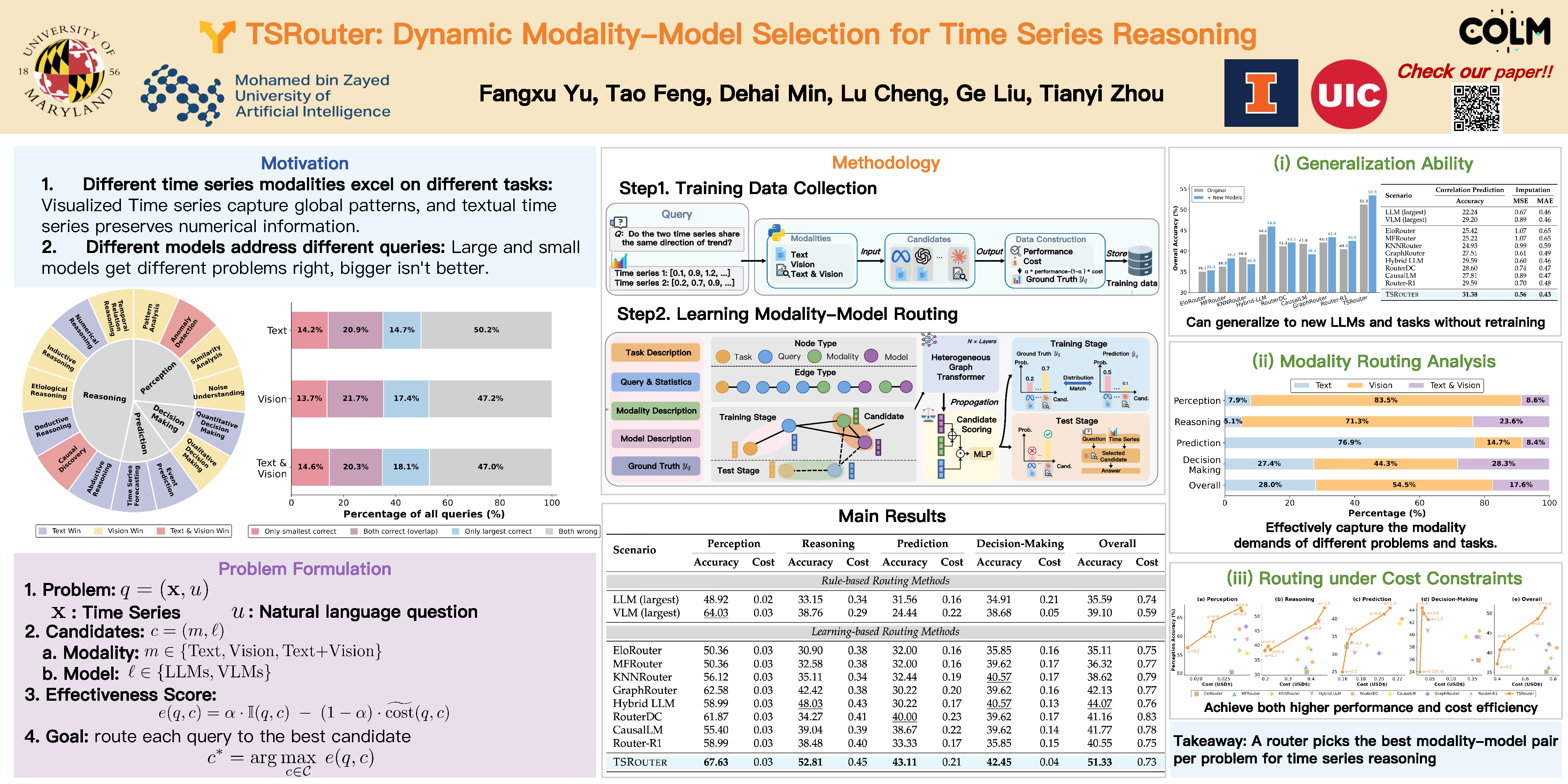
Time series reasoning is essential for real-world problem-solving. While both Large Language Models (LLMs) and Vision-Language Models (VLMs) can reason about time-series data, their capabilities are complementary: LLMs process time series as text sequences and thus preserve exact numerical understanding, but struggle with global patterns, whereas VLMs efficiently capture these patterns by visualizing time series but may lose fine-grained details. Moreover, models vary significantly in task-specific expertise and inference costs. Dynamically selecting the most suitable modality and model for each query is therefore crucial, yet challenging because it requires modeling the complex interactions among tasks, queries, modalities, and models, which carry rich contextual signals. To this end, we introduce TSRouter, a graph-based dynamic routing framework. TSRouter constructs a heterogeneous graph of task, query, modality, and model nodes to contextualize the interactions among query characteristics, modality attributes, and model capabilities. TSRouter formulates routing as a candidate scoring problem, where each modality-model pair is evaluated based on user-defined performance-cost preferences to select the optimal candidate. Comprehensive evaluations on 4 distinct time series reasoning tasks reveal that TSRouter substantially outperforms diverse baselines with 16\% to 46\% relative improvements. Furthermore, TSRouter demonstrates robust zero-shot plug-and-play generalization to unseen models and novel tasks and preserves high performance while reducing computational overhead through cost-aware optimization. Our code is available at https://github.com/tianyi-lab/TSRouter.
FlexRouter: Learning Complementary Model Sets for Flexible LLM Routing
Wang Wei ⋅ Hongzheng Yang ⋅ Tiankai Yang ⋅ Samyadeep Basu ⋅ Hongjie Chen ⋅ Yue Zhao ⋅ Franck Dernoncourt ⋅ Ryan Rossi ⋅ Hoda Eldardiry
Existing Large Language Model (LLM) routing methods score LLMs independently to select top-$k$ models. However, this ignores model correlations and enforces a rigid computational budget. Consequently, routers often select redundant models that share failure modes, limiting the overall probability of success. To address this, we propose FlexRouter, a routing framework that explicitly models model complementarity. FlexRouter optimizes for answer coverage, maximizing the probability that at least one selected model yields a correct response. This objective aligns with practical inference pipelines where multiple candidate outputs are generated and a downstream verifier or user selects the final one. We formulate routing as a coverage-oriented subset selection problem and model the routing policy using Determinantal Point Processes (DPPs), which naturally capture both model competence and redundancy. To directly optimize coverage without requiring a ground-truth target subset, we introduce a training objective based on marginalizing over failure sets. During inference, we employ a greedy strategy based on marginal log-determinant gains, enabling the router to adaptively determine subset sizes without a predefined budget. Extensive experiments on the large-scale RouterEval benchmark demonstrate that our proposed FlexRouter achieves higher coverage with lower redundancy across both in-domain and out-of-domain tasks than strong baselines while maintaining flexible inference cost.
FLINT: Influence-Guided Active Learning Framework for LoRA via Curvature-Aware Data Selection and Fine-Tuning
Zixuan Li ⋅ Shenglan Guo ⋅ Zhigen Li ⋅ Yanmeng Wang ⋅ Ning Cheng ⋅ Shaojun Wang ⋅ Deyi Xiong
In instruction fine-tuning of large language models (LLMs), identifying beneficial samples from large-scale datasets is pivotal to maximizing model performance. Traditional methods rely on static semantic heuristics, ignoring training dynamics and failing to accurately assess sample contributions. The influence function offers a theoretically grounded approach but incurs prohibitive computational cost due to Hessian inversion. Existing influence function-based methods (IF methods) resort to simplifying or omitting the second-order curvature term in the Hessian, leading to distorted contribution estimates on the non-convex parameter manifold. Going beyond such approximations, we propose FLINT: an Active Learning Framework for LoRA via Influence-Guided Data Selection and Fine-Tuning. By constraining influence computation to the LoRA parameter space, FLINT enables precise second-order curvature computation---the first method to achieve this on consumer-grade GPUs, accurately characterizing optimization trajectories and overcoming the limitations of prior approaches. Furthermore, FLINT utilizes Singular Value Decomposition (SVD) as a cold-start mechanism to address initialization instability, alongside predictive entropy pre-filtering and Kronecker-Factored Approximate Curvature (K-FAC)-based decoupling to maximize selection efficiency. Employing an iterative multi-round active learning mechanism, FLINT dynamically filters the most valuable data as the LoRA manifold evolves. Evaluated across complex reasoning benchmarks (GSM8K, BBH, StrategyQA), FLINT achieves a new state-of-the-art among IF methods, significantly accelerating training while consistently outperforming the full-dataset LoRA baseline with less than 20% of the training data, and establishing a principled approach to the non-convex optimization of underlying LLM parameters.
When Verification Fails: How Compositionally Infeasible Claims Escape Rejection
Muxin Liu ⋅ Delip Rao ⋅ Grace Kim ⋅ Chris Callison-Burch
Scientific claim verification, the task of determining whether claims are entailed by scientific evidence, is fundamental to establishing discoveries in evidence while preventing misinformation. This process involves evaluating each asserted constraint against validated evidence. Under the Closed-World Assumption (CWA), a claim is accepted if and only if all asserted constraints are positively supported. We show that existing verification benchmarks cannot distinguish models enforcing this standard from models applying a simpler shortcut called salient-constraint checking, which applies CWA's rejection criterion only to the most salient constraint and accepts when that constraint is supported. Because existing benchmarks construct infeasible claims by perturbing a single salient element they are insufficient at distinguishing between rigorous claim verification and simple salient-constraint reliance. To separate the two, we construct compositionally infeasible claims where the salient constraint is supported but a non-salient constraint is contradicted. Across model families and modalities, models that otherwise saturate existing benchmarks consistently over-accept these claims, confirming the prevalence of such shortcut reasoning. Via model context interventions, we show that different models and prompting strategies occupy distinct positions on a shared ROC curve, indicating that the gap between model families reflects differences in verification threshold rather than underlying reasoning ability, and that the compositional inference bottleneck is a structural property of current verification behavior that strategy guidance alone cannot overcome.
Towards Active Synthetic Data Generation for Finetuning Language Models
Samuel Kessler ⋅ Menglin Xia ⋅ Daniel Madrigal ⋅ Dongge Han ⋅ Helia Hashemi ⋅ Saravan Rajmohan ⋅ Victor Rühle ⋅ Jordan T Ash
A common and effective means for improving language model capabilities involves finetuning a “student” language model’s parameters on generations from a more proficient “teacher” model. Termed “synthetic data”, these generations are often produced before any student finetuning, but some work has considered generating new synthetic samples as training progresses. This paper studies and advocates for the latter case, where data are generated in an iterative, closed-loop fashion that is guided by the current state of the student model. For a fixed budget of generated samples, or a budget in terms of compute spent querying a teacher, we show that this curation of finetuning data affords improved student performance over static generation. Further, while there have been several LLM-specific methods proposed that operate in this regime, we find that simple, inexpensive selection criteria from the active learning literature tend to be most performant. We validate these claims across four mathematical and logical reasoning datasets using four different small language models.
Synthetic Data for any Differentiable Target
Tristan Thrush ⋅ Sung Min Park ⋅ Herman Brunborg ⋅ Luke Bailey ⋅ Marcel Rød ⋅ Neil Band ⋅ Christopher Potts ⋅ Tatsunori Hashimoto
What are the limits of controlling language models via synthetic training data? We develop a reinforcement learning (RL) primitive, the Dataset Policy Gradient (DPG), which can precisely optimize synthetic data generators to produce a dataset of targeted examples. When used for supervised fine-tuning of a target model, these examples cause the target model to do well on a differentiable metric of our choice. Our approach achieves this by taking exact data attribution via higher-order gradients and using those scores as policy gradient rewards. We prove that this procedure closely approximates the true, intractable gradient for the synthetic data generator. To illustrate the potential of DPG we show that, using only SFT on generated examples, we can cause the target model's LM head weights to (1) embed a QR code, (2) embed the pattern $\texttt{67}$, and (3) have lower $\ell^2$ norm. We additionally show that we can cause the generator to (4) rephrase inputs in a new language and (5) produce a specific UUID, even though neither of these objectives is conveyed in the generator's input prompts. These findings suggest that the DPG is a powerful and flexible technique for shaping model properties using only synthetic training examples. We release the code for our project at https://github.com/TristanThrush/dataset-policy-gradients.
Synthesizing Instruction-Tuning Datasets with Contrastive Decoding
Tatsuya Ichinose ⋅ Youmi Ma ⋅ Masanari Oi ⋅ Ryuto Koike ⋅ Naoaki Okazaki
Using responses generated by high-performing large language models (LLMs) for instruction tuning has become a widely adopted approach. However, the existing literature overlooks a property of LLM-generated responses: they conflate world knowledge acquired during pre-training with instruction-following capabilities acquired during post-training. We hypothesize that disentangling the instruction-following capabilities from pre-trained knowledge improves the effectiveness of instruction tuning. To this end, we propose CoDIT, a method that applies contrastive decoding between a post-trained model and its pre-trained counterpart during response generation. The method suppresses pre-trained knowledge shared between the two models while amplifying the instruction-following behavior acquired via post-training, resulting in responses that more purely reflect instruction-following capabilities. Experiment results demonstrate that models trained on datasets constructed via CoDIT consistently outperform those trained on directly generated responses. Training on our datasets also yields better performance than on existing publicly available instruction-tuning datasets across multiple benchmarks. Furthermore, we theoretically and empirically show that CoDIT can be interpreted as distilling the chat vector from parameter space to text space, enabling the transfer of instruction-tuning capabilities across models of different architectures.
From Terminology to Diagrams: Visual-Instruction Generation for Scientific Diagram Understanding
Raúl Ortega ⋅ José Manuel Gómez-Pérez
Vision–language models (VLMs) have demonstrated strong performance in visual question answering with natural images. However, they continue to struggle with scientific diagrams, which are designed to convey functional or relational meaning rather than literal scenes. We therefore introduce a framework for generating large-scale diagram-grounded instruction data by leveraging terminology derived from scientific curricula. Our approach systematically extracts domain concepts, synthesizes atomic facts, retrieves relevant diagrams from the web, and generates multimodal supervision in the form of diagram captions and multiple-choice questions. Using this pipeline, we construct SciGram, a dataset of over 194K diagrams and 1.4M visual instructions across life, earth, and physical sciences. Despite relying on noisy web data and synthetic annotations, models fine-tuned on SciGram achieve substantial improvements on diagram-centric benchmarks, including TQA, ScienceQA, and AI2D, outperforming or matching state-of-the-art VLMs while using fewer training instances. Furthermore, augmenting existing models such as LLaVA OneVision with SciGram establishes new state-of-the-art performance on diagram question answering. Our results highlight the effectiveness of terminology-grounded instruction generation as a general strategy for improving vision-language reasoning in scientific domains. To support future research in scientific diagram understanding, we release both the SciGram dataset and models.
All-Weather VLM: Enhancing Vision Language Models' Robustness Under Adverse Imaging Conditions
Tianfu Wang ⋅ Mingyang Xie ⋅ Haoming Cai ⋅ Tianyi Xiong ⋅ Xiyao Wang ⋅ Dongdong Fu ⋅ Guan-Ming Su ⋅ Paola Cascante-Bonilla ⋅ Christopher Metzler
Visual Language Models (VLMs) have shown strong multimodal inference capabilities, yet their robustness under real-world degradations remains underexplored. We study VLM performance under common adverse imaging conditions, including rain, fog, snow, haze, motion blur, low light, turbulence, and adherent raindrops, without prior knowledge of degradation type. Many of these conditions are critical for autonomous driving safety and related applications. We show that naive supervised fine-tuning fails to generalize across degradation types and that existing VLMs suffer substantial performance drops. A natural solution is to pre-process degraded images with restoration models before VLM inference; however, we show that these methods often hallucinate details that mislead the VLM and further hurt performance. Surprisingly, we found that skipping restoration and directly applying VLM to degraded images sometimes yields better results. Building on this finding, we propose a multi-stage training framework that integrates degradation awareness into the VLM reasoning process. A degradation-aware encoder predicts corruption type and severity to condition generation through a unified reasoning trace before the final response. Direct Preference Optimization (DPO) further improves factual grounding by treating responses from clean images as a more reliable reference for the scene's content, while penalizing degradation-induced errors. In visual question answering (VQA) tasks, our approach yields $\sim 10$ percent gains on real-world driving scenes and $\sim 4$ percent gains on real-world camera-degradation benchmarks for generic scenes, while showing that robustness can be maintained without sacrificing general capability.
Wiener Filtering for VLM Hallucination Suppression
Ameen Ali ⋅ Tamim Zoabi ⋅ Lidor Brami ⋅ Lior Wolf
Vision-language models (VLMs) excel at open-ended captioning and visual QA but often describe objects, attributes, or relations absent from the image, a phenomenon known as object hallucination. We propose a training-free, post-hoc representation editing technique that operates in the representation space of the language backbone. The method performs a lightweight, one-time offline calibration on a modest paired dataset to estimate the required covariance structures, using only forward passes and empirical second-order statistics with no gradient updates or fine-tuning, after which the correction is absorbed directly into the model's existing weights. By modeling hidden states as a superposition of truthful and hallucination-associated components, we derive a Wiener-type estimator whose optimal gains are given in closed form from the covariances of paired truthful and hallucinated representations. An eigendecomposition yields mode-wise attenuation that respects a stability criterion, i.e., the filter responds continuously to estimation noise. The correction is applied once to the feed-forward output projections of selected deeper layers, at inference time, the model runs unchanged and at the same speed. Experiments on LLaVA-1.5, MiniGPT-4, Gemma3, and mPLUG-Owl2 demonstrate consistent reductions in object hallucination on CHAIR, POPE, and MME while maintaining caption fluency and overall response quality. We further demonstrate the generality of our approach on the TempCompass video understanding benchmark and on discrete diffusion language models for grounded dialogue, showing that representation filtering reduces hallucinations even in temporal video reasoning and multi-step, sequence-wide denoising settings.
Do Language Models Consistently Encode the Current Year?
Suze van Adrichem ⋅ Aditi Bhaskar ⋅ Diyi Yang ⋅ Christopher Potts ⋅ Jing Huang
A consistent concept of the current time is important for temporal reasoning, yet how language models represent the current time is not well understood. We contribute two tasks that probe the current year in conceptually distinct ways: an associative task, which infers the current year from verb tense, and a declarative task, which directly queries for the current year. Both tasks estimate current years within one year of the post-training data cutoff of instruction-tuned language models. For base models, predictions on the associative task serve as a strong proxy for the pre-training data cutoff, with an average error of only 10 months across 13 models. However, their internal mechanisms diverge: the associative task uses mechanisms similar to factual recall, while the declarative task lacks consistent causal pathways. This divergence poses a challenge for updating the current year in language models. None of prompting, SFT, or weight editing succeed in shifting the associative and declarative years simultaneously. Prompting updates the declarative year (94.6% success across 351 target years) but leaves the associative year nearly unchanged (1.7% success). Year-shifted SFT also fails to shift the associative year, matching the target year in only one of eight models. Weight editing, while effective for both tasks individually, does not generalize across both. Overall, our results show that the current year is not consistently encoded in language models: The associative notion, deeply ingrained in linguistic structures learned in pre-training, uses different causal mechanisms and resists the same modifications that easily shift the declarative notion learned in post-training.
Fine-Tuning Was Not Broken but Diffuse: Precise Knowledge Editing via Projected Error Signals
Shahar Katz ⋅ Avi Caciularu ⋅ Lior Wolf
Transformer-based large language models (LLMs), trained via backpropagation on massive textual corpora, encode substantial factual knowledge, yet may also retain false or outdated associations. Prior work on factual editing in LLMs shows that fine-tuning (FT) often induces a repelling effect, degrading generalization and overwriting non-targeted knowledge, motivating alternative approaches such as rank-1 optimizations. In this work, we revisit knowledge editing in LLMs through FT by analyzing the activations and Vector-Jacobian Products (VJPs), the error signals produced during backpropagation when learning new facts. We show that each layer and token induces its own error signals, and that attempts to edit a specific association can inadvertently encourage the model to memorize the entire prompt in a diffuse or inefficient manner. Building on this analysis, we introduce Precise-FT (PFT), a method that constructs gradient updates from a small set of projected error signals most strongly associated with the learned fact, achieving strong performance across multi-knowledge editing benchmarks and LLMs.
LLM Knowledge is Brittle: Truthfulness Representations Rely on Superficial Resemblance
Patrick Haller ⋅ Mark Ibrahim ⋅ Polina Kirichenko ⋅ Levent Sagun ⋅ Samuel J Bell
For Large Language Models (LLMs) to be reliable, they must learn robust knowledge that can be generally applied in diverse settings---often unlike those seen during training. Yet, extensive research has shown that LLM performance can be brittle, with models exhibiting excessive sensitivity to trivial input variations. In this work, we explore whether this brittleness is a direct result of unstable internal knowledge representations. To explore this question, we build on previous work showing that LLM representations encode statement truthfulness---i.e., true, factual statements can be easily separated from false, inaccurate ones. Specifically, we test the robustness of learned knowledge by evaluating representation separability on samples that have undergone superficial transformations to drive them out-of-distribution (OOD), such as typos or reformulations. By applying semantically-preserving perturbations, we study how separability degrades as statements become more OOD, across four LLM families, five evaluation datasets, and three knowledge probing methods. Our results reveal that internal representations of statement truthfulness collapse as the samples' presentations become less similar to those seen during pre-training. While LLMs can often distinguish between true and false statements when they closely resemble the pre-training data, this ability is highly dependent on the statement's exact surface form. These findings offer a possible explanation for brittle benchmark performance: LLMs may learn shallow, non-robust knowledge representations that allow for only limited generalizability. Our work presents a fundamental challenge for the utility of truthfulness probes, and more broadly, calls for further research on improving the robustness of learned knowledge representations.
ReFIne: A Framework for Trustworthy Large Reasoning Models with Reliability, Faithfulness, and Interpretability
Chung-En Sun ⋅ Ge Yan ⋅ Akshay R Kulkarni ⋅ Tsui-Wei (Lily) Weng
Recent advances in long chain-of-thought (CoT) reasoning have largely prioritized answer accuracy and token efficiency, while overlooking aspects critical to trustworthiness. We argue that usable reasoning systems must be trustworthy, characterized by three properties: interpretability, faithfulness, and reliability. To this end, we propose ReFIne, a new training framework that integrates supervised fine-tuning with GRPO to encourage models to: (i) improve interpretability by producing structured, tag-based traces with high-level planning that are easier for humans to follow; (ii) enhance faithfulness by explicitly disclosing the decisive information guiding each solution, with consistent cross-section references; and (iii) promote reliability by providing self-assessments of both the derivation's soundness and the confidence of the final answer. We apply ReFIne to the Qwen3 models at multiple scales (1.7B/4B/8B) and evaluate across mathematical benchmarks of varying difficulty. Our experimental results show that ReFIne models generate clearer and better-structured reasoning traces (interpretability +44.0%), more faithfully expose their underlying decision process (faithfulness +18.8%), and offer informative confidence estimates (reliability +42.4%). These findings highlight an overlooked but important direction: reasoning models should be optimized not only for accuracy, but also for broader dimensions of trustworthiness.
Filtered Reasoning Score: Evaluating Reasoning Quality on a Model's Most-Confident Traces
Manas Pathak ⋅ Xingyao Chen ⋅ Shuozhe Li ⋅ Amy Zhang ⋅ Leqi Liu
Should we trust Large Language Models (LLMs) with high accuracy? LLMs achieve high accuracy on reasoning benchmarks, but correctness alone does not reveal the quality of the reasoning used to produce it. This highlights a fundamental limitation of outcome-based evaluation: models may arrive at correct answers through flawed reasoning, and models with substantially different reasoning capabilities can nevertheless exhibit similar benchmark accuracy, for example due to memorization or over-optimization. In this paper, we ask: given existing benchmarks, can we move beyond outcome-based evaluation to assess the quality of reasoning itself? We seek metrics that (1) differentiate models with similar accuracy and (2) are robust to variations in input prompts and generation configurations. To this end, we propose a reasoning score that evaluates reasoning traces along dimensions such as faithfulness, coherence, utility, and factuality. A remaining question is how to aggregate this score across multiple sampled traces. Naively averaging them is undesirable, particularly in long-horizon settings, where the number of possible trajectories grows rapidly, and low-confidence correct traces are more likely to be coincidental. To address this, we introduce the Filtered Reasoning Score (FRS), which computes reasoning quality using only the top-K% most confident traces. Evaluating with FRS, models that are indistinguishable under standard accuracy exhibit significant differences in reasoning quality. Moreover, models with higher FRS on one benchmark tend to perform better on other reasoning benchmarks, in both accuracy and reasoning quality. Together, these findings suggest that FRS complements accuracy by capturing a model’s transferable reasoning capabilities. We open source our evaluation codebase: https://github.com/HumainLab/filteredreasoningscore_evaluation.
Understanding and Mitigating Premature Confidence for Better LLM Reasoning
Jingchu Gai ⋅ Guanning Zeng ⋅ Christina Baek ⋅ Chen Wu ⋅ J Kolter ⋅ Andrej Risteski ⋅ Aditi Raghunathan
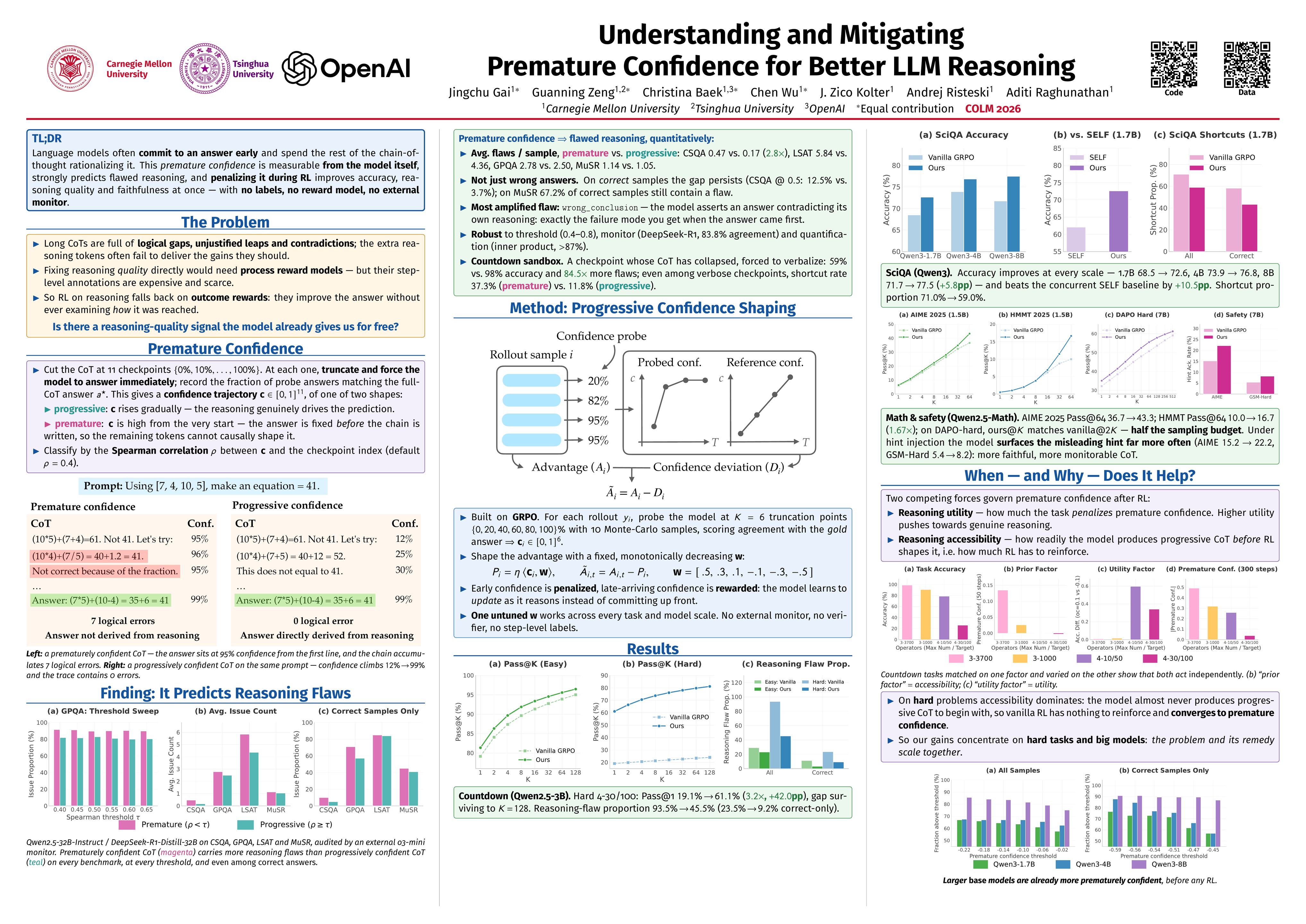
Long chains of thought (CoT) from current language models frequently contain logical gaps and unjustified leaps, limiting the gains from additional test-time compute. Improving reasoning quality directly would require process reward models, but the step-level annotations needed to train them are expensive and scarce. We find such a signal in how the model's confidence evolves during reasoning: \emph{premature confidence}, the tendency to commit to an answer early and use the remaining tokens to rationalize it, strongly predicts flawed reasoning across tasks and model scales. We exploit this in \emph{progressive confidence shaping}, a reinforcement learning objective that trains models to update their confidence as they reason rather than commit early—rewarding gradual confidence growth and penalizing early commitment, with no external labels or reward models. The method improves accuracy and reasoning quality from 1.5B to 8B parameters across arithmetic (Countdown), math (DAPO, AIME), and science (ScienceQA): on Countdown, accuracy improves 3.2 x(+42.0pp) and flawed reasoning drops 48pp; on AIME, Pass@64 improves 6.6pp. Consistent with this mechanism, the method also improves faithfulness: on a safety benchmark, our models more transparently surface misleading content in their reasoning traces rather than concealing it. Controlled experiments reveal that the problem and its remedy scale together: premature confidence grows with model size and task difficulty, and so do the gains from addressing it.
Counterfactual Simulation Training for Chain-of-Thought Faithfulness
Peter Hase ⋅ Christopher Potts
Inspecting Chain-of-Thought reasoning is a common approach to understanding why an LLM produced its output. But well-known problems with CoT faithfulness severely limit what insights can be gained from this practice. In this paper, we introduce a training method called Counterfactual Simulation Training (CST), which aims to improve CoT faithfulness by rewarding CoTs that enable a simulator to accurately predict a model's outputs over counterfactual inputs. We apply CST in two settings: (1) CoT monitoring with cue-based counterfactuals, to detect when models rely on spurious features, reward hack, or are sycophantic, and (2) counterfactual simulation over generic model-based counterfactuals, to encourage models to produce more faithful, generalizable reasoning in the CoT. Experiments with models up to 235B parameters show that CST can substantially improve monitor accuracy on cue-based counterfactuals (by 35 accuracy points) as well as simulatability over generic counterfactuals (by 2 points). We further show that: (1) CST outperforms prompting baselines, (2) rewriting unfaithful CoTs with an LLM is 5x more efficient than RL alone, and (3) faithfulness improvements do not generalize to dissuading cues (as opposed to persuading cues). These results suggest that CST can improve CoT faithfulness in many settings, with promising applications for CoT monitoring.
Data Repetition Beats Data Scaling in Long-CoT Supervised Fine-Tuning
Dawid J Kopiczko ⋅ Sagar Vaze ⋅ Tijmen Blankevoort ⋅ Yuki M Asano
Supervised fine-tuning (SFT) on chain-of-thought data is an essential post-training step for reasoning language models. Standard machine learning intuition suggests that training with more unique training samples yields better generalization. Counterintuitively, we show that SFT benefits from repetition: under a fixed update budget, training for more epochs on smaller datasets outperforms single-epoch training on larger datasets. On AIME'24/25 and GPQA benchmarks, Olmo3-7B trained for 128 epochs on 400 long chain-of-thought samples outperforms the equivalent 1 epoch on 51200 samples by 12-26 percentage points, with no additional catastrophic forgetting. We find that training token accuracy reliably signals when repetition has saturated, as improvements from additional epochs plateau at full memorization, a pattern consistent across all settings. These findings provide a practical approach for reasoning SFT, where scaling epochs with token accuracy as a stopping criterion can replace expensive undirected data scaling. We pose the repetition advantage, where full memorization coincides with improved generalization, as a new open problem for the community in understanding the training dynamics of large language models.
Early Data Exposure Improves Robustness to Subsequent Fine-Tuning
Lawrence Feng ⋅ Gaurav R Ghosal ⋅ Jacob M Springer ⋅ Ziqian Zhong ⋅ Aditi Raghunathan
How can we train models whose post-trained capabilities survive subsequent fine-tuning? Rather than focusing on downstream interventions to mitigate forgetting of upstream capabilities, we study how upstream training choices --- that is, the manner in which a capability is acquired --- shape how robustly that capability is retained. We investigate this question in a controlled three-stage language-model pipeline: pretraining, post-training to acquire a target capability, and downstream fine-tuning on a new objective. Across 135M and 1B models, two post-training domains, and two downstream fine-tuning tasks, we find that immediate post-training performance does not reliably predict retention after subsequent fine-tuning: training recipes that look equivalent immediately after post-training can retain the target capability very differently after subsequent fine-tuning. In particular, \textit{early exposure} --- mixing post-training data into pretraining --- consistently improves the frontier between retained upstream performance and downstream performance. In compute-matched experiments, where the target data must be allocated between pretraining and post-training, we find that the optimum lies at neither extreme. Together with our other empirical and theoretical findings, this supports the view that post-training drives immediate specialization while early exposure improves robustness to later forgetting. Replay and dropout, typically used to mitigate forgetting as it occurs during fine-tuning, provide complementary gains to early exposure when applied during post-training. Our findings suggest that robustness to subsequent fine-tuning should be treated as a first-class objective of upstream training, addressed preventatively through choices like early exposure rather than reactively during fine-tuning itself.
PivotRL: High Accuracy Agentic Post-Training at Low Compute Cost
Junkeun Yi ⋅ Damon Mosk-Aoyama ⋅ Baihe Huang ⋅ Ritu Gala ⋅ Charles Wang ⋅ Sugam Devare ⋅ Khushi Bhardwaj ⋅ Abhibha Gupta ⋅ Oleksii Kuchaiev ⋅ Jiantao Jiao ⋅ Jian Zhang ⋅ Venkat Krishna Srinivasan
Post-training for long-horizon agentic tasks has a tension between compute efficiency and generalization. While supervised fine-tuning (SFT) is compute efficient, it often suffers from out-of-domain (OOD) degradation. Conversely, end-to-end reinforcement learning (E2E RL) preserves OOD capabilities, but incurs high compute costs due to many turns of on-policy rollout. We introduce PivotRL, a novel framework that operates on existing SFT trajectories to combine the compute efficiency of SFT with the OOD accuracy of E2E RL. PivotRL relies on two key mechanisms: first, it executes local, on-policy rollouts and filters for pivots: informative intermediate turns where sampled actions exhibit high variance in outcomes; second, it utilizes rewards for functional-equivalent actions rather than demanding strict string matching with the SFT data demonstration. We theoretically show that these mechanisms incentivize strong learning signals with high natural gradient norm, while preserving policy probability ordering on actions unrelated to training tasks. In comparison to standard SFT on identical data, we demonstrate that PivotRL achieves +4.17% higher in-domain accuracy on average across four agentic domains, and +10.04% higher OOD accuracy in non-agentic tasks. Notably, on agentic coding tasks, PivotRL achieves competitive accuracy with E2E RL with 4x fewer rollout turns.
$V_{0.5}$: Generalist Value Model as a Prior for Sparse RL Rollouts
Yi-Kai Zhang ⋅ Yueqing Sun ⋅ Hongyan Hao ⋅ Xierui SONG ⋅ Xunliang Cai ⋅ Long Chen ⋅ De-Chuan Zhan ⋅ Han-Jia Ye
In Reinforcement Learning with Verifiable Rewards (RLVR), constructing a robust advantage baseline is critical for policy gradients, effectively guiding the policy model to reinforce desired behaviors. Recent research has introduced Generalist Value Models (such as $V_0$), which achieve pre-trained value estimation by explicitly encoding model capabilities in-context, eliminating the need to synchronously update the value model alongside the policy model. In this paper, we propose $V_{0.5}$, whose advantage baseline is a convex combination of the frozen value model's prior prediction and the empirical rollout mean. An adaptive weight automatically governs the balance based on the real-time agreement between the two estimators. When the prior is reliable, the baseline heavily leverages the value model for variance reduction. When a conflict is detected, the baseline safely reverts to the unbiased empirical mean, and $V_{0.5}$ dynamically allocates additional rollout budget to sharpen the estimate. This mechanism minimizes the baseline estimator's Mean Squared Error (MSE), guaranteeing stable policy gradients, even under extreme sparsity with a group size of 4. Extensive evaluations across six mathematical reasoning benchmarks demonstrate that $V_{0.5}$ significantly outperforms GRPO and DAPO, achieving faster convergence and up to 12\% accuracy improvement.
HeaPA: Difficulty-Aware Heap Sampling and On-Policy Query Augmentation for LLM Reinforcement Learning
Weiqi Wang ⋅ Xin Liu ⋅ Binxuan Huang ⋅ Hejie Cui ⋅ Rongzhi Zhang ⋅ Changlong Yu ⋅ Shuowei Jin ⋅ Jingfeng Yang ⋅ Qingyu Yin ⋅ Zhengyang Wang ⋅ Zheng Li ⋅ Yifan Gao ⋅ Priyanka Nigam ⋅ Bing Yin ⋅ Lihong Li ⋅ Yangqiu Song
RLVR has become a standard recipe for training LLMs on reasoning tasks with verifiable outcomes, but when rollout generation dominates the cost, efficiency hinges on which prompts are sampled and when. In practice, prompt pools are often static or only weakly coupled to policy progress, so uniform sampling fails to track the moving capability frontier and wastes rollouts on regions that are already solved or still unreachable. Prior methods improve efficiency via filtering, curricula, adaptive rollout allocation, or teacher guidance, but they often assume a fixed pool, which does not support stable on-policy pool growth, or they introduce additional teacher cost and latency. In this work, we propose HEAPA (Heap Sampling and On-Policy Query Augmentation), which maintains a bounded, evolving pool, tracks the frontier with heap-based boundary sampling, grows the pool via on-policy augmentation under lightweight asynchronous validation, and stabilizes correlated queries via topology-aware pool statistics re-estimation and controlled reinsertion. Across two training corpora, two training recipes, and seven benchmarks, HEAPA consistently improves accuracy and reaches target performance with fewer computations at comparable wall-clock time. Analyses attribute the gains to frontier-focused sampling and on-policy pool growth, with more pronounced improvements at mid-to-large model scales. Our training code is publicly available at https://github.com/horizon-llm/HeaPA.
Adversarial Reward Auditing for Active Detection and Mitigation of Reward Hacking
Mohammad Beigi ⋅ Ming Jin ⋅ Junshan Zhang ⋅ Qifan Wang ⋅ Lifu Huang
Reinforcement learning from human feedback (RLHF) is vulnerable to reward hacking: policies can exploit spurious correlations in learned reward models to increase proxy reward while degrading true alignment. Existing defenses are largely static. They regularize optimization, improve the reward model, or target known biases, but do not explicitly detect exploitation as it emerges during training. We propose \textbf{Adversarial Reward Auditing (ARA)}, a two-stage framework for detecting and mitigating reward hacking. In Stage 1, a Hacker policy searches for vulnerabilities in a frozen reward model while an Auditor learns to detect exploitative responses from the reward model's internal representations. In Stage 2, the trained Auditor guides RLHF by downweighting rewards for responses likely to be exploitative. Across sycophancy, length bias, and code gaming, ARA yields the strongest alignment--utility tradeoff among competitive baselines, reducing exploitation while preserving or improving task performance. We also find cross-domain transfer in both attack and defense: a Hacker trained on code gaming increases sycophancy despite receiving no direct reward for that behavior, while an Auditor trained in one domain helps suppress exploits in others. These results suggest that reward hacking is a dynamic, transferable phenomenon and that auditing optimization in reward-model representation space is an effective way to control it.
Behavioral Canaries: Auditing Private Retrieved Context Usage in RL Fine-Tuning
Chaoran Chen ⋅ Dayu Yuan ⋅ Peter Kairouz
In agentic workflows, LLMs frequently process retrieved contexts that are legally protected from further training. However, auditors currently lack a reliable way to verify if a provider has violated the terms of service by incorporating these data into post-training, especially through Reinforcement Learning (RL). While standard auditing relies on verbatim memorization and membership inference, these methods are ineffective for RL-trained models, as RL primarily influences a model's behavioral style rather than the retention of specific facts. To bridge this gap, we introduce Behavioral Canaries, a new auditing mechanism for RLFT pipelines. The framework instruments preference data by pairing document triggers with feedback that rewards a distinctive stylistic response, inducing a latent trigger-conditioned preference if such data are used in training. Empirical results show that these behavioral signals enable detection of unauthorized document-conditioned training, achieving a 67% detection rate at a 10% false-positive rate (AUROC = 0.756) at a 1% canary injection rate. More broadly, our results establish behavioral canaries as a new auditing mechanism for RLFT pipelines, enabling auditors to test for training-time influence even when such influence manifests as distributional behavioral change rather than memorization. We release our code at: https://github.com/CRChenCode/behavioral_canary.
A Statistical Framework for Auditing Behavioral Dependence and Induced Bias in LLM Judges
Chenchen Kuai ⋅ Jiwan Jiang ⋅ Zihao Zhu ⋅ Hao Wang ⋅ Keshu Wu ⋅ Zihao Li ⋅ Yunlong Zhang ⋅ Chenxi Liu ⋅ Zhengzhong Tu ⋅ Zhiwen Fan ⋅ Yang Zhou
The rapid growth of the large language model (LLM) ecosystem raises a critical question: are seemingly diverse models truly independent? Shared pretraining data, distillation, and alignment pipelines can induce hidden behavioral dependencies, latent entanglement, that undermine multi-model systems such as LLM-as-a-judge pipelines and ensemble verification, which implicitly assume independent signals. In practice, this manifests as correlated reasoning patterns and synchronized failures, where apparent agreement reflects shared error modes rather than independent validation. To address this, we develop a statistical framework for auditing behavioral entanglement among black-box LLMs. Our approach introduces a multi-resolution hierarchy that characterizes the joint failure manifold through two information-theoretic metrics: (i) a Difficulty-Weighted Behavioral Entanglement Index (BEI), which amplifies synchronized failures on easy tasks, and (ii) a Cumulative Information Gain (CIG) metric, which captures directional alignment in erroneous responses. Through experiments on 18 LLMs from six model families, we identify statistically significant behavioral entanglement. Such behavioral dependence is associated with judge over-endorsement bias on a disjoint MMLU-Pro evaluation set ($\rho=0.508$ for BEI and $\rho=0.520$ for CIG; $p<0.01$). The association further transfers to the MATH-500 benchmark ($\rho=0.441$ for BEI and $\rho=0.457$ for CIG; $p<0.05$), providing cross-benchmark evidence that the identified dependency structure generalizes beyond the data and response format used for its estimation. Finally, we demonstrate a practical use case of entanglement through de-entangled verifier ensemble reweighting, achieving 3.5 and 2.6 percentage-point gains in accuracy and precision, respectively, over majority voting.
FLY-EVAL++: Evidence-Based Evaluation for Safety-Constrained Modeling in Embodied Systems
Yalun Wu ⋅ Junfeng Fang ⋅ Jiawei Wang ⋅ Haotian Liu ⋅ Qijun Yang ⋅ Minghan Yang ⋅ Hongcheng Guo ⋅ Zhoujun Li ⋅ Boyang Wang
Evaluating large language models (LLMs) in safety-critical, physics-governed environments requires more than accuracy-based metrics, because predictions that are numerically close to the ground truth can still violate operational constraints, combine fields in physically inconsistent ways, or fail to produce usable structured outputs. Existing evaluation protocols do not measure these failure modes reliably. We propose FLY-EVAL++, an evidence-driven evaluation protocol that combines deterministic verification of protocol compliance, physical feasibility, and safety constraints with fixed rubric-guided aggregation into interpretable multi-dimensional scores. We instantiate FLY-EVAL++ for Flight Trajectory and Attitude Prediction (FTAP) by extending the PilotBench setting with history-conditioned and multi-step prediction tasks. Across 66 LLMs, safety compliance is the most discriminative dimension of model behavior: models with comparable predictive performance differ by more than 28 points in safety score, and we observe recurrent failures including safety violations under physically plausible predictions and instability in multi-step rollouts. These results show that evaluation in safety-critical domains should measure constraint satisfaction and structured validity explicitly rather than rely on accuracy-centric reporting alone.
Measuring Nines of Reliability: Sample-Efficient LLM Evaluation in Saturated GSM Benchmarks
Eungyeup Kim ⋅ Chenchen Gu ⋅ Vashisth Tiwari ⋅ J Kolter
While existing benchmarks demonstrate the near-perfect performance of large language models (LLMs) on various tasks, this apparent saturation often obscures the need for rigorous evaluation of their reliability. In real-world deployment, however, achieving high reliability, where each added "nine" (e.g., "four-nines" (99.99\%) vs.\ "three-nines" (99.9\%)) is critical, as this gap yields an order-of-magnitude increase in failures, catastrophic in reliability-critical applications. Still, estimating such a rare failure probability with tight confidence bounds requires prohibitively large LLM inference sizes, making standard Monte Carlo evaluation infeasible under limited compute budgets. In this paper, we observe that, on parameterized GSM8K math-reasoning tasks, LLM failures exhibit strong systematic patterns: across these parameterized input spaces, a small subset of inputs disproportionately accounts for the majority of failures. Leveraging this observation, we propose to learn a sampling distribution concentrated on failure-prone inputs via the cross-entropy method (CEM). We evaluate our framework on three LLMs, Qwen2.5-Math-7B-Instruct, gpt-oss-20b-low, and Gemini 2.5 Flash Lite, across parameterized GSM8K templates and achieve up to 156.22$\times$ reduction in required inferences compared to naive uniform sampling. Our estimates reveal that models with indistinguishable accuracy on standard benchmarks can differ substantially in estimated failure rates, underscoring that reliability is a distinct and measurable axis of model quality. Our simple framework takes a first step toward evaluating high-reliability regimes of LLMs on saturated GSM benchmarks, a distinct and underexplored dimension of evaluation beyond existing benchmarks.
The Illusion of Stochasticity in LLMs
Xiangming Gu ⋅ Soham De ⋅ Michalis Titsias ⋅ Larisa Markeeva ⋅ Petar Veličković ⋅ Razvan Pascanu
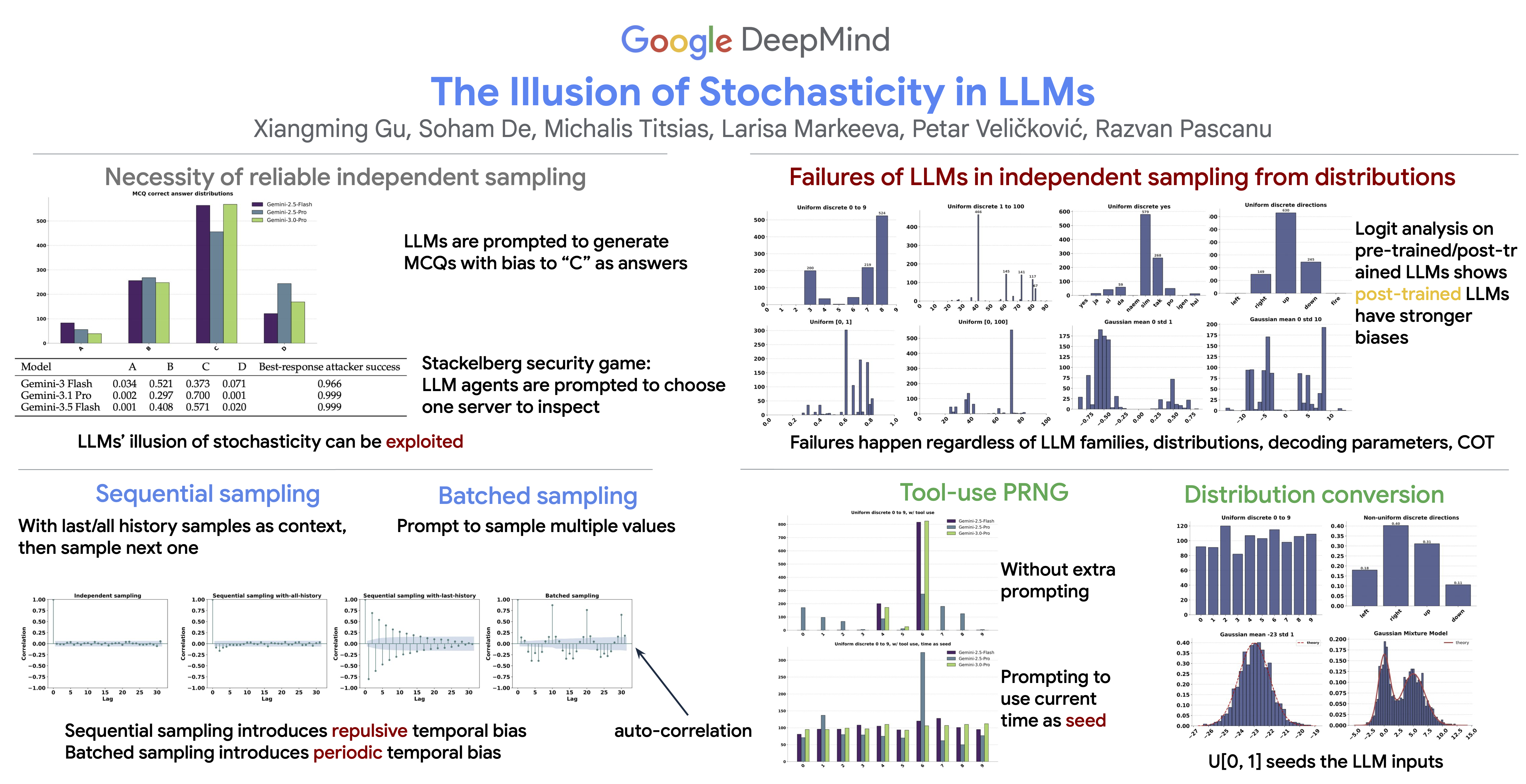
In this work, we demonstrate that reliable stochastic sampling is a fundamental yet unfulfilled requirement for Large Language Models (LLMs) operating as agents. Agentic systems are frequently required to sample from distributions, often inferred from observed data, a process which needs to be emulated by the LLM. This leads to a distinct failure point: while standard RL agents rely on external sampling mechanisms, LLMs fail to map their internal probability estimates to their stochastic outputs. Through rigorous empirical analysis across multiple model families, model sizes, prompting styles, and distributions, we demonstrate the extent of this failure. Crucially, we show that while powerful frontier models can convert provided random seeds to target distributions, their ability to sample directly from specific distributions is fundamentally flawed.
Why Gaussian Diffusion Models Fail on Discrete Data?
Alexander Shabalin ⋅ Simon Elistratov ⋅ Viacheslav Meshchaninov ⋅ Ildus Sadrtdinov ⋅ Dmitry Vetrov
Diffusion models have become a standard approach for generative modeling in continuous domains, yet their application to discrete data remains challenging. We investigate why Gaussian diffusion models with the DDPM solver struggle to sample from discrete distributions that are represented as a mixture of delta-distributions in the continuous space. Using a toy Random Hierarchy Model, we identify a critical sampling interval in which the density of noisified data becomes multimodal. In this regime, DDPM occasionally enters low-density regions between modes producing out-of-distribution inputs for the model and degrading sample quality. We show that existing heuristics, including self-conditioning and a solver we term q-sampling, help alleviate this issue. Furthermore, we demonstrate that combining self-conditioning with switching from DDPM to q-sampling within the critical interval improves generation quality on real data. We validate these findings across conditional and unconditional tasks in multiple domains, including text, programming code, and proteins.
Measuring AI "Slop" in Text
Chantal Shaib ⋅ Tuhin Chakrabarty ⋅ Diego Garcia-Olano ⋅ Byron Wallace
AI "slop" is an increasingly popular term used to describe low-quality AI-generated text, but there is currently no agreed upon definition of this term nor a means to measure its occurrence. In this work, we develop a taxonomy of "slop" through interviews with experts in NLP, writing, and philosophy, and propose a set of interpretable dimensions for its assessment in text. Through span-level annotation, we find that binary ``slop'' judgments are (somewhat) subjective, but such determinations nonetheless correlate with latent dimensions such as coherence and relevance. Our framework can be used to examine AI-generated text in both detection and binary preference tasks, potentially offering new insights into the linguistic and stylistic factors that contribute to quality judgments. We highlight that fully automated and scalable methods remain an open challenge.
A common formalism for constraining the output of autoregressive text generation models involves lexical constraints, words or phrases which are required to occur in the generated text. DFA-constrained beam search and grid beam search are two widely used paradigms for decoding from autoregressive models while enforcing lexical constraints. As the former approach requires a number of forward passes exponential in the number of constraint tokens, it is often dispreferred to the latter, which requires only linearly many forward calls. However, while grid beam search achieves an exponential speedup, it does so in a manner which does not treat all of the constraints equally. In this paper, we demonstrate that grid beam search is biased to incorporate easier-to-satisfy constraints first, leaving harder constraints to the end of the sequence. This contrasts with DFA-constrained beam search, which exhibits no such bias. To address this shortcoming, we propose fair grid beam search, a modification to grid beam search which avoids this bias while still requiring only linearly many forward passes. Experimentally, we confirm grid beam search's bias on two constrained generation tasks, finding significant differences in how it orders constraint tokens as compared to DFA-constrained beam search and fair grid beam search. Furthermore, we find that fair grid beam search not only fixes grid beam search's bias, but finds higher-probability strings in the process.
Encode Once, Decode Never: Reusing Audio LM Internals for Efficient Temporal Localization
Joseph An ⋅ Phillip Keung ⋅ Jiaqi Wang ⋅ Orevaoghene Ahia ⋅ Noah Smith
Audio language models process input audio into rich frame-level representations, but the standard approach to temporal localization generates timestamps as sequences of text tokens, which discards the frame-level representations in favor of autoregressive decoding. However, generating timestamps as tokens is slow and not parallelizable, and tends to hallucinate when producing timestamps outside the training distribution. We propose internal frame-level reuse, a method that trains audio LMs to reuse their own internal audio representations for temporal localization directly, bypassing token generation altogether. We introduce a lightweight prediction head trained via different frame-level objectives: a binary frame classifier and a novel inhomogeneous Poisson process (IHP) loss that models temporal event intensity. Across word localization, speaker diarization, and event localization tasks, our approach can achieve a >50x inference speedup over token-based generation and demonstrates robust length generalization, maintaining high accuracy on out-of-distribution audio durations where token-based models collapse completely. We find that reusing audio frame-level representations yields localization accuracies comparable to (and often better than) finetuned token-based baselines.
Extracting memorized pieces of (copyrighted) books from open-weight language models
A. Feder Cooper ⋅ Mark Lemley ⋅ Allison Casasola ⋅ Ahmed M Ahmed ⋅ Aaron Gokaslan ⋅ Amy B Cyphert ⋅ Christopher De Sa ⋅ Daniel Ho ⋅ Percy Liang
Plaintiffs and defendants in copyright lawsuits make sweeping, opposing claims about the extent to which large language models (LLMs) memorize protected expression from books in their training data. We show that these polarized positions dramatically oversimplify the relationship between memorization and copyright. To do so, we develop a technique to measure memorization of books, which we apply to 200 books and 14 open-weight LLMs. Through over 3000 experiments, we show that memorization varies both by model and book. While we find that most LLMs do not memorize most books either in whole or in part, there are notable exceptions. Llama 3.1 70B entirely memorizes some books, like Harry Potter and the Sorcerer's Stone; memorization is so extensive that one can deterministically extract the whole book almost verbatim using the book's first few words as an initial prompt. We discuss why our results have significant implications for copyright cases, though not ones that unambiguously favor either side.
Inference Scaling of LLM Ensembling: Bridging Token Spaces with Token Translation
Tianxin Wei ⋅ Zhichen Zeng ⋅ Ruizhong Qiu ⋅ Zhining Liu ⋅ Xuying Ning ⋅ Xinrui He ⋅ Wenxuan Bao ⋅ Xiao Lin ⋅ Qi He ⋅ Xianfeng Tang ⋅ Hanghang Tong ⋅ Jingrui He
Large language models (LLMs) exhibit diverse strengths and weaknesses across tasks, motivating recent efforts to ensemble multiple models to harness their complementary capabilities, boosting test-time performance. While model diversity and capability are known to influence ensemble effectiveness, a persistent challenge in LLM ensembling arises from mismatched tokenizer vocabularies. Existing alignment strategies typically rely on token-level embeddings or string-level heuristics of tokens, overlooking the tokenizer priors embedded during LLM pretraining. Specifically, tokenizers such as Byte-Pair Encoding (BPE) and Unigram are constructed by statistically analyzing large pretraining corpora to identify frequent subword units, and they tokenize text using greedy or probabilistic algorithms that reflect these learned subword distributions. In this work, we propose a novel and remarkably simple Token Translation (ToT) method that explicitly leverages these tokenizer priors to bridge heterogeneous token spaces. Our method is lightweight, requiring only a few lines of code, pre-computable, and highly efficient at inference. To further enhance robustness, we incorporate token-level model uncertainty to dynamically reweight each model’s contribution during decoding. Extensive evaluations across diverse model combinations and tasks demonstrate that our method consistently outperforms existing ensembling baselines.
Tiny Aya: Bridging Scale and Multilingual Depth
Alejandro R Salamanca ⋅ Diana Abagyan ⋅ Daniel D'souza ⋅ Ammar Khairi ⋅ David Mora ⋅ Saurabh Dash ⋅ Viraat Aryabumi ⋅ Sara Rajaee ⋅ Mehrnaz Mofakhami ⋅ Ananya Sahu ⋅ Thomas Euyang ⋅ Brittawnya Prince ⋅ Madeline Smith ⋅ Hangyu Lin ⋅ Acyr Locatelli ⋅ Sara Hooker ⋅ Tom Kocmi ⋅ Aidan Gomez ⋅ Ivan Zhang ⋅ Phil Blunsom ⋅ Nicholas Frosst ⋅ Joelle Pineau ⋅ Beyza Ermis ⋅ Ahmet Üstün ⋅ Julia Kreutzer ⋅ Marzieh Fadaee
We introduce Tiny Aya, a family of open-weight multilingual language models that achieve strong, balanced performance across 70 languages with 3.35 billion parameters through deliberate data curation and training design. The release includes a pretrained base model, a globally balanced instruction-tuned variant, and three region-specialized models targeting Africa, South Asia, Europe, Asia-Pacific, and West Asia. We contribute: (1) a script-aware tokenizer weighting scheme that achieves competitive or superior compression across most writing systems, particularly for underrepresented scripts; (2) a posttraining pipeline combining FusioN, a multi-teacher synthetic data generation framework, with region-aware supervised finetuning and SimMerge, a predictive model merging method that preserves global consistency while retaining regional gains; (3) a comprehensive multilingual evaluation suite spanning translation, understanding, reasoning, generation, safety, and cultural awareness across up to 66 languages. Despite its compact size, Tiny Aya outperforms Gemma3-4B on translation in 46 of 55 languages, is competitive with or outperforms similar-sized models on generative benchmarks with substantially lower cross-language variance, and achieves the highest mean safe response rate (91.1%) on multilingual safety benchmarks. Quantized variants run on smartphones and quantization degradation attenuates for lower-resource languages . We release all models to support research into efficient, inclusive multilingual AI.
MameLoshnLM: Yiddish Language Model and Evaluation Benchmark
Uri Katz ⋅ Omer Goldman ⋅ Tomasz Limisiewicz ⋅ Reut Tsarfaty ⋅ Noah Smith
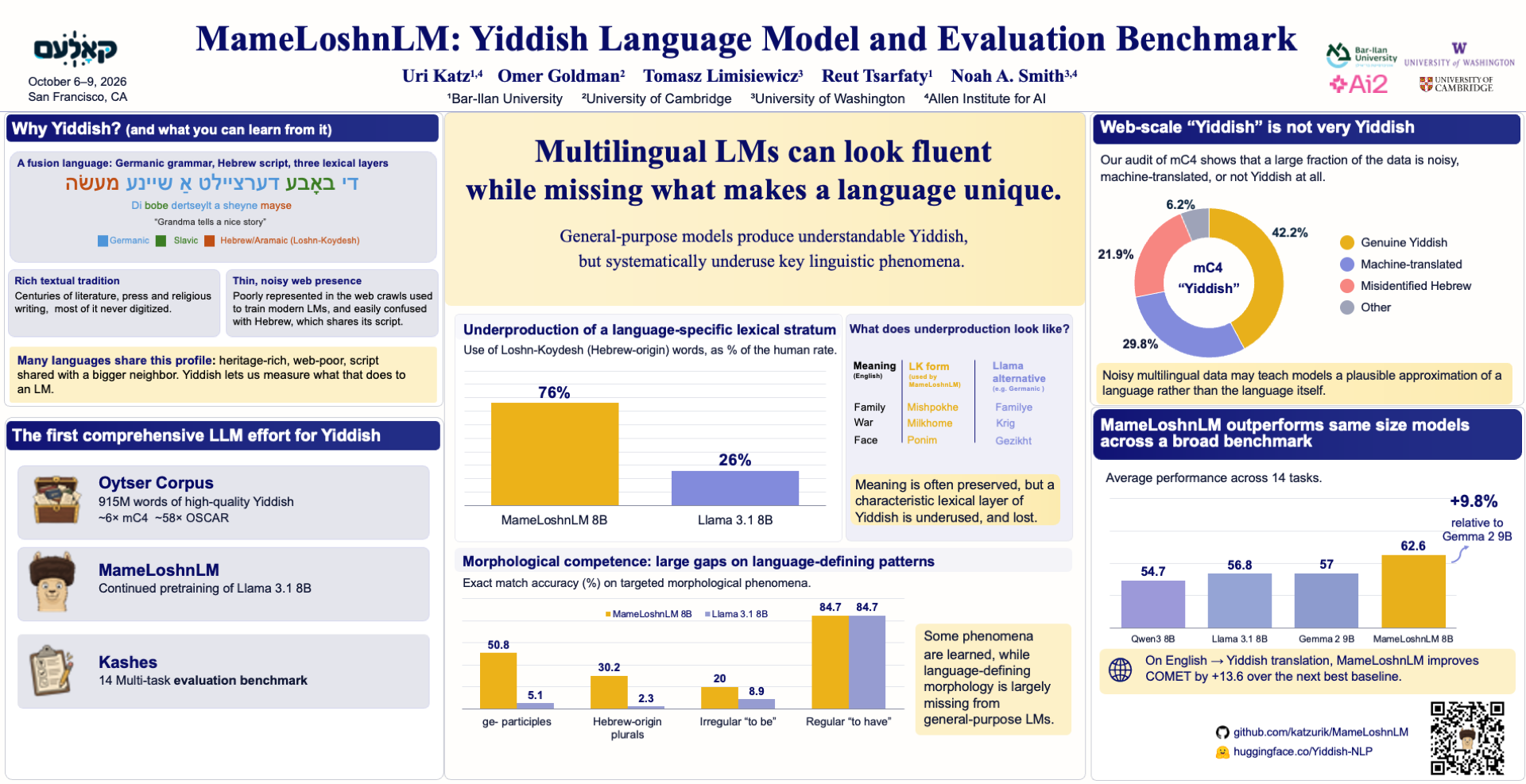
We present MameLoshnLM, the first open-source 8B-parameter language model built specifically for Yiddish. Despite Yiddish's rich textual tradition, its limited digital presence and the scarcity of reliable evaluation resources have constrained progress in Yiddish language modeling. Existing multilingual corpora and benchmarks are often poor proxies for the language, containing substantial amounts of noisy, machine-translated, and misclassified text. We address these gaps by introducing Oytser, a high-quality Yiddish pretraining corpus that combines contemporary web-native sources with literary materials, and Kashes, a multi-task benchmark spanning translation, linguistic analysis, information extraction, and language understanding. Using these resources, we continue pretraining Llama 3.1 8B to obtain MameLoshnLM. Across the tasks in the benchmark, MameLoshnLM outperforms open baselines of similar scale. Our analyses show that these gains are not only quantitative: relative to general-purpose multilingual models, MameLoshnLM better captures language-defining lexical and morphological patterns, pointing to a broader failure mode of noisy web-scale multilingual data for low-resource languages. Our results provide both a foundation for Yiddish NLP and a practical template for language model development in historically rich but digitally underrepresented languages.
The Embedder's Dilemma: LLMs Are Better, but at What Cost?
Adnan El Assadi ⋅ Niklas Muennighoff ⋅ Jinhyuk Lee
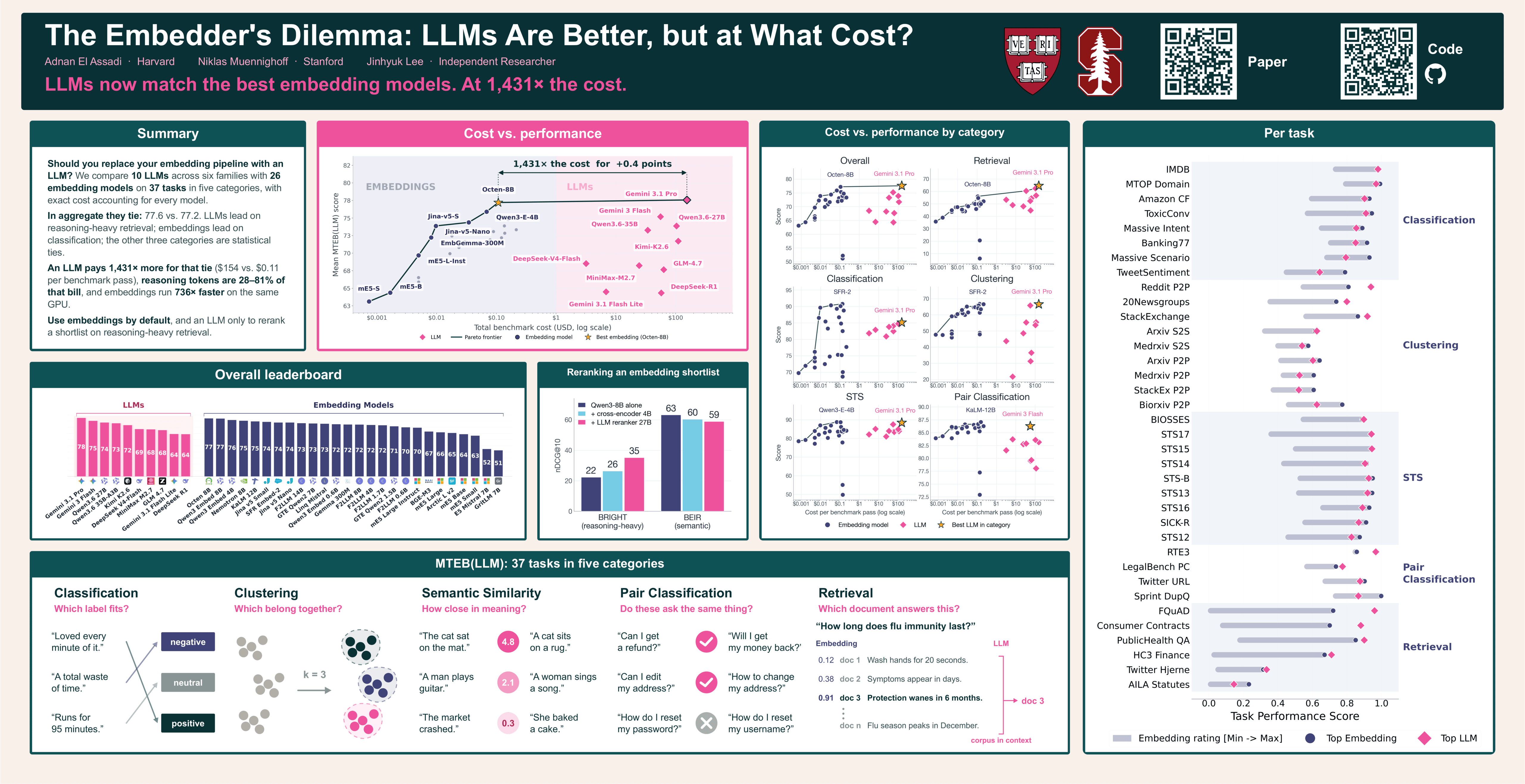
Should you replace your text-embedding pipeline with a large language model? We answer this with a controlled, cost-aware comparison of ten LLMs across six families and 26 embedding models (118M to 14B parameters) on 37 tasks spanning classification, semantic textual similarity (STS), clustering, pair classification, and retrieval. In aggregate the two paradigms are effectively tied: the best LLM (Gemini 3.1 Pro, 77.6) and the best embedding model (77.2) differ by 0.4 points. Their strengths differ by task: LLMs lead on reasoning-heavy retrieval, embedding models lead on classification, and the two match on clustering, STS, and pair classification. Reaching that parity is expensive. An LLM costs up to 1,431× more than an embedding model of comparable quality (USD 154 vs. USD 0.11 per benchmark pass), and the open LLMs tested process tokens 2.5 to 736× more slowly on the same GPU. Reasoning tokens account for 28 to 81% of LLM inference cost; lower reasoning budgets preserve or improve retrieval quality for most models in our ablation. The Pareto frontier contains the leading embedding models and one LLM, Gemini 3.1 Pro. These results support a division of labour: use embedding models for similarity, classification, and clustering, and reserve LLMs for reasoning-intensive retrieval. Our code, datasets, and results are publicly available at https://github.com/embeddings-benchmark/embedders-dilemma.
LLMs Encode Their Failures: Predicting Success from Pre-Generation Activations
William Gitta Lugoloobi ⋅ Thomas Foster ⋅ William Bankes ⋅ Chris Russell
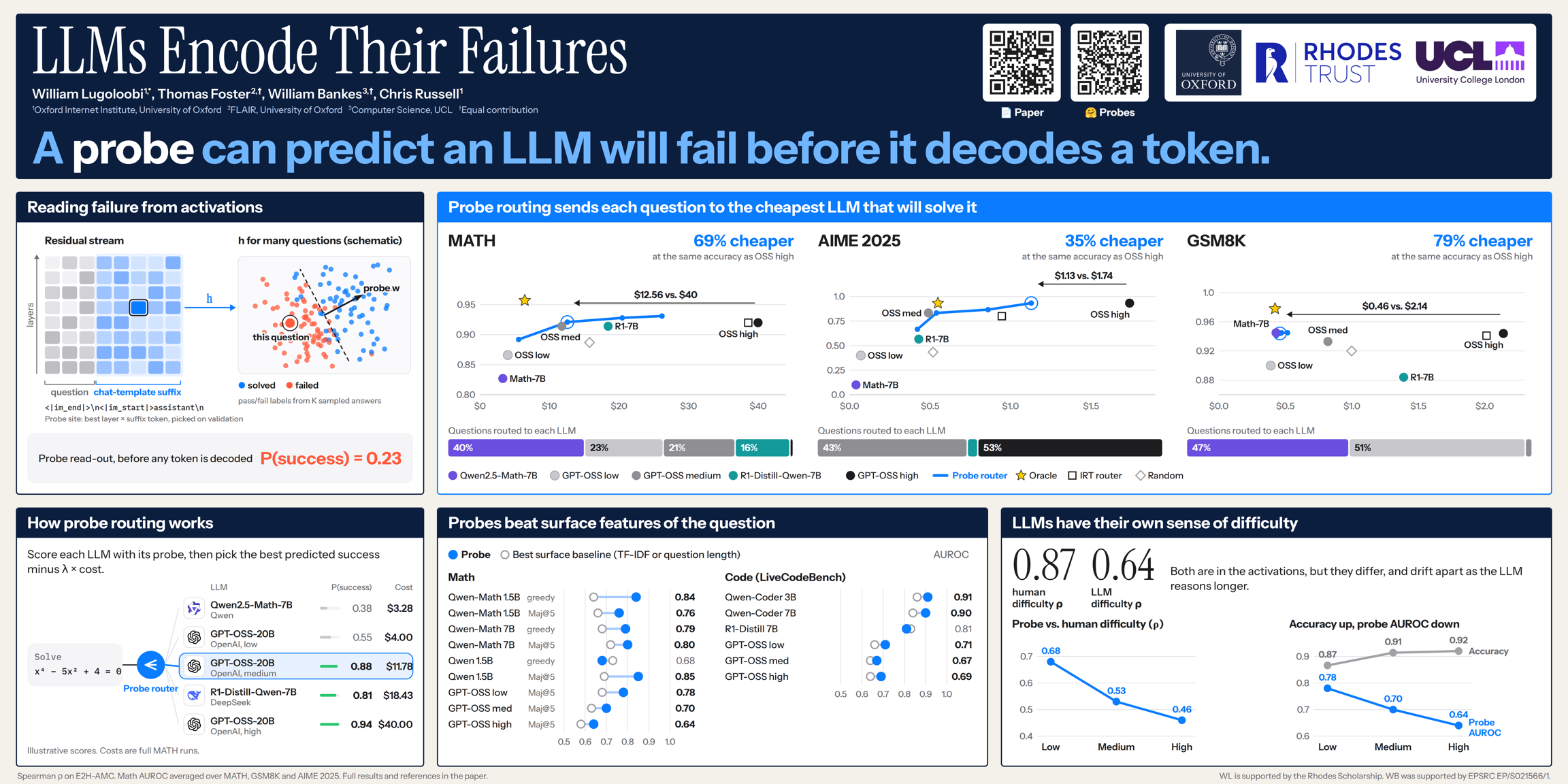
Running LLMs with extended reasoning on every problem is expensive, but determining which inputs actually require additional compute remains challenging. We investigate whether a model's likelihood of success is recoverable from its internal representations prior to generation, and whether this signal can guide more efficient inference. We train linear probes on pre-generation activations to predict policy-specific success on math and coding tasks, substantially outperforming surface features such as question length and TF-IDF. Using E2H-AMC, which provides both human and model performance on identical problems, we show that models encode a model-specific notion of difficulty that is distinct from human difficulty, and that this distinction increases with extended reasoning. Leveraging these probes, we demonstrate that routing queries across a pool of models can match the performance of the best-performing model whilst reducing inference cost by up to 70\% on MATH, showing that internal representations enable practical efficiency gains even when they diverge from human intuitions about difficulty.
Scaling Test-Time Compute for Agentic Coding
Joongwon Kim ⋅ Wannan Yang ⋅ Kelvin Niu ⋅ Hongming Zhang ⋅ Yun Zhu ⋅ Eryk Helenowski ⋅ Ruan Silva ⋅ Zhengxing Chen ⋅ Srini Iyer ⋅ Manzil Zaheer ⋅ Daniel Fried ⋅ Hanna Hajishirzi ⋅ Sanjeev Arora ⋅ Ruslan Salakhutdinov ⋅ Gabriel Synnaeve ⋅ Anirudh Goyal
Test-time scaling has emerged as a powerful way to improve LLMs. However, existing methods are best suited to short, bounded outputs that can be directly compared, ranked or refined. Long-horizon coding agents violate this premise: each attempt produces an extended trajectory of actions, observations, errors, and partial progress taken by the agent. In this setting, the main challenge is no longer generating more attempts, but representing prior experience in a form that can be effectively selected from and reused. We propose a test-time scaling framework for agentic coding based on compact representations of rollout trajectories. Our framework converts each rollout into a structured summary that preserves its salient hypotheses, progress, and failure modes while discarding low-signal trace details. These representations enable two complementary forms of scaling. For parallel scaling, we introduce Recursive Tournament Voting (RTV), which recursively narrows a population of rollout summaries through small-group comparisons. For sequential scaling, we adapt Parallel-Distill-Refine (PDR) to condition new rollouts on summaries of prior attempts. Our method consistently improves the performance of frontier coding agents across SWE-Bench Verified and Terminal-Bench v2.0. For example, by using our method Claude 4.5 Opus improves from 70.9% to 77.6% on SWE-Bench Verified (mini-SWE-agent) and 46.9% to 59.1% on Terminal-Bench v2.0 (Terminus 1). Our results suggest that test-time scaling for long-horizon agents is fundamentally a problem of representation, selection, and reuse.
SWE-Replay: Efficient Test-Time Scaling for Software Engineering Agents
Yifeng Ding ⋅ LINGMING ZHANG
Test-time scaling has been widely adopted to enhance the capabilities of Large Language Model (LLM) agents in software engineering (SWE) tasks. However, the standard approach of repeatedly sampling trajectories from scratch is computationally expensive. While recent methods have attempted to mitigate costs using specialized value agents, they can suffer from model miscalibration and fail to generalize to modern agents that synthesize custom bash scripts as tools. In this paper, we introduce SWE-Replay, the first efficient and generalizable test-time scaling technique for modern agents that does not rely on potentially noisy value estimates. SWE-Replay optimizes the efficiency of the scaling process by recycling trajectories from prior trials, dynamically choosing to either explore from scratch or exploit archived experience by branching at critical intermediate steps. This selection of intermediate steps is driven by the potential and reasoning significance of repository exploration, rather than external LLM-based quality estimates. Our evaluation shows that SWE-Replay reduces the computational cost of test-time scaling by up to 17.4%, while maintaining comparable performance (with slight improvements of up to 3.8%), demonstrating that effective scaling can be achieved without proportional cost increases. Further evaluation on SWE-Bench Pro and Multilingual validates the generalizability of SWE-Replay, establishing it as a robust foundation for efficient test-time scaling of software engineering agents.
Learning Reasoning World Models for Parallel Code
Gautam Singh ⋅ Arjun Guha ⋅ Bhavya Kailkhura ⋅ Harshitha Menon
Large language models have shown remarkable ability in serial code generation, but they still struggle with parallel code for which training data is comparatively scarce. A common remedy is to use coding agents that interact with external tools, but tool calls can be costly and sometimes impractical, e.g., for partially written code. We propose Parallel-Code World Models (PCWMs), reasoning LLMs that aim to predict tool outcomes directly from parallel source code. To train PCWMs, we design a novel exploration and data generation pipeline that samples diverse parallel-coding problems and candidate implementations across multiple domains, then executes them via tools to record data races and performance profiles. From these, we synthesize reasoning traces that aim to causally connect source code to observed tool outcomes. Fine-tuning on the resulting data yields noticeable gains, with a 7B-parameter world model improving from 64.3\% to 72.8\% accuracy in race-outcome prediction, while an 8B-parameter model improves in a performance profiling task from 49.3\% to 58.6\% accuracy. Furthermore, when open-weight models were tasked with fixing data races, world-model feedback improved their race-fixing rates relative to self-feedback by 2.7\%-9.1\% using our 7B-parameter world model and by 6.1\%-11.1\% using our 14B-parameter world model. Our results suggest that reasoning world models may have the potential to serve alongside external tool calls in parallel-coding agents.
SuperCoder: Assembly Program Superoptimization with Large Language Models
Anjiang Wei ⋅ Tarun Suresh ⋅ Huanmi Tan ⋅ Yinglun Xu ⋅ Gagandeep Singh ⋅ Ke Wang ⋅ Alex Aiken
Superoptimization is the task of transforming a program into a faster one, and ideally the very fastest possible one, while preserving its input-output behavior. In this work, we investigate whether large language models (LLMs) can serve as superoptimizers, generating assembly programs that outperform code already optimized by industry-standard compilers in end-to-end runtime. We construct the first large-scale benchmark for this problem, consisting of 8,072 assembly programs averaging 130 lines, in contrast to prior datasets restricted to 2–15 straight-line, loop-free programs. We evaluate 23 LLMs on this benchmark and find that the strongest baseline, Claude-opus-4, achieves a 51.5% test-passing rate and a 1.43× average speedup over gcc -O3. To further enhance performance, we fine-tune models with reinforcement learning, optimizing a reward function that integrates correctness and performance speedup. Starting from Qwen2.5-Coder-7B-Instruct (61.4% correctness, 1.10× speedup), the fine-tuned model SuperCoder attains 95.0% correctness and 1.46× average speedup, with additional improvement enabled by Best-of-N sampling and iterative refinement. Our results demonstrate, for the first time, that LLMs can be applied as superoptimizers for assembly programs, establishing a foundation for future research in program performance optimization beyond compiler heuristics.
DarwinLM: Evolutionary Structured Pruning of Large Language Models
Shengkun Tang ⋅ Oliver Sieberling ⋅ Eldar Kurtic ⋅ Zhiqiang Shen ⋅ Dan Alistarh
Large Language Models (LLMs) have achieved significant success across various NLP tasks. However, their massive computational costs limit their widespread use, particularly in real-time applications. Structured pruning offers an effective solution by compressing models and directly providing end-to-end speed improvements, regardless of the hardware environment. Meanwhile, different components of the model exhibit varying sensitivities towards pruning, calling for non-uniform model compression. However, a pruning method should not only identify a capable substructure, but also account for post-compression training. To this end, we propose DarwinLM, a method for training-aware structured pruning. DarwinLM builds upon an evolutionary search process, generating multiple offspring models in each generation through mutation, and selecting the fittest for survival. To assess the effect of post-training, we incorporate a lightweight, multistep training process within the offspring population, progressively increasing the number of tokens and eliminating poorly performing models in each selection stage. We validate our method through extensive experiments on Llama-2-7B, Llama-3.1-8B and Qwen-2.5-14B-Instruct, achieving state-of-the-art performance for structured pruning. For instance, DarwinLM surpasses ShearedLlama while requiring less training data during post-compression training. We also extend our method to MoE models like Qwen3-30B-A3B. To the best of our knowledge, this is the first work to explore structured pruning in MoE architectures. Our approach, DarwinLM, outperforms uniform pruning baselines and demonstrates the effectiveness of structured sparsity even in complex expert-based models. Code and weights are available.
Sememe: Causal Modeling for Task-Aware Depth Pruning of Large Language Models
Charles Yu ⋅ Heng Ji
Large Language Models (LLMs) exhibit strong generalist capabilities, yet task-specific behavior is often supported by diffuse and redundant structures. While pruning has been widely explored as a means to reduce inference costs, few existing methods translate theoretical sparsity into tangible speedups without sacrificing commensurate performance. We introduce Sememe, a task-aware depth-pruning method that frames block-importance estimation as causal inference, treating block removals as interventions in a Structural Causal Model (SCM) and estimating importance scores as path coefficients from per-example calibration losses, with a provable unbiasedness guarantee. Sememe identifies redundancy using a small calibration set and only the forward pass, avoiding the memory overhead of gradients or activations. Across Llama2, Llama3.1, Mistral, and Qwen3 models, Sememe with 32 calibration examples matches or exceeds the downstream retention that other training-free depth-pruning methods reach with 256-512 examples, while remaining stable where other methods degenerate. Sememe's interventional formulation naturally extends to joint multi-block removals and to task-aware calibration, which prunes toward a target skill from a small set of in-task examples. At larger scales, we find this depth pruning to be highly effective: Sememe retains 93.3\% of downstream accuracy when removing 20\% of Llama3.1-70B's layers, with speedups proportional to the fraction of removed layers on any hardware.
SEER: Long-Context Reasoning via Selective Visual-Text Compression
Jiawei Xu ⋅ Zhilin Zhai ⋅ Jinrui Fang ⋅ Ruohan Xu ⋅ Mingfei Lu ⋅ Yi Zhang ⋅ Guanchu Wang ⋅ Tianlong Chen ⋅ Ying Ding
Long-context reasoning remains computationally expensive for large language models due to the quadratic complexity of attention over text tokens. Visual-text compression offers a promising alternative by rendering text into images and processing them with vision-language models, often reducing token usage. However, existing approaches apply uniform compression regardless of query relevance, potentially sacrificing precision where detailed extraction is required. We present SEER, a framework that learns to select query-relevant images through visual scanning and retrieve textual content only where needed, combining the efficiency of visual compression with the precision of text-based reasoning. Through supervised fine-tuning on tool-interaction trajectories, SEER learns adaptive tool invocation for selection and retrieval. Experiments on long-context benchmarks show that SEER improves extraction precision through selective text retrieval while retaining average prompt-token savings relative to full-text baselines. On LongBench, SEER achieves 51.11\% average accuracy, outperforming the visual-text baseline Glyph-9B by 2.33 points and Qwen3-8B by 3.49 points. Code can be accessed at https://github.com/jiaweixu98/SEER
Resa: Efficient Reasoning Models via SAEs
Shangshang Wang ⋅ Julian Asilis ⋅ Ömer Faruk Akgül ⋅ Enes B Bilgin ⋅ Ollie Liu ⋅ Deqing Fu ⋅ Willie Neiswanger
How cost-effectively can we elicit strong reasoning abilities in language models by leveraging their underlying representations? We present Resa, a family of reasoning models trained via an efficient sparse autoencoder tuning (SAE‑Tuning) procedure. This method first trains an SAE to capture reasoning abilities from a source model, and then uses the trained SAE to guide a standard supervised fine-tuning process to elicit such abilities in a target model, all using verified question-answer data without any reasoning traces. When applied to certain Qwen-style models before further RL training, SAE‑Tuning retains 97% of its RL‑trained counterpart’s performance while reducing training costs by 2000x to roughly $1 and training time by 450x to around 20 minutes. Furthermore, even at the 1.5B model size, SAE-Tuning on lightly RL-trained models delivers strong reasoning results, reaching 43.33% Pass@1 on AIME24 and 90% Pass@1 on AMC23. We also show that SAE-Tuning works for Llama-style models, boosting their scores by over 10% on tasks like AMC23 and MATH500. Surprisingly, the reasoning abilities extracted via SAEs are potentially both generalizable and modular. Generality means abilities extracted from one dataset still elevate performance on a larger and overlapping corpus. Modularity means abilities extracted from models like Qwen or Qwen‑Math can be attached to the R1‑Distilled Qwen model at test time, without any retraining, and yield comparable gains. Extensive ablations validate these findings and all artifacts are fully open-sourced.
$\pi^2$: Structure-Originated Reasoning Data Improves Long-Context Reasoning Ability of Large Language Models
Quyet V. Do ⋅ Thinh Pham ⋅ Nguyen P Nguyen ⋅ Sha Li ⋅ Pratibha Zunjare ⋅ Tu Vu
We study a QA curation pipeline for improving long-context complex reasoning in large language models (LLMs). Our approach, $\pi^2$, constructs high-quality reasoning data through rigorous QA curation: 1) extracting and expanding tables from Wikipedia, 2) from the collected tables together with relevant metadata, generating complex reasoning questions whose answers are automatically determined and validated through dual-path code execution, 3) finally, back-translating chain-of-thoughts solutions grounded in realistic context. Supervised fine-tuning with gpt-oss-20b and Qwen3-4B-Instruct-2507 on $\pi^2$ yields consistent improvements across four long-context reasoning benchmarks and our alike $\pi^2$-Bench, with average absolute accuracy gains of +6.25\% and +3.37\% respectively. Through deeper analyses, we observe that reasoning style contributes little, while faithful reasoning patterns discovered by back translation and grounded realistic long context, as \dataset is designed for, are crucial for the improvement. Our code, data, and models are fully open-source at [this url](https://github.com/vtpss/pi-squared).
LakeQuest: A Three-Domain Benchmark for Grounded Question Answering across Data Lakes
Michael Solodko ⋅ Steven Gong ⋅ Guangwei Yu ⋅ Satya Krishna Gorti ⋅ Jesse C Cresswell ⋅ Victor Zhong
While modern question answering (QA) systems excel on clean, schema-aligned corpora, real-world knowledge is rarely so neatly packaged. Answering questions over enterprise and scientific data lakes requires systems to navigate heterogeneous, weakly structured collections of tables, passages, and linked metadata. Current benchmarks abstract away this noisy discovery process, failing to evaluate end-to-end performance. To bridge this gap, we introduce LakeQuest, a human-validated benchmark of 9,846 QA pairs designed to evaluate the end-to-end retrieve-and-synthesize pipeline over realistic data lakes. LakeQuest spans three diverse domains—AI/ML metadata, retail banking, and multimodal biomedical drug information—and pairs every question with exact, modality-aware evidence pointers. By isolating source discovery from cross-modal synthesis, LakeQuest exposes critical failure modes in modern QA systems. Our baseline evaluations, including standard Retrieval-Augmented Generation (RAG) and agentic tool-use methods, reveal that high-quality retrieval does not guarantee correct reasoning. Systems consistently struggle with relation chaining in metadata graphs, policy grounding in bank ledgers, and joint tabular QA in biomedical contexts, highlighting the need for robust discovery and faithful cross-file composition mechanisms in future agentic QA systems.
OfficeQA Pro: An Enterprise Benchmark for End-to-End Grounded Reasoning
Krista Opsahl-On g ⋅ Arnav Singhvi ⋅ Jasmine Collins ⋅ Josh Joseph ⋅ Ivan Zhou ⋅ Xinyi Wang ⋅ Ashutosh Baheti ⋅ Owen Oertell ⋅ Sam Havens ⋅ Jacob Portes ⋅ Michael Bendersky ⋅ Erich Elsen ⋅ Matei Zaharia
We introduce OfficeQA Pro, a benchmark for evaluating AI agents on grounded, multi-document reasoning over a large and heterogeneous document corpus. The corpus consists of U.S. Treasury Bulletins spanning nearly 100 years, comprising 89,000 pages and over 26 million numerical values. OfficeQA Pro consists of 133 questions that require precise document parsing, retrieval, and analytical reasoning across both unstructured text and tabular data. Frontier LLMs achieve less than 5% accuracy on OfficeQA Pro when relying on parametric knowledge, and less than 12% with additional access to the web. When provided directly with the document corpus, frontier agents still struggle on over half of questions, scoring 34.1% on average. We find that structured parsing of documents prior to agentic reasoning yields a +16.1% average relative performance gain, indicating that pre-processing remains a critical bottleneck despite advances in multimodal document understanding. We conduct additional ablations to study the effects of model selection, table representation, retrieval strategy, and test-time scaling on performance. Despite these improvements, significant headroom remains for agents in enterprise-grade grounded reasoning.
Co-Evolving Structured Knowledge and Reasoning in Language Models
Ryan T Noonan ⋅ Linxi Zhao ⋅ Menghan Xu ⋅ Akanksha Sarkar ⋅ Mihir Mishra ⋅ Dongyoung Go ⋅ Kilian Weinberger ⋅ Yoav Artzi ⋅ Jennifer J. Sun
Retrieval-augmented methods improve factual accuracy by grounding language models in external knowledge, but retrieving over unstructured text often introduces irrelevant context and offers limited control over the retrieved information. Structured knowledge bases offer a more controllable alternative, yet they are expensive to construct and often brittle to reason over. To address these limitations, we propose KBevo: a co-evolving framework that jointly learns to construct a structured knowledge base and reason over it for knowledge-intensive question answering. By optimizing both components end-to-end with QA outcome rewards, our method enables reasoning success to directly improve the quality of the constructed knowledge base. This leads to larger, better-connected knowledge structures with higher answer reachability, while also improving compositional factual reasoning and controllability compared to standard retrieval baselines.
SAKE: Structured Agentic Knowledge Extrapolation for Complex LLM Reasoning via Reinforcement Learning
Jiashu He ⋅ Jinxuan Fan ⋅ Bowen Jiang ⋅ Ignacio Hounie ⋅ Dan Roth ⋅ Alejandro Ribeiro
Knowledge extrapolation is the process of inferring novel information by combining and extending existing knowledge that is explicitly available. It is essential for solving complex questions in specialized domains where retrieving comprehensive external knowledge is impractical. We propose SAKE (Structured Agentic Knowledge Extrapolation), a RL powered agentic framework that trains LLMs to autonomously retrieve and extrapolate structured knowledge through tool-augmented reinforcement learning. SAKE defines two external KG tools: entity group construction and cross-group triplet retrieval. The model learns to interleave these 2 retrieval tools during a three-turn rollout: extracting key entities, filtering relevant concept groups, and associative reasoning by constructing new triplets through analogy. The entire pipeline is optimized end-to-end with GRPO using a reward that combines output format and answer correctness, teaching the model what to retrieve and how to reason over it. Our experiments proved that SAKE fine-tuned Qwen2.5-7B model surpasses GPT-3.5-Turbo with state-of-the-art agentic KG reasoning on both biomedical (75.4\% vs. 70.1\%) and commonsense (81.3\% vs. 74.7\%) benchmarks, while reducing token usage by over 90\%. These results demonstrate that associative reasoning over incomplete structured knowledge does not require large models with complex, multi-step prompting, thus can be learned end-to-end by small, open-weight models through reinforcement learning with the right tools and training signal. Our code is available at https://github.com/jxfan99/SAKE.
CABLE: Extending the Reach of Memory Retrieval via Complementary Antecedent-Based Linking and Expansion
Zheling Tan ⋅ Jin Gao ⋅ Dequan Wang
As LLM agents operate across structured workflows and sessions, preserving long-term history does not ensure that later contexts can recover relevant evidence through a bounded memory interface. We study this evidence-reachability problem in long-term conversational memory, where retrieval still relies heavily on semantic similarity. This works well for topical recall, but it often misses earlier experiences, plans, or motivations that are semantically distant from the later events they help explain. Existing memory graphs provide cross-memory structure, yet links driven mainly by semantic overlap can duplicate what the host retriever already recovers. We argue that link construction should instead prioritize a sparse set of retriever-complementary associations. We present CABLE (\textbf{C}omplementary \textbf{A}ntecedent-\textbf{B}ased \textbf{L}inking and \textbf{E}xpansion), a plug-in augmentation that constructs links designed to extend the host retriever's direct semantic reach. For each new memory, CABLE generates antecedent-oriented queries, retrieves prior memories, subtracts candidates in the direct semantic neighborhood, and verifies the remainder before adding the accepted complementary associations into a sparse directed graph. At retrieval time, CABLE expands the host system's retrieved seeds along these links to surface implicit supporting evidence. We evaluate CABLE with A-MEM on LoCoMo and MA-LongMemEval, and further integrate it into SimpleMem and Mem0\textsuperscript{g} on LoCoMo, using Qwen3.5-27B, DeepSeek-chat, and GPT-4o-mini. CABLE yields higher mean LLM-judge scores in every evaluated system-level setting, with the largest gains in categories where useful evidence is distributed across memories or sessions, including open-domain, multi-session, and preference-oriented questions. These results support prioritizing sparse, reasoning-relevant associations that complement rather than duplicate the host retriever. The core CABLE implementation is available at \url{https://github.com/TanZheling/CABLE}.
RecaLLM: Addressing the Lost-in-Thought Phenomenon with Explicit In-Context Retrieval
Kyle Whitecross ⋅ Razieh Rahimi
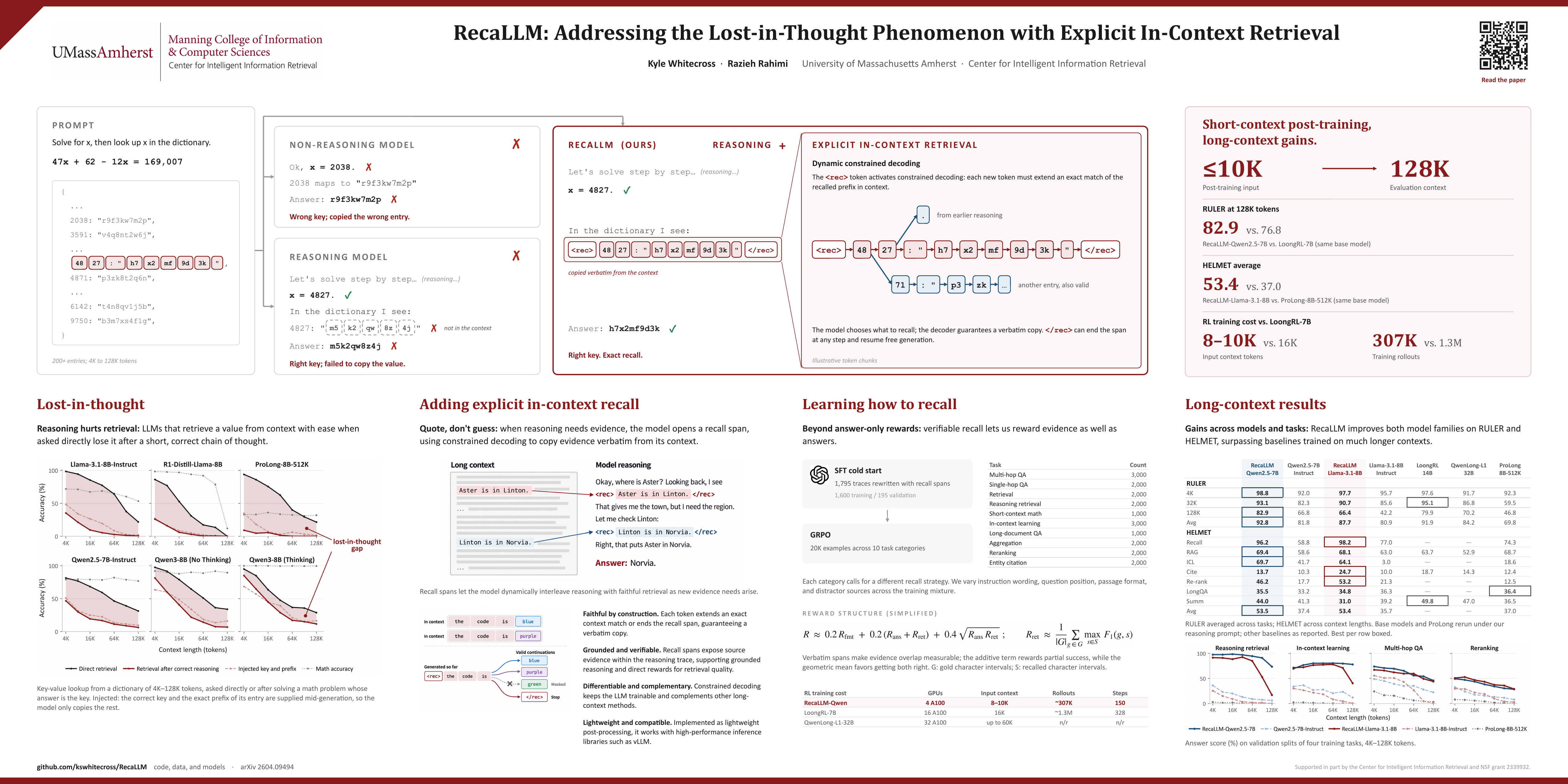
We propose RecaLLM, a set of reasoning language models post-trained to make effective use of long-context information. In-context retrieval, which identifies relevant evidence from context, and reasoning are deeply intertwined: retrieval supports reasoning, while reasoning often determines what must be retrieved. However, their interaction remains largely underexplored. In preliminary experiments on several open-source LLMs, we observe that in-context retrieval performance substantially degrades even after a short reasoning span, revealing a key bottleneck for test-time scaling that we refer to as lost-in-thought: reasoning steps that improve performance also make subsequent in-context retrieval more challenging. To address this limitation, RecaLLM interleaves reasoning with explicit in-context retrieval, alternating between reasoning and retrieving context information needed to solve intermediate subproblems. We further introduce a negligible-overhead constrained decoding that enables verbatim copying of evidence spans, improving the grounding of subsequent generation. Trained on diverse lexical and semantic retrieval tasks, RecaLLM achieves strong performance on two long-context benchmarks, RULER and HELMET, significantly outperforming baselines. Notably, we observe consistent gains at context windows of up to 128K tokens using training samples of at most 10K tokens, far shorter than those used by existing long-context approaches, highlighting a promising path toward improving long-context performance without expensive long-context training data.
Unable to Forget: Proactive Interference Reveals Working Memory Limits in LLMs Beyond Context Length
Chupei Wang ⋅ Jiaqiu Vince Sun
Large language models are often assumed to benefit from longer context windows, yet retrieval from context requires not only locating the target information but also suppressing competing information tied to the same cue. Inspired by the proactive interference (PI) paradigm in cognitive science, we introduce PI-LLM, an evaluation in which interleaved key-value updates are streamed and models are queried to retrieve only the final value of each key, therefore isolating interference rather than search as the primary variable. Across 35+ models ranging from 0.6B open-weight to frontier-scale proprietary systems, retrieval accuracy declines approximately log-linearly as repeated same-key updates accumulate, with errors dominated by outdated values. Similar log-linear degradation patterns emerge across multiple independent load dimensions, and persist when total input length is held constant, pointing to a working-memory-like bottleneck in maintaining and retrieving the current binding under interference; resistance scales with effective parameter size rather than context window length. This degradation is not alleviated by explicit "forget" instructions or chain-of-thought reasoning, and shows no sign of leveling off within the tested range, in contrast to the plateau observed in human PI studies. Together, these results suggest that LLMs' working-memory-like capacity, though large, is governed by less flexible control than the executive processes that support human resilience to interference.
Does Episodic Memory Help Close the Lexical Frequency Gap in Sensitivity to Syntactic Contrasts? A Test Using Retrieval-Augmented Language Models
Jing Liu ⋅ Najoung Kim
Grammatical knowledge and how it is empirically tested are typically considered robust to the frequency of the lexical items used in the expressions. Complementary Learning Systems theory proposes that hippocampal episodic memory, which enables rapid encoding and retrieval of specific experiences, allows learners to leverage those experiences when processing rare patterns. We test the hypothesis that robustness to lexical frequency can arise via such an episodic memory mechanism by evaluating whether retrieval-augmented language models (specifically, $k$-nearest-neighbor language models that augment parametric neural networks with explicit instance storage), help close the lexical frequency gap in syntactic contrasts that vanilla language models exhibit. Using syntactic contrasts with frequency-stratified test items, we find that retrieval augmentation leads to improvements for test instances containing low-frequency lexical items, consistent with episodic memory compensating for weak parametric representations. This benefit is consistent across different syntactic phenomena and across models pretrained on child-realistic and large-scale data. Additionally, we show that structural information is critical for effective retrieval, whereas semantic information is only responsible for minor gains. While these are promising proof-of-concept results supporting our hypothesis, the frequency gap remains not fully closed. Based on our analyses, we posit preferential reweighting of retrieved instances, better representations and retrieval strategies of structural information, and flexible configurations of storage and retrieval as promising future directions for improving the implementation of episodic memory in language models.
Asymmetric Idiosyncrasies in Multimodal Models
Muzi Tao ⋅ Chufan Shi ⋅ Huijuan Wang ⋅ Shengbang Tong ⋅ Xuezhe (Max) Ma
In this work, we study idiosyncrasies in the caption models and their downstream impact on text-to-image models. We design a systematic analysis: given either a generated caption or the corresponding image, we train neural networks to predict the originating caption model. Our results show that text classification yields very high accuracy (99.53%), indicating that captioning models embed distinctive stylistic signatures. In contrast, these signatures largely disappear in the generated images, with classification accuracy dropping to at most 50% even for the state-of-the-art Flux model. To better understand this cross-modal discrepancy, we further analyze the data and find that the generated images fail to preserve key variations present in captions, such as differences in the level of detail, emphasis on color and texture, and the distribution of objects within a scene. Overall, our classification-based framework provides a novel methodology for quantifying both the stylistic idiosyncrasies of caption models and the prompt-following ability of text-to-image systems.
LPDS: Evaluating LLM Robustness Through Logic-Preserving Difficulty Scaling
Philipp Mondorf ⋅ Samuel J Bell ⋅ Jesse Dodge ⋅ Dieuwke Hupkes
As large language models (LLMs) are increasingly deployed to perform tasks with minimal human oversight, it is crucial that these models operate robustly. In particular, a model that can solve a given problem should not fail simply because certain entities—such as names, numbers, or other contextual details—have changed while the underlying problem logic remains the same. Prior work suggests that current LLMs still struggle with this form of robustness: they often succeed on some variations of a problem but fail on others. However, existing evaluations often lack a systematic way to identify which logic-preserving variations are most likely to induce failure. Instead, they typically test a random subset of allowable variations, which can overstate robustness. To address this gap, we introduce logic-preserving difficulty scaling (LPDS), a framework that (i) quantifies the difficulty of a problem variation and (ii) systematically searches the space of allowable variations to find those that maximize difficulty and expose failures. We show that as difficulty increases, performance declines and errors in the models' reasoning chains become more pronounced. We further demonstrate that LPDS efficiently finds difficult problem variations for a model, resulting in performance drops up to $5\times$ larger compared to random sampling. Finally, we show that fine-tuning on more difficult variations leads to more consistent robustness gains than training on easier ones.
Are LLMs Robust Enough for Operations Research? An Adversarial Attack and Defense Study via AttackOR
Hanxi Zhu ⋅ Jingru Yu ⋅ Yan Teng ⋅ Jian Wang ⋅ Yi YU
Operations research (OR) solves complex real-world decision problems, from supply chain optimization to resource allocation, where errors carry real costs. LLMs are increasingly deployed to solve such problems by translating natural-language descriptions into optimization code. But how reliable are LLMs when problem descriptions are noisy, ambiguous, or deliberately misleading? We propose AttackOR, a unified framework for adversarial evaluation and robustness training in OR. We introduce four attack strategies that generate domain-consistent, instance-specific distractors to simulate the noisy and ambiguous inputs encountered in real-world OR: attribute injection, phantom options, arithmetic equivalence, and unit conversion. Experiments show that even a strong OR-tuned model is highly vulnerable, dropping from 59% to 40% Pass@1 under attack. To improve robustness, we combine supervised fine-tuning with GRPO-based reinforcement learning on adversarially augmented data. Our approach not only defends against adversarial inputs, achieving 71% Pass@1 under attack, but also improves performance on standard OR benchmarks, from 59% to 74%. Findings reveal that clean-benchmark performance alone is insufficient to guarantee the reliability of LLM-based OR solvers in practice.
ConformalGuard: False-Positive-Controlled Action Gating for LM Classifiers
Bishnu Bista ⋅ Dhanraj Haibatrao Jadhav ⋅ Vibha Choudhary ⋅ Gaurav Saxena ⋅ Arun Pandiyan Perumal ⋅ Arjun Subedi ⋅ Jignesh Ammineni
Language model classifiers are increasingly deployed for high-stakes decisions such as phishing screening, content moderation, and fraud triage, yet validation-set thresholds provide no finite-sample control of deployment-time false positives. We present ConformalGuard, a model-agnostic calibration layer that wraps a fixed scoring function with finite-sample control over the rate at which legitimate inputs trigger an intervention tier. Our contribution is empirical and operational, not a new conformal theorem: zero-shot LM API scores can be coarse enough (10–11 unique values here) to make temperature scaling and isotonic regression operationally identical to raw thresholding for low-FPR action gating. We compare these methods with conformal calibration for fine-tuned BERT, Claude Sonnet 4, and GPT-4o on public email corpora. For Claude, conformal calibration reduces FPR from 0.040 to 0.008 while recall falls from 0.938 to 0.875. For deterministic GPT-4o scores, the 1% operating point is too conservative to deploy (recall 0.564); three-run stochastic averaging raises recall to 0.732 at FPR 0.005. At 2% prevalence with BERT, conformal calibration removes 25 false-positive reviews per 10,000 emails (95% CI [10, 43]). The guarantee is legitimate-event-rate control under exchangeability; discrimination, workload effects, and robustness to shift remain empirical.
BAS: A Decision-Theoretic Approach to Evaluating Large Language Model Confidence
Sean Wu ⋅ Fredrik K. Gustafsson ⋅ Edward Phillips ⋅ Boyan Gao ⋅ Anshul Thakur ⋅ David A Clifton
Large language models (LLMs) often produce confident but incorrect answers in settings where abstention would be safer. Standard evaluation protocols, however, require a response and do not account for how confidence should guide decisions under different risk preferences. To address this gap, we introduce the Behavioral Alignment Score (BAS), a decision-theoretic metric for evaluating how well LLM confidence supports abstention-aware decision making. BAS is derived from an explicit answer-or-abstain utility model and aggregates realized utility across a continuum of risk thresholds, yielding a measure of decision-level reliability that depends on both the magnitude and ordering of confidence. We show theoretically that truthful confidence estimates uniquely maximize expected BAS utility, linking calibration to decision-optimal behavior. BAS is related to proper scoring rules such as log loss, but differs structurally: log loss penalizes underconfidence and overconfidence symmetrically, whereas BAS imposes an asymmetric penalty that strongly prioritizes avoiding overconfident errors. Using BAS alongside widely used metrics such as ECE and AURC, we then construct a benchmark of self-reported confidence reliability across multiple LLMs and tasks. Our results reveal substantial variation in decision-useful confidence, and while larger and more accurate models tend to achieve higher BAS, even frontier models remain prone to severe overconfidence. Importantly, models with similar ECE or AURC can exhibit very different BAS due to highly overconfident errors, highlighting limitations of standard metrics. We further show that simple interventions, such as top-$k$ confidence elicitation and post-hoc calibration, can meaningfully improve confidence reliability. Overall, our work provides both a principled metric and a comprehensive benchmark for evaluating LLM confidence reliability.
Pinocchio: Fast Uncertainty Estimates for Black-Box Language Models
Kevin D Hayes ⋅ Arka Pal ⋅ Haosong Zhang ⋅ Tom Goldstein ⋅ Micah Goldblum
In high-stakes decision-making applications of large language models (LLMs), practitioners require not only accurate LLMs but also uncertainty estimates for their predictions. Existing approaches to uncertainty estimation for LLMs require access to log-probabilities output by the model or require fine-tuning access. However, the vast majority of industrial LLM products use closed-source API models, and many such API models like GPT-5 do not return log-probabilities and may not allow fine-tuning. We introduce PINOCCHIO, a suite of 8B checkpoints for assigning uncertainty estimates to predictions made by popular API models. To this end, we curate a large collection of hard datasets, ranging from long-context to vision-language, that expose conditions under which frontier models output incorrect responses. We then train PINOCCHIO to recognize the patterns in prompts and model responses that indicate confidence or uncertainty. PINOCCHIO checkpoints significantly outperform existing baselines for black-box uncertainty estimation in calibration metrics and transfer to unseen model families, including OpenAI, Qwen, Meta, Anthropic, Google, and Moonshot, whose responses they were not trained on. We release code for adding uncertainty estimation to existing repos in only two additional lines of code.
FERA: Uncertainty-Aware Federated Reasoning for Large Language Models
Ruhan Wang ⋅ Chengkai Huang ⋅ Zhiyong Wang ⋅ Junda Wu ⋅ Rui Wang ⋅ Tong Yu ⋅ Julian McAuley ⋅ Lina Yao ⋅ Dongruo Zhou
Large Language Models (LLMs) exhibit strong multi-step reasoning, but their inference-time performance depends critically on the quality of available reasoning traces. In many realistic settings, such traces are generated by multiple clients holding private and heterogeneous data, motivating the problem of federated reasoning, where a server aggregates client-generated reasoning without centralized training or data sharing. A key challenge is that client reasoning quality is highly query-dependent, and naive aggregation can amplify miscalibrated confidence and correlated reasoning errors. We propose Uncertainty-Aware Federated Reasoning (FERA), a training-free framework that aggregates client reasoning using query-dependent trust weights derived from uncertainty signals, rather than treating all client outputs equally. We instantiate FERA with Uncertainty-Aware Self-Critique Aggregation (UA-SCA), which leverages structured self-critique and cross-client verification to identify unsupported reasoning steps and downweight high-confidence but weakly justified traces. We provide theoretical guarantees on the convergence of the resulting trust-weighted aggregation and demonstrate on multiple reasoning benchmarks that FERA consistently improves accuracy over standard ensembling baselines, while requiring minimal communication and no model updates.
KoSimpleQA: A Korean Factuality Benchmark with an Analysis of Reasoning LLMs
Donghyeon Ko ⋅ Kyubyung Chae ⋅ Yeguk Jin ⋅ Byungwook Lee ⋅ Chansong Jo ⋅ Sookyo In ⋅ Jaehong Lee ⋅ Taesup Kim ⋅ Donghyun Kwak
We present $\textbf{Korean SimpleQA (KoSimpleQA)}$, a benchmark for evaluating factuality in large language models (LLMs) with a focus on Korean cultural knowledge. KoSimpleQA is designed to be challenging yet easy to grade, consisting of 938 short, fact-seeking questions with unambiguous answers. We conduct a comprehensive evaluation across a diverse set of open-source LLMs of varying sizes that support Korean, and find that even the strongest model generates correct answer only 31.6\% of the time, underscoring the challenging nature of KoSimpleQA. Notably, performance rankings on KoSimpleQA differ substantially from those on the English SimpleQA, highlighting the unique value of our dataset. Furthermore, we observe that reasoning helps mitigate the cross-lingual knowledge gap in LLMs, which refers to disparities in their ability to manifest knowledge across languages. KoSimpleQA can be found at https://github.com/naver-ai/KoSimpleQA.
Learning to Learn from Language Feedback with Social Meta-Learning
Jonathan Cook ⋅ Diego Antognini ⋅ Martin Klissarov ⋅ Claudiu C Musat ⋅ Edward Grefenstette
While large language models (LLMs) excel at processing static knowledge, they often struggle to adapt their behaviour based on language feedback. Current training paradigms rely on static corpora and fully defined tasks, overlooking the interactive feedback loops essential for learning to adapt. In this work, we regard learning from language feedback as a capability to be meta-learned. We introduce Social Meta-Learning (SML), an algorithm that transforms single-trial verifiable tasks into multi-trial teacher-student interactions driven by information asymmetry. During meta-training, a teacher model is given privileged information, such as a ground truth solution, and prompted to provide language feedback to the student after an incorrect solution attempt. This partial observability from the perspective of the student incentivises adaptation between trials, allowing us to train models to iteratively refine their solutions by integrating external guidance. Our experiments demonstrate that online reinforcement learning performs better as the outer loop learning algorithm than offline supervised finetuning. Once learned, the ability to learn from language feedback transfers across domains. Furthermore, we identify asking questions as a cognitive behaviour that improves transfer to tasks that are initially underspecified at test time. By repurposing static tasks as interactive social learning environments, SML provides a scalable path towards LLMs capable of learning and improving on their raw parametric capabilities during deployment.
In-Context Exploration-Exploitation is Biased by Semantic Priors
David Austin ⋅ Kaheer Suleman ⋅ Jackie Cheung
Large language models (LLMs) are increasingly deployed as decision-making agents in settings that require sophisticated environmental exploration. However, existing work has raised questions about how LLMs actually balance exploration and exploitation. Unlike classical agents, LLM agents engage with tasks through natural language, exposing them to semantic information with no formal counterpart in the task structure. We introduce the semantic bandit, an extension of the multi-armed bandit setting that explicitly considers the textual labels assigned to actions, and use it to study how semantic priors --- inductive biases arising from associations between language and expected reward learned during pre-training, shape LLM exploration behaviour. We find that semantically informative action labels reduce exploration in favour of exploitation, improving performance when aligned with the reward structure and severely degrading it when misaligned. We further find that negative rewards trigger substantially more exploration than equivalent positive rewards, consistent with an expected-scale bias induced by reward conventions common in pre-training data. Overall, we argue that the use of language to define the environment and rewards introduces unavoidable biases derived from the fact that the model is trained on word co-occurence, with implications for the reliability and robustness of LLM agents in real-world decision-making settings.
ContextBudget: Budget-Aware Context Management for Long-Horizon Search Agents
Yong Wu ⋅ Yanzhao Zheng ⋅ Tianze Xu ⋅ Zhentao Zhang ⋅ Yuanqiang Yu ⋅ Jihuai Zhu ⋅ Chao Ma ⋅ Binbin Lin ⋅ Baohua Dong ⋅ Hangcheng Zhu ⋅ Ruohui Huang ⋅ Gang Yu
LLM-based agents show strong potential for long-horizon reasoning, yet their context size is limited by deployment factors (e.g., memory, latency, and cost), yielding a constrained context budget. As interaction histories grow, this induces a trade-off between retaining past information and staying within the context limit. To address this challenge, we propose Budget-Aware Context Management (BACM), which formulates context management as a sequential decision problem with a context budget constraint. It enables agents to assess the available budget before incorporating new observations and decide when and how much of the interaction history to compress. We further develop BACM-RL, an end-to-end curriculum-based reinforcement learning approach that learns compression strategies under varying context budgets. Experiments on compositional multi-objective QA and long-horizon web browsing benchmarks show that BACM-RL consistently outperforms prior methods across model scales and task complexities, achieving over $1.6\times$ gains over strong baselines in high-complexity settings, while maintaining strong advantages as budgets shrink, where most methods exhibit a downward performance trend.
Source-Modality Monitoring in Vision-Language Models
Etha Tianze Hua ⋅ Tian Yun ⋅ Ellie Pavlick
We define and investigate source-modality monitoring -- the ability of multimodal models to track and communicate the input source from which pieces of information originate. We consider source-modality monitoring as an instance of the more general binding problem, and evaluate the extent to which models exploit syntactic vs. semantic signals in order to bind words like image in a user-provided prompt to specific components of their input and context (i.e., actual images). Across experiments spanning 11 vision-language models (VLMs) performing target-modality information retrieval tasks, we find that both syntactic and semantic signals play an important role, but that the latter tend to outweigh the former in cases when modalities are highly distinct distributionally. We discuss the implications of these findings for model robustness, and in the context of increasingly multimodal agentic systems.
Latent Context Compilation: Distilling Long Context into Compact Portable Memory
Zeju Li ⋅ Yizhou Zhou ⋅ Qiang Xu
Efficient long-context LLM deployment is stalled by a dichotomy between amortized compression, which struggles with out-of-distribution generalization, and Test-Time Training, which incurs prohibitive synthetic data costs and requires modifying model weights, creating stateful parameters that complicate concurrent serving. We propose Latent Context Compilation, a framework that fundamentally shifts context processing from adaptation to compilation. By utilizing a disposable LoRA module as a compiler, we distill long contexts into compact buffer tokens---stateless, portable memory artifacts that are plug-and-play compatible with frozen base models. Crucially, we introduce a self-aligned optimization strategy that eliminates the need for synthetic context-relevant QA pairs. By regularizing context reconstruction task with context-agnostic random queries, we force compressed tokens to reside within the model's existing instruction-following manifold. Experiments with Llama-3.1-8B and Qwen3-8B demonstrate that Latent Context Compilation preserves fine-grained details and reasoning capabilities where prior methods falter, effectively decoupling memory density from model parameters even at 16x or 32x compression ratio.
A Self-Pruning Transformer: Extreme KV-Cache Compression with Universal Attention
Davis Wertheimer ⋅ Haochen Shen ⋅ Ahan Gupta ⋅ Derrick Liu ⋅ Yu Chin Fabian Lim ⋅ Mudhakar Srivatsa ⋅ Raghu K Ganti ⋅ Minjia Zhang ⋅ Naigang Wang
The large KV-cache size of modern LLMs creates a barrier to efficient deployment. Recent work has explored replacing attention layers' RoPE positional embeddings with alternative decay-based mechanisms, which can then be used to prune KV-cache during inference. However, these decay functions have limited expressivity, and in practice devolve into sliding-window-like eviction patterns. In this work, we propose a unifying framework for complementary and novel decay mechanisms, capturing complex key statistics and interactions while preserving expressive RoPE embeddings and Softmax attention. The resulting *Universal Attention* is a highly expressive and end-to-end trainable architecture, whose composite decay mechanism acts as a natural, *adaptive* pruning criterion, removing tokens that contribute least to attention computation. Experimentally, Universal Attention achieves state-of-the-art $10\times$ compression on natural language and synthetic task data, while *improving* downstream performance compared to both state-of-the-art baselines and unpruned oracles. It further demonstrates superior long-context generalization with unprecedented $25\times$ compression at length 16k.
HISA: Efficient Hierarchical Indexing for Fine-Grained Sparse Attention
Yufei Xu ⋅ Fanxu Meng ⋅ Fan Jiang ⋅ Yuxuan Wang ⋅ Ruijie Zhou ⋅ Zhaohui Wang ⋅ Jiexi Wu ⋅ Zhixin Pan ⋅ Xiaojuan Tang ⋅ Wenjie Pei ⋅ Tongxuan Liu ⋅ di yin ⋅ Xing Sun ⋅ Muhan Zhang
Token-level sparse attention mechanisms, exemplified by DeepSeek Sparse Attention (DSA), achieve fine-grained key selection by scoring every historical key for each query through a lightweight indexer, then computing attention only on the selected subset. While the downstream sparse attention itself scales favorably, the indexer must still scan the entire prefix for every query, introducing an $\mathcal{O}(L^2)$ per-layer bottleneck that grows prohibitively with context length. We propose HISA (Hierarchical Indexed Sparse Attention), a plug-and-play replacement for the indexer that rewrites the search path from a flat token scan into a two-stage hierarchical procedure: (1) a block-level coarse filtering stage that scores pooled block representations to discard irrelevant regions, followed by (2) a token-level refinement stage that applies the original indexer exclusively within the retained candidate blocks. HISA preserves the token-level top-$k$ index interface consumed by the downstream Sparse MLA operator and requires no additional training. In end-to-end serving with DeepSeek-V3.2, HISA improves throughput by $1.65\times$ and time to first token by $1.70\times$ over the official DSA implementation, despite the HISA-specific operators being implemented in TileLang/Triton while the official DSA baseline uses highly optimized hand-tuned CUDA kernels. With matched TileLang implementations of both indexers, controlled microbenchmarks show up to $3.75\times$ indexer speedup at 64K context. On Needle-in-a-Haystack and LongBench, we directly replace the indexer in DeepSeek-V3.2 and GLM-5 with our HISA indexer, without any finetuning. HISA closely matches the original DSA in quality, while substantially outperforming block-sparse baselines.
Gaze Attention: Query-Adaptive Visual Routing for Efficient Multimodal LLMs
Junha Song ⋅ Byeongho Heo ⋅ Geonmo Gu ⋅ Jaegul Choo ⋅ Dongyoon Han ⋅ Sangdoo Yun
When humans describe a visual scene, they do not process the entire image uniformly; instead, they selectively fixate on regions relevant to their intended description. In contrast, current multimodal large language models (MLLMs) attend to all visual tokens at each generation step, leading to diluted focus and unnecessary computational overhead. In this work, we introduce Gaze Attention, a novel mechanism that enables MLLMs to selectively attend to task-relevant visual regions during generation. Specifically, we spatially group visual embeddings—stored as key-value caches—into compact gaze regions, each represented by a lightweight descriptor. At each decoding step, the model dynamically selects the most relevant regions and restricts attention to them, reducing redundant computation while enhancing focus. To mitigate the loss of global context caused by localized attention, we further propose learnable context tokens appended to each image or frame, allowing the model to maintain holistic visual awareness. Extensive experiments on image and video understanding benchmarks demonstrate that Gaze Attention matches or surpasses dense-attention baselines, while reducing the visual KV cache size by up to 90%.
We propose to fine-tune vision-language models to generate more pragmatically-optimal referring expressions by transforming observations of incremental listener comprehension, in the form of gaze scanpaths, into learning signals. During training, referring expressions are sampled from the speaker policy being optimized, conditioned on images and target referents; then, a neural listener estimating human gaze behavior maps from images and sampled referring expressions to scanpaths, each represented by a sequence of fixations, with each fixation corresponding to a word in the referring expression. We experiment with several approaches to convert fixation sequences and target referents into word- and sequence-level rewards, which are used to optimize policy parameters. Through evaluation with human listeners, we find that speaker policies trained with gaze-estimating listeners result in significantly more pragmatically-optimal references than base models, reducing sequence length from 15.4 down to 4.0 words while increasing referential success from 75.2 up to 80.0%. Our work demonstrates a promising opportunity for learning to generate utterances through language-based interaction, not only from the explicit signal of communicative success, but also from implicitly-available observations of a listener's process of comprehension.
Improving GUI Grounding with Explicit Position-to-Coordinate Mapping
Suyuchen Wang ⋅ TIANYU ZHANG ⋅ Ahmed Masry ⋅ Christopher Pal ⋅ Spandana Gella ⋅ Bang Liu ⋅ Perouz Taslakian
GUI grounding, the task of mapping natural-language instructions to pixel coordinates, is crucial for autonomous computer-use agents (CUA) yet remains difficult for current VLMs. The core bottleneck is reliable patch-to-pixel mapping: current approaches generate coordinates as text tokens directly from visual features, forcing the model to infer complex position-to-pixel mappings implicitly. This implicit regression is unstable and breaks when extrapolating to high-resolution displays unseen during training. We address this with RULER tokens, explicit coordinate markers that share positional embeddings with image patches, letting the model reference known positions and adjust within a bounded range rather than regress coordinates from scratch. We also propose Interleaved MRoPE (I-MRoPE), which corrects a frequency imbalance in standard positional encodings so that width and height dimensions receive equal representational capacity. Experiments on ScreenSpot, ScreenSpot-V2, and ScreenSpot-Pro show consistent grounding improvements, with the largest gains on high-resolution displays unseen during training (+2.6% on ScreenSpot-Pro), achieved with less than 1% additional tokens.
v1: Learning to Point Visual Tokens for Multimodal Mathematical Grounded Reasoning
Jiwan Chung ⋅ Junhyeok Kim ⋅ Siyeol Kim ⋅ Jaeyoung Lee ⋅ Min Soo Kim ⋅ Youngjae Yu
When thinking with images, humans rarely rely on a single glance: they revisit visual evidence while reasoning. In contrast, most Multimodal Language Models encode an image once to key-value cache and then reason purely in text, making it hard to re-ground intermediate steps. We empirically confirm this: as reasoning chains lengthen, models progressively lose focus on relevant regions. We introduce v1, a lightweight extension for active visual referencing via point-and-copy: the model selects relevant image patches and copies their embeddings back into the reasoning stream. Crucially, our point-and-copy mechanism retrieves patches using their semantic representations as keys, ensuring perceptual evidence remains aligned with the reasoning space. To train this behavior, we build v1g, a dataset of 300K multimodal reasoning traces with interleaved grounding annotations. Across multimodal mathematical reasoning benchmarks, v1 consistently outperforms comparable baselines.
To See the Unseen: on the Generalization Ability of Transformers in Symbolic Reasoning
Nevena Lazic ⋅ Liam H Fowl ⋅ András György ⋅ Csaba Szepesvari
We investigate the ability of decoder-only transformer models to perform abstract symbolic reasoning; specifically solving propositional logic reasoning problems given in-context. Previous work demonstrated that models fail to generalize to problems involving variable names that were not observed during training, and it was shown that one reason behind this is the difficulty of copying (or generating) unseen tokens. We show both theoretically and empirically that a particular representational collapse also plays a crucial role: the unembeddings (last-layer weights) of unseen tokens collapse to nearly the same vector during training. The collapse makes distinguishing multiple unseen variables difficult for the model (especially when the embedding and unembedding parameters are shared), and provides a mechanistic explanation for the effectiveness of existing heuristic interventions like "active forgetting", which periodically reset the token (un)embeddings. Based on these observations, we devise a combination of techniques, involving a small architecture change facilitating copying, data diversity, and freezing or resetting (un)embeddings, that achieves generalization to unseen tokens. We support our claims with extensive controlled experiments on propositional logic reasoning problems. Beyond synthetic experiments, we also observe evidence of (un)embedding collapse in the open-weight models in the Gemma 3 family, which includes 99 unused tokens reserved for downstream use. Empirically we find that the correlated embeddings of these tokens are a poor initialization for finetuning applications.
Thinking to Recall: How Reasoning Unlocks Parametric Knowledge in LLMs
Zorik Gekhman ⋅ Roee Aharoni ⋅ Eran Ofek ⋅ Mor Geva ⋅ Roi Reichart ⋅ Jonathan Herzig
While reasoning in LLMs plays a natural role in math, code generation, and multi-hop factual questions, its effect on simple, single-hop factual questions remains unclear. Such questions do not require step-by-step logical decomposition, making the utility of reasoning highly counterintuitive. Nevertheless, we find that enabling reasoning substantially expands the capability boundary of the model's parametric knowledge recall, unlocking correct answers that are otherwise effectively unreachable. Why does reasoning aid parametric knowledge recall when there are no complex reasoning steps to be done? To answer this, we design a series of hypothesis-driven controlled experiments, and identify two key driving mechanisms: (1) a computational buffer effect, where the model uses the generated reasoning tokens to perform latent computation independent of their semantic content; and (2) factual priming, where generating topically related facts acts as a semantic bridge that facilitates correct answer retrieval. Importantly, this latter generative self-retrieval mechanism carries inherent risks: we demonstrate that hallucinating intermediate facts during the reasoning process increases the likelihood of hallucinations in the final answer. Finally, we show that these insights can be harnessed to directly improve overall model accuracy by prioritizing reasoning trajectories that contain hallucination-free factual statements.
Reasoning over Non-Parametric Memory in Multilingual LLMs: A Cognitive-Based Analysis of Relational Knowledge
Zohreh A Liasi ⋅ Batoul Hammoud ⋅ Anas Madkoor ⋅ Ehsaneddin Asgari
We introduce WIKI-BLOOM, a multilingual diagnostic benchmark for evaluating how large language models reason over supplied relational knowledge, with the goal of separating evidence-conditioned reasoning from memorized entity associations. WIKI-BLOOM contains 450 multiple-choice questions grounded in 30 curated Wikidata relations, instantiated under factual, counterfactual, and neutralized conditions and spanning five levels adapted from Bloom's revised taxonomy: Remember, Understand, Apply, Analyze, and Evaluate. We evaluate 43 models, 41 open-weight models across eight series and two closed-weight Gemini models, in six languages (Arabic, Chinese, English, Hindi, Persian, and Spanish) and two multilingual settings, yielding 226,800 predictions. Statistical inference is clustered at the level of the 30 source relations. Several concrete patterns emerge. Open-weight families consistently exhibit an Apply-to-Analyze accuracy drop, but its magnitude varies substantially with family and scale and disappears entirely for both Gemini models. Evaluate, however, remains a persistent bottleneck even when the earlier cliff has closed. Gemini 3.1 Pro, for example, averages 99.5\% across Remember, Understand, Apply, and Analyze, but only 60.7\% on Evaluate. Item-difficulty rankings are significantly stable across languages in every evaluated family and size bucket, and relation-difficulty hierarchies show similarly strong cross-language stability. The interaction between parametric knowledge and supplied context also changes with cognitive demand. The Neutralized-over-Factual advantage is often larger at Analyze and Evaluate than at Remember and Understand, with gains reaching more than 20 percentage points in some settings, suggesting that entity-specific associations become increasingly disruptive as reasoning demands increase. Counterfactual contexts are generally the weakest condition, and the factual--counterfactual gap widens with cognitive complexity in several model families, including both Gemini models, showing that context conflict can remain damaging even near ceiling performance. Together, these results show that increasing model capability alone does not eliminate failures in cognitively demanding use of supplied knowledge, and that the structure of these failures is remarkably stable across languages.
When Seeing Overrides Knowing: Visual Dominance and Deferral-Based Method for Personalized Safety in VLMs
Edward Sun ⋅ Yuchen Wu ⋅ Zixian Ma ⋅ Eric H Jiang ⋅ Yijia Xiao ⋅ Xiaoyuan Yi ⋅ Ranjay Krishna ⋅ Wei Wang ⋅ Jindong Wang ⋅ Aylin Caliskan
Vision-language models (VLMs) are increasingly deployed in high-stakes settings, where a response that is reasonable in general may still be unsafe for a particular user whose medical, emotional, or situational context is unknown to the model. We study this problem of personalized safety in multimodal systems and introduce MPS-Bench, a benchmark of 5,181 scenarios from 584 real-world images across 12 high-risk domains, each paired with a hidden user profile. Evaluating eight frontier VLMs, we find that they almost always respond directly (86--99\%) rather than seek missing context, and none exceeds 2.6/5 on personalized safety. To understand why these failures arise, we analyze multimodal interactions and identify visual dominance: visual information enters text representations early and suppresses textual risk signals during multimodal fusion. Causal interventions reveal a two-stage mechanism in which visual affect is first transferred into the text stream in early layers and then shapes the final decision through this altered text representation, making late-stage internal remediation unreliable. Motivated by this mechanism, we propose PRISM, a lightweight input monitor that uses bidirectional cross-modal modulation to predict when a query is likely to require deferral. PRISM achieves 0.978 AUC and strictly dominates the safety--utility Pareto frontier across all tested models.
Uncovering the computational ingredients that support human-like conceptual representations in large language models
Zach Studdiford ⋅ Timothy T Rogers ⋅ Kushin Mukherjee ⋅ Siddharth Suresh
The human ability to translate diverse perceptual and linguistic inputs into structured behavior has been thought to rest on learning robust representations of concepts. The rapid advancement of transformer-based large language models (LLMs) has surfaced a diversity of computational ingredients relevant for model building — architectures, fine-tuning methods, and training datasets among others — yet it remains unclear which are most crucial for developing human-like conceptual representations. Further, most current benchmarks are ill-suited to measuring representational alignment, making LLMs' scores on them unreliable for assessing whether they are progressing as cognitive models. We address these limitations by evaluating over 75 models on a triplet similarity task, a method well established in cognitive science for measuring conceptual representations, using concepts from the THINGS database. We find that instruction fine-tuning and larger attention head dimensionality are among the strongest predictors of human alignment, while activation function choice, multimodal pretraining, and parameter size have limited influence on alignment. Correlations between alignment scores and existing benchmark scores reveal that while some benchmarks (e.g., BigBenchHard) better capture representational alignment than others (e.g., MUSR), none fully accounts for the variance in human-model alignment, demonstrating their insufficiency. Taken together, our findings highlight key computational ingredients for advancing LLMs as models of human conceptual representation and address a key gap in LLM evaluation.
Large Language Models Align with the Human Brain during Creative Thinking
Mete Ismayilzada ⋅ Simone A Luchini ⋅ Abdulkadir Gokce ⋅ Badr AlKhamissi ⋅ Antoine Bosselut ⋅ Antonio Laverghetta Jr. ⋅ Lonneke v Plas ⋅ Roger Beaty
Creative thinking is a fundamental aspect of human cognition, and divergent thinking—the capacity to generate novel and varied ideas—is widely regarded as its core generative engine. Large language models (LLMs) have recently demonstrated impressive performance on divergent thinking tests and prior work has shown that models with higher task performance tend to be more aligned to human brain activity. However, existing brain-LLM alignment studies have focused on passive, non-creative tasks. Here, we explore brain alignment during creative thinking using fMRI data from 170 participants performing the Alternate Uses Task (AUT). We extract representations from LLMs varying in size (270M–72B) and measure alignment to brain responses via Representational Similarity Analysis (RSA), targeting the creativity-related default mode and frontoparietal networks. We find that brain-LLM alignment is positively associated with model size (default mode network only) and with idea originality (both networks), with these relationships clearest early in the creative process. We further find that post-training objectives are associated with functionally selective differences in alignment: a creativity-optimized Llama-3.1-8B-Instruct retains alignment with high-creativity neural responses while lacking the positive low-creativity alignment present in other variants, but a reasoning-trained variant shows the opposite asymmetry, with negative alignment to high-creativity responses. Together, these results suggest that brain alignment offers an informative lens on how post-training relates to the neural geometry of human creative thought.
CreativityBench: Evaluating Creative Reasoning via Affordance-Based Tool Repurposing
Cheng Qian ⋅ Hyeonjeong Ha ⋅ Jiayu Liu ⋅ Bingxiang He ⋅ Jeonghwan Kim ⋅ Jiateng Liu ⋅ Bingxuan Li ⋅ Aditi Tiwari ⋅ Dwip Dalal ⋅ Zhenhailong Wang ⋅ Xiusi Chen ⋅ Aleksey Panasyuk ⋅ Mahdi Namazifar ⋅ Yunzhu Li ⋅ Heng Ji
Recent advances in large language models (LLMs) have enabled strong performance in reasoning and environment-interaction, yet their ability for creative problem solving remains underexplored. One core form of such creativity is tool use: repurposing objects by reasoning about their affordances and attributes rather than relying on canonical usage. To study this capability, we introduce CreativityBench, a benchmark for affordance-based creative tool use. It is built on a large-scale affordance knowledge base containing 4K entities and 150K+ annotations linking objects, parts, attributes, and uses, from which we generate 14K grounded tasks requiring non-obvious but physically plausible solutions under constraints. Evaluation across 10 closed and open-source LLMs reveal a consistent gap: while models often select plausible objects, they fail to identify the correct parts, affordances, and underlying physical mechanism. Moreover, general reasoning ability does not reliably transfer to creative affordance discovery, gains from scaling quickly saturate, and Chain-of-Thought yields limited benefit. These findings highlight creative tool use as a missing dimension in current LLMs capabilities, and position CreativityBench as a systematic testbed for advancing creative intelligence in future LLMs and embodied agents.
The Tool Illusion: Rethinking Tool Use in Web Agents
Renze Lou ⋅ Baolin Peng ⋅ Wenlin Yao ⋅ Qianhui Wu ⋅ Hao Cheng ⋅ Suman Nath ⋅ Wenpeng Yin ⋅ Jianfeng Gao

As web agents rapidly evolve, an increasing body of work has moved beyond conventional atomic browser interactions and explored tool use as a higher-level action paradigm. Although prior studies have shown the promise of tools, their conclusions are often drawn from limited experimental scales and sometimes non-comparable settings. As a result, several fundamental questions remain unclear: i) whether tools provide consistent gains for web agents, ii) what practical design principles characterize effective tools, and iii) what side effects tool use may introduce. To establish a stronger empirical foundation for future research, we revisit tool use in web agents through an extensive and carefully controlled study across diverse tool sources, backbone models, tool-use frameworks, and evaluation benchmarks. Our findings both revise some prior conclusions and complement others with broader evidence. We hope this study provides a more reliable empirical basis and inspires future research on tool-use web agents.
CollabSkill: Evaluating Human-Agent Collaboration On Real-World Tasks
Yijia Shao ⋅ Zora Wang ⋅ Neel Ahuja ⋅ Yicheng Wang ⋅ Bowen Liu ⋅ Diyi Yang
AI agents are reshaping the workspace, leading to drastic change of how humans work. Despite the considerable potential of human-agent collaboration both in preserving human agency and generating economic value, this paradigm remains largely absent from occupational task evaluation, hindered by the difficulty of gathering real human data and accounting for inter-human variability. We introduce CollabSkill, a framework for evaluating human-agent collaboration on real-world occupational tasks. CollabSkill pairs real human workers with AI agents on tasks matched to their occupational background, collecting data that capture the complexity of economically valuable tasks and the usage patterns of real workers. To account for inter-human variability, CollabSkill employs a Bayesian skill rating system to disentangle and quantify the skill contributions of both humans and AI agents. Drawing on over 1,500 prompts from 386 working sessions contributed by 93 human workers, our analysis yields insights on two fronts: on the agent side, rankings on CollabSkill diverge meaningfully from those of existing fully autonomous benchmarks where Codex leads, with Claude Code ranking first; on the human side, CollabSkill reveals that practical experience emerges as the primary driver of collaboration skill, with hands-on collaboration meaningfully shifting workers' AI literacy. Together, we hope CollabSkill enables the community to invest in systematic evaluation of human-agent collaboration and spurs development efforts aimed at building AI agents that genuinely augment human workers.
SkillLearnBench: Benchmarking Continual Learning Methods for Agent Skill Generation on Real-World Tasks
Shanshan Zhong ⋅ Yi Lu ⋅ Jingjie Ning ⋅ Yibing Wan ⋅ Lihan Feng ⋅ Yuyi Ao ⋅ Leonardo F Ribeiro ⋅ Markus Dreyer ⋅ Sean Ammirati ⋅ Chenyan Xiong
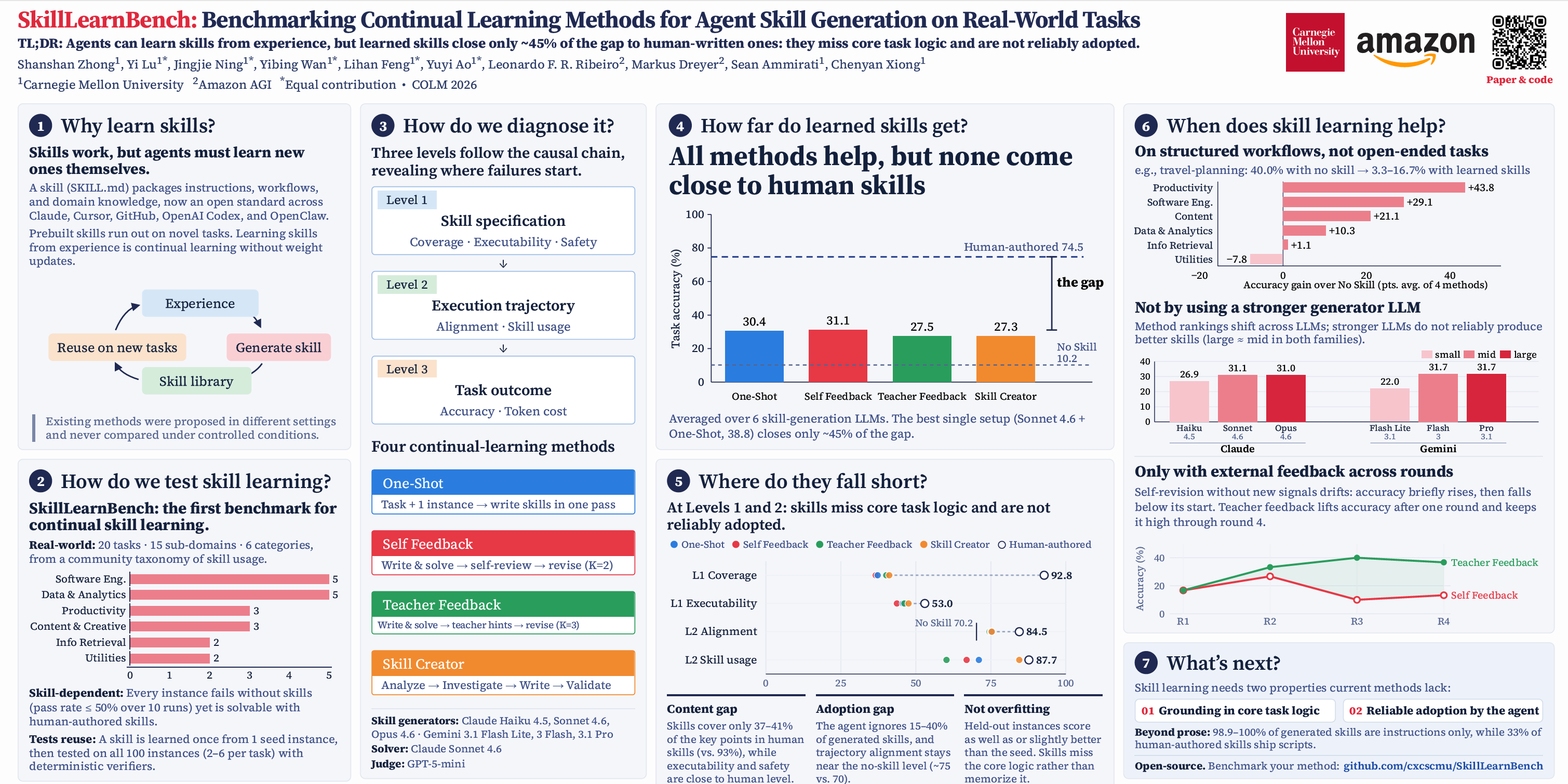
Skills have become the de facto way to enable LLM agents to perform complex real-world tasks with customized instructions, workflows, and tools, but how to learn them automatically and effectively remains unclear. We introduce SkillLearnBench, the first benchmark for evaluating continual skill learning methods, comprising 20 verified, skill-dependent tasks across 15 sub-domains derived from a real-world skill taxonomy , evaluated at three levels: skill quality, execution trajectory, and task outcome. Using this benchmark, we evaluate recent continual learning techniques, those leveraging one-shot, self/teacher feedback, and skill creator to generate skills from agent experiences. We find that all continual learning methods improve over the no-skill baseline, yet consistent gains remain elusive: no method leads across all tasks and LLMs, and scaling to stronger LLMs does not reliably help. Continual learning improves tasks with clear, reusable workflows but struggles on open-ended tasks, and using stronger LLM backbones does not consistently produce better skills. Our analysis also revealed that multiple iterations in continual learning facilitate genuine improvement via external feedback, whereas self-feedback alone induces recursive drift. Our data and code are open-source at https://github.com/cxcscmu/SkillLearnBench to enable further studies of automatic skill generation and continual learning techniques.
Skills are a natural unit for describing what a language model can do and how its behavior can be changed. However, existing characterizations rely on human-written taxonomies, textual descriptions, or manual profiling pipelines---all external hypotheses about what matters that need not align with the model's internal representations. We argue that when the goal is to intervene on model behavior, skill characterization should be \emph{model-native}: grounded in the model's own representations rather than imposed through external ontologies. We instantiate this view by recovering a compact orthogonal basis from sequence-level activations. The resulting basis is semantically interpretable but need not correspond to any predefined human ontology; instead, it captures axes of behavioral variation that the model itself organizes around. We validate this characterization on reasoning post-training, using the recovered basis for both supervised fine-tuning data selection and inference-time steering. We develop lightweight proxy interventions to identify which directions are most useful for a given model. Across Llama3-8B and Qwen2.5-3B, selecting data along those directions improves Pass@1 by up to 20\% on MATH-500 and 41\% on AMC, outperforming data selection based on human-characterized skills. Because the basis lives in activation space, the same directions also serve as steering vectors at inference time, improving Pass@8 by up to 4.8\% on MATH-500---an intervention that human-characterized skills cannot support. We further validate the characterization on safety alignment, where selecting adversarial training data for model-native skill coverage rather than textual diversity yields more sample-efficient learning. These results suggest that recovering skills from the model's own representations, rather than imposing them externally, provides a more effective foundation for intervening on model behavior. Codes are open-sourced.
Capability Provenance in Language Models: A Case Study in Social Reasoning
Glenn Matlin ⋅ Chandreyi Chakraborty ⋅ Saehee Eom ⋅ Mika Okamoto ⋅ Rayan Castilla ⋅ Louis Jaburi ⋅ Alvin Deng ⋅ Taywon Min ⋅ Lucia Quirke ⋅ Stella Biderman ⋅ Mark Riedl
We use training-data attribution as an interpretable tool for capability discovery, mapping which regions of the pretraining corpus support social reasoning versus STEM reasoning in OLMo3-7B. Training-data attribution measures how strongly each training document influences a model's predictions on a benchmark, but document-level scores are too noisy to identify which corpus regions support which capabilities. We compute gradient-based attribution (TrackStar via Bergson) over a working set drawn from the de-duplicated Dolma3 mix, aggregate influence across WebOrganizer's 24-format $\times$ 24-topic taxonomy (576 bins), and contrast benchmark pairs in a $2{\times}2$ design that varies domain (social vs. STEM) and capability type (reasoning vs. knowledge): SocialIQA and MMLU Social Sciences against ARC-Challenge and MMLU STEM. Social and STEM reasoning draw on qualitatively distinct corpus regions, and the contrast is sharper at the reasoning level than at the knowledge level. Targeted machine unlearning provides partial causal validation: forgetting high-attribution topics (e.g., Literature for SocialIQA) degrades the aligned benchmark more than within-topic random baselines. We open-source all code, data artifacts, influence scores, and checkpoints at https://github.com/HCAI-Lab-GT/capabilibara and https://huggingface.co/HCAI-Lab-GT.
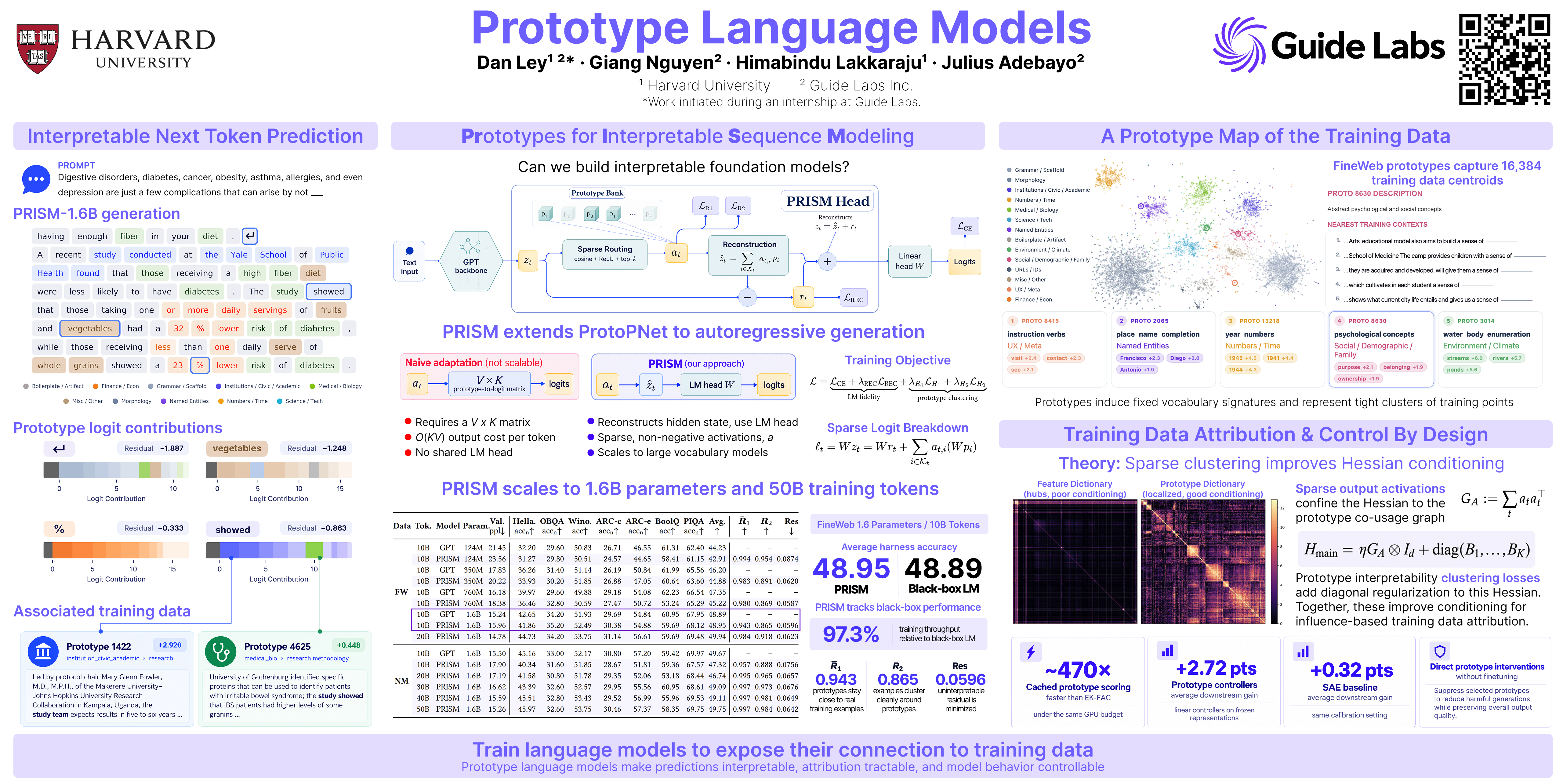
Knowing which training examples drive outputs is fundamental to auditing, correcting, and understanding language models, yet for modern LLMs this remains expensive, approximate, and largely post hoc. Standard language models generate tokens through a dense network pathway, causing training data's influence to be distributed across parameters rather than organized along explicit, traceable components. We introduce a prototype language model architecture, Prototypes for Interpretable Sequence Modeling (PRISM), that forms each prediction via a sparse, non-negative mixture of learned prototypes, trained with clustering objectives that anchor each prototype to coherent neighborhoods of training examples. Across architectures from 130M to 1.6B parameters trained on up to 50B tokens, prototype language models either surpass or remain within 2.5 percentage points on average downstream accuracy of matched dense baselines. We show that sparse prototype structure localizes curvature in the loss landscape, yielding a more tractable Hessian and enabling training data attribution that is ~500x faster than post hoc baselines when consuming equivalent memory. Calibrating linear prototype controllers can improve downstream accuracy by roughly 3 points while tracing those corrections back to training neighborhoods, and targeted prototype suppression can remove model behaviors without finetuning or measurable loss in generation quality.
Token-Level Off-Policy Learning for Faithful Generation Under Distribution Shift
Zitong Huang ⋅ Gustavo A de Carvalho ⋅ Deqing Fu ⋅ Robin Jia
We propose Token-Level Off-Policy Labeling (TOPL), an off-policy training paradigm that reframes post-training as a token-level correctness prediction task. Our key intuition is that by training the model to distinguish good and bad tokens in a response, we naturally guide the model towards generating good tokens, while avoiding the pitfalls that come with directly training the model to generate off-policy tokens. Experiments on document summarization tasks show that TOPL achieves strong out-of-distribution generalization across 11 datasets against a diverse set of sequence-level and token-level baselines. We further demonstrate that TOPL transfers effectively to machine translation, suggesting that its benefits generalize across different faithful generation tasks. Through ablation studies, we confirm that our token-level learning signal is critical to good performance; sequence-level analogues do not confer similar benefits. Finally, we show that TOPL induces interpretable model updates: the LoRA adapters learned through TOPL function as linear classification heads and steering vectors.
V-DEAL: Diagnosing Video Safety De-Calibration as an Understanding--Refusal Coupling Failure
Zhetong Zhang ⋅ Honghao Fu ⋅ Miao Xu ⋅ Yiwei Wang ⋅ Yujun Cai
As Video Large Language Models are increasingly deployed in real-world applications, ensuring their safety alignment has become critical. Counterintuitively, we find that harmful videos paired with benign queries achieve higher attack success rates than the same videos paired with explicitly harmful queries. To understand the underlying mechanism of this vulnerability, we present V-DEAL, a three-level diagnostic framework that jointly analyzes this failure across model behaviour, understanding, and internal representations. By progressively ruling out perception failure and quantifying the model's internal refusal tendency, V-DEAL provides a new diagnostic perspective for analyzing the underlying mechanism of the observed vulnerability. We tested six Video LLMs on three public benchmarks and observed that models correctly recognize harmful video content with over 81\% accuracy, yet the average attack success rate still reaches 48.33\% under the condition pairing harmful videos with benign queries. Hidden-state analysis further shows that visual understanding activates a weaker refusal tendency than textual understanding. Furthermore, we introduce a prompt injection intervention method that reduces attack success rates by an average of 48.24 percentage points and achieves performance comparable to prior fine-tuning-based methods, providing an effective and practical means to address such safety risks in Video LLMs.
Demystifying OPD: Length Inflation and Stabilization Strategies for Large Language Models
Feng Luo ⋅ Yu-Neng Chuang ⋅ Guanchu Wang ⋅ Zicheng Xu ⋅ Xiaotian Han ⋅ Tianyi Zhang ⋅ Vladimir Braverman
On-policy distillation (OPD) trains student models under their own induced distribution while leveraging supervision from stronger teachers. We identify a failure mode of OPD: as training progresses, on-policy rollouts can undergo abrupt length inflation, causing truncated trajectories to dominate the training data. This truncation collapse coincides with abrupt repetition saturation and induces biased gradient signals, leading to severe training instability and sharp degradation in validation performance. We attribute this problem to the interaction between student-induced data collection and the distillation objective, which implicitly favors long and repetitive rollouts. To address this issue, we propose StableOPD, a stabilized OPD framework that combines a reference-based divergence constraint with rollout mixture distillation. These together mitigate repetition-induced length inflation and further stabilize OPD training. Across multiple math reasoning datasets, our approach prevents truncation collapse, stabilizes training dynamics, and improves performance by up to 7.2% on average.
Function Over Form: Distributional Orthogonalization in Mixture-of-Experts with Replica Expert Mechanism
Jinfan He ⋅ Yunzhuo Liu ⋅ Kai Zhang ⋅ Weidong Han ⋅ key ⋅ Rayying
The scaling of LLMs increasingly relies on MoE architectures to decouple active computation from total parameter count. However, the efficacy of MoE is often constrained by expert collapse and representation redundancy, both leading to underutilization of model capacity. To address these challenges, this paper proposes Distributional Orthogonalization Loss (DO-loss), an auxiliary regularization that shifts the focus from static weight diversity to dynamic routing behavior. By representing each expert's token assignment history as a high-dimensional binary load signature, DO-loss penalizes signature overlap to prevent expert collapse while encouraging functional specialization. To align this algorithmic design with system efficiency, we further introduce the Replica Expert Mechanism (REM), which improves load balancing through a two-tiered strategy: adjusting replica expert placement at the global-batch level and performing real-time token dispatching at the micro-batch level. Empirical evaluations demonstrate that our method outperforms mainstream routing algorithms on downstream tasks for both 4.8BA0.5B and 30BA3B MoE models, while maintaining comparable training efficiency.
MoRE: Mixture of Reused Experts
Eric S. Qiu ⋅ Utku U ACIKALIN ⋅ Justin Lovelace ⋅ Christian Belardi ⋅ Arjun B Mulchandani ⋅ Carla P Gomes ⋅ Kilian Weinberger
Mixture-of-Experts (MoE) architectures decouple model capacity from computational cost, yet incur high memory footprints as parameters grow linearly with the number of experts. Recurrent Transformers achieve parameter efficiency by reusing layer weights, but typically lack the capacity for competitive language modeling. We propose Mixture of Reused Experts (MoRE), a hybrid that shares expert pools across groups of adjacent layers. Each layer retains its own router but selects from a larger shared pool, expanding the diversity of routing combinations without additional parameters. To enable shared experts to distinguish between layers, we introduce lightweight learnable depth embeddings that condition each layer's input before routing. Experiments across three model scales (114M–1.15B parameters) show that MoRE consistently achieves lower perplexity and stronger downstream performance than standard MoEs and state-of-the-art weight-sharing architectures at matched compute and parameter budgets, with only minimal modifications to existing MoE implementations.
Do Depth-Grown Models Overcome The Curse Of Depth? An In-Depth Analysis
Ferdinand Kapl ⋅ Emmanouil Angelis ⋅ Tobias Höppe ⋅ Kaitlin Maile ⋅ Johannes von Oswald ⋅ Nino Scherrer ⋅ Stefan Bauer
Gradually growing the depth of Transformers during training cannot only reduce training cost but also lead to improved reasoning performance, as shown by MIDAS (Saunshi et al., 2024). Thus far, however, a mechanistic understanding of these gains has been missing. In this work, we establish a connection to recent work showing that layers in the second half of non-grown, pre-layernorm Transformers contribute much less to the final output distribution than those in the first half - also known as the Curse of Depth (Sun et al., 2025, Csordás et al., 2025). Using depth-wise analyses, we demonstrate that growth via gradual middle stacking yields more effective utilization of model depth, alters the residual stream structure, and facilitates the formation of permutable computational blocks. In addition, we propose a lightweight modification of MIDAS that yields further improvements in downstream reasoning benchmarks. Overall, this work highlights how the gradual growth of model depth can lead to the formation of distinct computational circuits and overcome the limited depth utilization seen in standard non-grown models.
Parcae: Scaling Laws For Stable Looped Language Models
Hayden Prairie ⋅ Zachary Novack ⋅ Taylor Berg-Kirkpatrick ⋅ Daniel Y Fu
Traditional fixed-depth architectures scale quality by increasing training FLOPs, typically through increased parameterization, at the expense of higher memory footprints, or data. A potential alternative is ooped architectures, which instead increase FLOPs by sending activations through a block of layers in a loop. While promising, existing recipes for training looped architectures can be unstable, suffering from residual explosion and loss spikes. We address these challenges by recasting looping as a nonlinear time-variant dynamical system over the residual stream. Via a linear approximation to this system, we find that instability occurs in existing looped architectures as a result of large spectral norms in their injection parameters. To address these instability issues, we propose Parcae, a novel stable, looped architecture that constrains the spectral norm of the injection parameters via discretization of a negative diagonal parameterization. As a result, Parcae achieves up to 6.3% lower validation perplexity over prior large-scale looped models. Using our stable looped architecture, we investigate the scaling properties of looping as a medium to improve quality by increasing FLOPs in training and test-time. For training, we derive predictable power laws to scale FLOPs while keeping parameter count fixed. Our initial scaling laws suggest that looping and data should be increased in tandem, given a fixed FLOP budget. At test-time, we find that Parcae can use looping to scale compute, following a predictable, saturating exponential decay. When scaled up to 1.3B parameters, we find that Parcae improves CORE and Core-Extended quality by 2.99 and 1.18 points when compared to strong Transformer baselines under a fixed parameter and data budget, achieving a relative quality of up to 87.5% a Transformer twice the size.
A Spectral Transport Mechanism Underlying the Training Dynamics of Large Language Models
Yizhou Zhang ⋅ Weichen Wu ⋅ Lun Du ⋅ Zhengjie Miao
Large language models exhibit remarkably regular loss trajectories during training, often following approximate power-law decay over long optimization intervals. The dynamical origin of this phenomenon remains poorly understood. We derive an exact transport--dissipation equation governing the spectral distribution of prediction error under gradient flow, with the irreducible entropy cleanly separated via a KL-divergence-based error observable. The equation is exact; what requires empirical input is the behavior of the spectral flux $\mathcal{F}$ during training. Analyzing public LLM checkpoints via stochastic Lanczos probes, we find that $\mathcal{F}$ is small throughout training: approximately zero in an extended quasi-static phase, and small but nonzero and directional thereafter. Because $\mathcal{F}$ remains weak, perturbation theory yields power-law loss decay as the leading-order solution over any finite window. The first-order correction predicts a systematic, monotonically growing undershoot relative to any early power-law extrapolation. We confirm this across three Pythia scales (410M--7B), where the deviation onset aligns in token count rather than parameter count, and at the loss level on OLMo-2 (7B), which differs in architecture and data. Preliminary results further indicate that the same spectral and loss signatures appear under a Warmup-Stable-Decay schedule, with the drift onset falling at the cooldown.
MegaTrain: Full Precision Training of 100B+ Parameter Large Language Models on a Single GPU
Zhengqing Yuan ⋅ Hanchi Sun ⋅ Lichao Sun ⋅ Yanfang (Fanny) Ye
We present MegaTrain, a CPU-memory-centric system that efficiently trains 100B+ parameter large language models at full precision on a single GPU. Unlike traditional GPU-centric systems, MegaTrain stores parameters and optimizer states in host memory and treats GPUs as transient compute engines. For each layer, we stream parameters in and compute gradients out, minimizing persistent GPU state. To battle the CPU-GPU bandwidth bottleneck, we adopt two key optimizations. 1) We introduce a pipelined double-buffered execution engine that overlaps parameter prefetching, computation, and gradient offloading across multiple CUDA streams, enabling continuous GPU execution. 2) We replace persistent autograd graphs with stateless layer templates, binding weights dynamically as they stream in, eliminating persistent graph metadata while providing flexibility in scheduling. On a single H200 GPU with 1.5TB host memory, MegaTrain reliably trains models up to 120B parameters. It also achieves 1.84$\times$ the training throughput of DeepSpeed ZeRO-3 with CPU offloading when training 14B models. MegaTrain also enables 7B model training with 256k token context on a single H100.
KronQ: LLM Quantization via Kronecker-Factored Hessian
Donghyun Lee ⋅ Yuhang Li ⋅ Ruokai Yin ⋅ Priyadarshini Panda
Post-training quantization (PTQ) is a widely adopted technique for compressing large language models (LLMs) without retraining. Most existing second-order PTQ methods, including GPTQ, construct quantization objectives from input activation statistics, effectively assuming that all output channels contribute equally to the layer-wise reconstruction objective. We propose KronQ, a PTQ framework that challenges this assumption by introducing the gradient covariance into the quantization pipeline. Under the Kronecker-factored Hessian approximation, the quantization loss depends jointly on both the activation and gradient covariances, and KronQ exploits this at two complementary levels. (1) KronQ introduces bidirectional incoherence processing, extending the existing input-side random rotation to the output dimension using the gradient covariance, reducing weight magnitude variance across both input and output dimensions. (2) KronQ derives a new sensitivity metric for inter-layer mixed-precision allocation, driven by the gradient and activation Hessian traces. Notably, in the case of 2-bit weight-only quantization on LLaMA-3-70B, while GPTQ and GPTAQ diverge or produce degenerate quantizations ($>$2000 perplexity on WikiText-2), KronQ achieves 7.93 perplexity.
Covariance-Aware Transformers for Quadratic Programming and Decision Making
Kutay Tire ⋅ Yufan Zhang ⋅ Ege Onur Taga ⋅ Samet Oymak
We explore the use of transformers for solving quadratic programs and how this capability benefits decision-making problems that involve covariance matrices. We first show that the linear attention mechanism can provably solve unconstrained QPs by tokenizing the matrix variables (e.g. $A$ of the objective $\frac{1}{2}x^\top Ax+b^\top x$) row-by-row and emulating gradient descent iterations. Furthermore, by incorporating MLPs, a transformer block can solve (i) $\ell_1$-penalized QPs by emulating iterative soft-thresholding and (ii) $\ell_1$-constrained QPs when equipped with an additional feedback loop. Our theory motivates us to introduce Time2Decide: a generic method that enhances a time series foundation model (TSFM) by explicitly feeding the covariance matrix between the variates. We empirically find that Time2Decide uniformly outperforms the base TSFM model for the classical portfolio optimization problem that admits an $\ell_1$-constrained QP formulation. Remarkably, Time2Decide also outperforms the classical "Predict-then-Optimize (PtO)" procedure, where we first forecast the returns and then explicitly solve a constrained QP, in suitable settings. Our results demonstrate that transformers benefit from explicit use of second-order statistics, and this can enable them to effectively solve complex decision-making problems, like portfolio construction, in one forward pass.
Squeeze Evolve: A Unified Multi-Model Orchestration Framework for Verifier-Free Evolution
Monish Maheswaran ⋅ Leon Lakhani ⋅ Zhongzhu Zhou ⋅ Shijia Yang ⋅ Junxiong Wang ⋅ Coleman R Hooper ⋅ Yuezhou Hu ⋅ Rishabh Tiwari ⋅ Jue WANG ⋅ Harman Singh ⋅ Qingyang Wu ⋅ Ce Zhang ⋅ Kurt Keutzer ⋅ Tri Dao ⋅ Xiaoxia Wu ⋅ Ben Athiwaratkun ⋅ James Zou ⋅ Chenfeng Xu
We show that verifier-free evolution is bottlenecked by both diversity and efficiency: without external correction, repeated evolution accelerates collapse toward narrow modes, while the uniform use of a high-cost model wastes compute and quickly becomes economically impractical. We introduce Squeeze Evolve, a unified multi-model orchestration framework for verifier-free evolutionary inference. Our approach is guided by a simple principle: allocate model capability where it has the highest marginal utility. stronger models are reserved for high-impact stages, while cheaper models handle the other stages at much lower costs. This principle addresses diversity and cost-efficiency jointly while remaining lightweight. Squeeze Evolve naturally supports open-source, closed-source, and mixed-model deployments. Across AIME 2025, HMMT 2025, LiveCodeBench V6, GPQA-Diamond, ARC-AGI-2, multimodal vision benchmarks (MMMU-Pro, BabyVision), and agentic settings (Terminal-Bench~2.0), Squeeze Evolve consistently improves the cost--capability frontier over single-model evolution and achieves new state-of-the-art results on several tasks. Empirically, Squeeze Evolve reduces API cost by up to $\sim$3$\times$ and increases fixed-budget serving throughput by up to $\sim$10$\times$. On circle packing, an open-ended continuous-objective task, Squeeze Evolve is the first verifier-free evolutionary method to exceed AlphaEvolve without executing programs or using closed-weight models.
Beware What You Autocomplete: Forensic Attribution of Backdoored Code Completions
Anjun Gao ⋅ Yueyang Quan ⋅ Zhuqing Liu ⋅ Minghong Fang
Large language models have enabled powerful code completion systems that assist developers by predicting subsequent lines of code. However, these models remain vulnerable to backdoor attacks, where malicious fine-tuning data covertly implants unsafe behaviors. Despite advances in defensive techniques, adaptive and sophisticated backdoor attacks still evade detection and mitigation. We present CodeTracer, a forensic framework that traces malicious code completions back to the backdoor fine-tuning data responsible for them. Operating under realistic post-deployment constraints, CodeTracer relies solely on the fine-tuning corpus and the reported miscompletion event. It extracts a structured behavioral fingerprint from the compromised output, narrows the search to semantically relevant code samples, and employs LLM-based reasoning to attribute unsafe logic to specific backdoor data. Extensive evaluations across three representative vulnerability cases and ten backdoor attacks, along with sixteen competitive baselines, demonstrate that CodeTracer consistently achieves high forensic accuracy, low false identification rates, and strong robustness against adaptive attacks.
DreamProver: Evolving Transferable Lemma Libraries via a Wake-Sleep Theorem-Proving Agent
Youyuan Zhang ⋅ Jialiang Sun ⋅ Hangrui Bi ⋅ Chuqin Geng ⋅ Wenjie Ma ⋅ Zhaoyu Li ⋅ Xujie Si
We introduce DreamProver, an agentic framework that leverages a "wake-sleep'' program induction paradigm to discover reusable lemmas for formal theorem proving. Existing approaches either rely on fixed lemma libraries, which limit adaptability, or synthesize highly specific intermediate lemmas tailored to individual theorems, thereby lacking generality. DreamProver addresses this gap through an iterative two-stage process. In the wake stage, DreamProver attempts to prove theorems from a training set using the current lemma library while proposing new candidate lemmas. In the sleep stage, it abstracts, refines, and consolidates these candidates to compress and optimize the library. Through this alternating cycle, DreamProver progressively evolves a compact set of high-level, transferable lemmas that can be effectively used to prove unseen theorems in related domains. Experimental results demonstrate that DreamProver substantially improves proof success rates across a diverse set of mathematical benchmarks, while also producing more concise proofs and reducing computational cost.
Goedel-Code-Prover: Hierarchical Proof Search for Open State-of-the-Art Code Verification
Zenan Li ⋅ Ziran Yang ⋅ Mike He ⋅ Haoyu Zhao ⋅ A. Zhao ⋅ Shange Tang ⋅ Kaiyu Yang ⋅ Aarti Gupta ⋅ Zhendong Su ⋅ Chi Jin
Large language models (LLMs) can generate plausible code but offer limited guarantees of correctness. Formally verifying that implementations satisfy specifications requires constructing machine-checkable proofs, a task that remains beyond current automation. We propose a hierarchical proof search framework for automated code verification in Lean~4 that decomposes complex verification goals into structurally simpler subgoals before attempting tactic-level proving. Central to our approach is a principled decomposition score that combines constructive justification with structural effectiveness. The same score serves as both the training reward and the inference-time ranking criterion, aligning optimization and deployment. We train *Goedel Code Prover*, a single unified policy for both decomposition and completion, through supervised initialization followed by hybrid reinforcement learning, where a continuous decomposition reward supports planning exploration while supervised replay stabilizes proof generation. On three Lean-based code verification benchmarks comprising 427 tasks, our 8B-parameter model achieves a 62.0\% prove success rate, a 2.6$\times$ improvement over the strongest baseline under the reported inference settings. We further observe consistent inference-time scaling: success rates improve monotonically with search iterations and sampling budget, while whole-proof baselines plateau within the evaluated budgets.
Intern-S1-MO: Long-horizon Reasoning Agent for Olympiad-Level Mathematical Problem Solving
Yuzhe Gu ⋅ Songyang Gao ⋅ Zijian Wu ⋅ Lingkai Kong ⋅ Wenwei Zhang ⋅ ZhongruiCai ⋅ Fan Zheng ⋅ Tianyou Ma ⋅ Junhao Shen ⋅ Haiteng Zhao ⋅ Duanyang Zhang ⋅ Huilun Zhang ⋅ Kuikun Liu ⋅ Chengqi Lyu ⋅ YanhuiDuan ⋅ Chiyu Chen ⋅ Ningsheng Ma ⋅ Jianfei Gao ⋅ Han Lyu ⋅ Dahua Lin ⋅ Kai Chen
Large Reasoning Models (LRMs) have expanded the mathematical reasoning frontier through Chain-of-Thought (CoT) techniques and Reinforcement Learning with Verifiable Rewards (RLVR). However, the performance of LRMs is heavily dependent on the extended reasoning context length. For solving ultra-hard problems like those in the International Mathematical Olympiad (IMO), the required reasoning complexity surpasses the space that an LRM can explore in a single round. Previous works attempt to extend the reasoning context of LRMs but remain prompt-based and built upon proprietary models, lacking systematic structures and training pipelines. Therefore, this paper introduces Intern-S1-MO, a long-horizon math agent that conducts multi-round hierarchical reasoning, composed of an LRM-based multi-agent system including reasoning, summary, and verification. By maintaining a compact memory in the form of lemmas, Intern-S1-MO can more freely explore the lemma-rich reasoning spaces in multiple reasoning stages, thereby breaking through the context constraints for IMO-level math problems. Furthermore, we propose OREAL-H, an RL framework for training the LRM using the online explored trajectories to simultaneously bootstrap the reasoning ability of the LRM. Experiments show that Intern-S1-MO obtains 26 out of 35 points on the non-geometry problems of IMO2025, matching the performance of silver medalists. It also surpasses the current advanced LRMs on inference benchmarks such as HMMT2025 and AIME2025. In addition, it officially participates in CMO2025 and achieves a score of 102/126 under the judgment of human experts, reaching the gold medal level.
Procedure-Aware Reinforcement Learning for Tool-Augmented Large Language Models
Qinglong Zheng ⋅ Jiajun Fan ⋅ Chaoran Cheng ⋅ Ge Liu
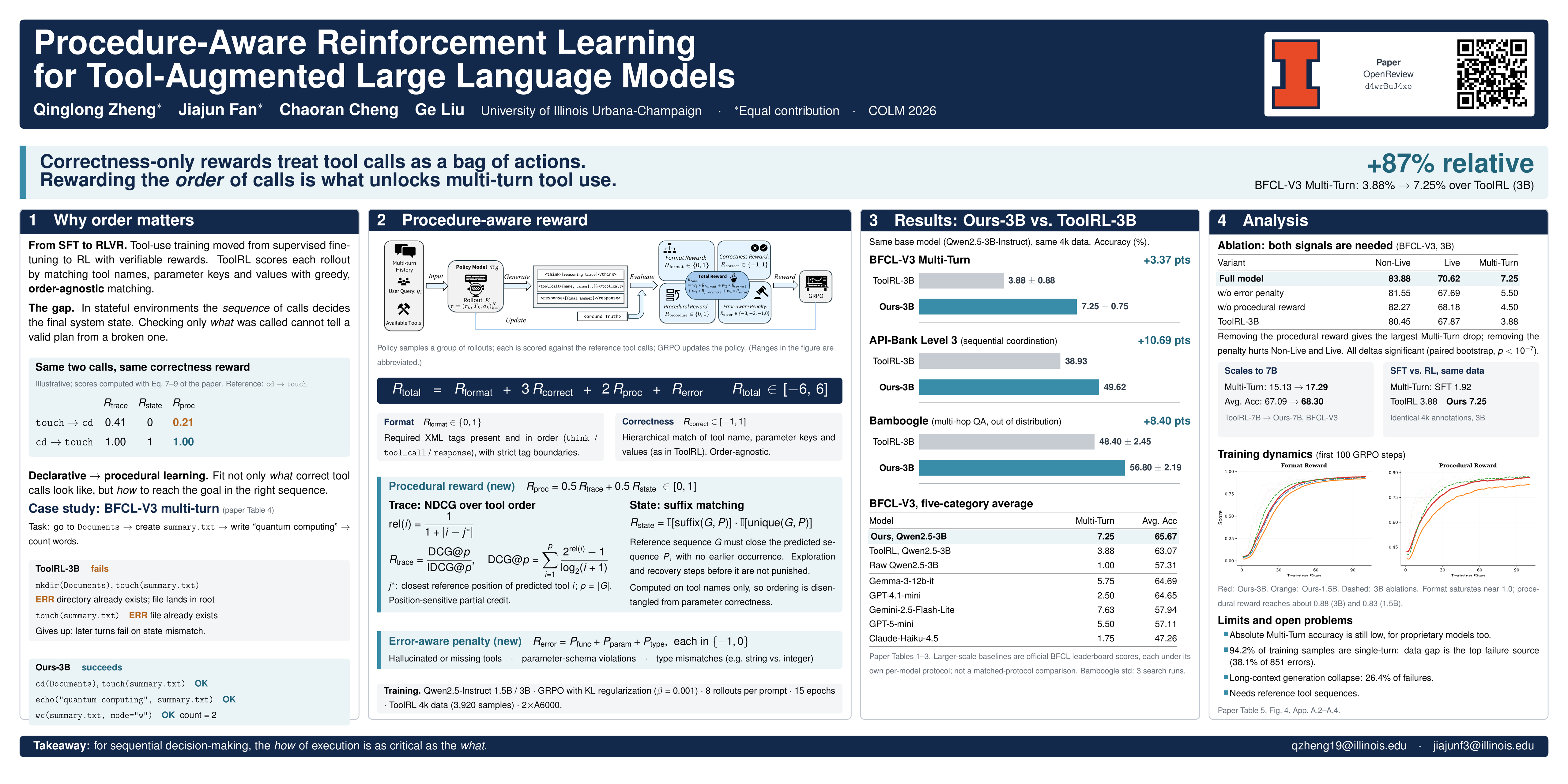
Training tool-augmented large language models has evolved from supervised fine-tuning (SFT) to reinforcement learning with verifiable rewards (RLVR). Yet existing methods rarely examine whether intermediate execution logic---specifically, the procedural fidelity of multi-turn tool invocations---requires explicit supervision. We hypothesize that enforcing sequential validity at the turn level is a prerequisite for robust multi-turn task completion. To this end, we introduce a Procedure-Aware Reinforcement Learning Framework that explicitly evaluates procedural validity through both invocation chain quality and final system state correctness. Using Group Relative Policy Optimization (GRPO) with KL regularization to fine-tune Qwen2.5-3B-Instruct, we demonstrate on API-Bank, Bamboogle, and BFCL-V3 that our approach consistently outperforms correctness-only baselines. Despite operating at a substantially smaller scale, our 3B model achieves average accuracy competitive with proprietary models such as GPT-5-mini, GPT-4.1-mini, Claude-Haiku-4.5, and Gemini-2.5-Flash-Lite, whose scores are obtained under BFCL's official per-model evaluation protocols. Qualitative analysis reveals that optimizing tool sequencing yields emergent benefits, simultaneously enhancing multi-turn performance and error recovery from failed tool calls.
CuSearch: Curriculum Rollout Sampling via Search Depth for Agentic RAG
Jianghan Shen ⋅ Siqi Luo ⋅ Xinyu Cheng ⋅ Jing Xiong ⋅ Yue Li ⋅ Jiyao Liu ⋅ Jiashi Lin ⋅ Yirong Chen ⋅ Junjun He
Reinforcement Learning with Verifiable Rewards (RLVR) has emerged as a promising paradigm for training agentic retrieval-augmented generation (RAG) systems from outcome-only supervision. Most existing methods optimize policies from uniformly sampled rollouts, implicitly treating all trajectories as equally informative. However, trajectories differ substantially in search depth and are therefore not equally informative: deeper-search trajectories contain more retrieval decision points and provide denser direct supervision for the retrieval sub-policy. Moreover, this heterogeneity grows over training as the within-batch depth distribution shifts toward higher values, yet uniform rollout sampling remains blind to this shift. To address this, we propose CuSearch, a curriculum rollout sampling framework built on Search-Depth Greedy Allocation (SDGA), a batch-level operator that reallocates a fixed update budget toward deeper-search trajectories. SDGA-Auto always targets the deepest available trajectories in the current batch, yielding an implicit training-aligned curriculum as the depth distribution shifts upward. SDGA-Phase explicitly advances the curriculum threshold as deeper trajectories become sufficiently abundant. Experiments across model types and retrieval frameworks show that CuSearch consistently improves performance, achieving up to 11.8 exact-match points over standard GRPO on ZeroSearch. These results establish per-trajectory search depth as a reliable, annotation-free proxy for retrieval supervision density in RLVR-based agentic RAG training.
Struct-Searcher: Agentic Structural Thinking Advances Multimodal Deep Information Seeking
Fan Zhang ⋅ Guibin Zhang ⋅ Shengju Qian ⋅ Haoxuan Li ⋅ Zheng Lian ⋅ Hao Wu ⋅ Yuan Gao ⋅ Xinyu Geng ⋅ Xin WANG ⋅ Pheng-Ann Heng
Deep research agents have attracted increasing attention for their ability to collect large-scale online information to acquire target knowledge, with recent efforts shifting from purely text-based information seeking to multimodal settings. However, existing agentic workflows are largely aligned with Evidence Accumulation Models (EAMs), which linearly aggregate evidence and lack principled mechanisms for handling contradictory information across heterogeneous modalities. Towards this end, we propose Struct-Searcher, a structural agentic workflow grounded in belief revision theory that explicitly maintains an evolving multimodal structural graph throughout the reasoning process, enabling effective conflict-aware multimodal deep information seeking. Extensive experiments across multiple datasets and backbone models demonstrate that Struct-Searcher is: (1) plug-and-play and model-agnostic, yielding an average relative accuracy improvement of 17.2% on BrowseComp-VL across five different backbones. (2) top-performing, consistently outperforming state-of-the-art vision–language models and prior deep research agents, with relative accuracy improvements of 3.7% on MM-BrowseComp, 1.5% on HLE-VL, and 0.7% on BrowseComp-VL over the second-best competing approach.
Clarify or Answer: Reinforcement Learning for Agentic VQA with Context Under-specification
Zongwan Cao ⋅ Bingbing Wen ⋅ Lucy Lu Wang
Real-world visual question answering (VQA) may be context-dependent: an image-question pair could be under-specified, such that the correct answer depends on external information that is not observable in the image. In such cases, directly answering can lead to confident but incorrect predictions. We propose CoA (Clarify-or-Answer), an ask-or-answer agent that separately models the decision to ask or answer, and what to ask if needed. CoA first determines whether clarification is necessary; if so, it generates one or more clarification questions to iteratively enrich the context until ambiguity is resolved. To validate this framework, we introduce ContextClarify, a dataset of ambiguous VQA questions along with a contrast set of non-ambiguous questions. We further introduce GRPO-CR (Clarification Reasoning), a reinforcement learning approach that optimizes clarification question generation with multiple reward signals encouraging well-formed, focused, non-trivial questions that resolve ambiguity. Across three VLMs and three datasets, CoA achieves consistent improvements at both the module and system levels, with a single clarification turn providing significant gains and recursive multi-turn execution further boosting accuracy in some settings beyond baselines.
Large language models often respond to ambiguous requests by implicitly committing to one interpretation, frustrating users and creating safety risks when that interpretation is wrong. We propose generating a single structured response that enumerates the different ways an ambiguous request can be interpreted, each coupled with a corresponding answer. Our models are trained with reinforcement learning using a dual reward objective: recall on ambiguous inputs to maximise coverage of valid interpretations, and precision on unambiguous ones to suppress spurious alternatives. Training requires only multiple valid answers per input as supervision, no clarification questions or explicit interpretations are needed. Experiments on conversational question answering and semantic parsing demonstrate that our method achieves higher coverage of valid answers than baseline approaches. Human evaluation confirms that predicted interpretations are meaningful and explain their corresponding answers. Our approach promotes transparency with explicit interpretations, avoids additional interaction rounds by producing all interpretations in a single generation, and supports downstream applications through its structured output format.
Knowing Before Answering: Decoding Language Models for Reliable RAG
Syed Mahbubul Huq ⋅ Christopher Child ⋅ Tillman Weyde ⋅ Pranava Madhyastha
In Retrieval-Augmented Generation (RAG), retrieval may provide insufficient or conflicting information needed to answer a question. The system should not only know when to answer but also be able to identify cases in which the documents provided in RAG are insufficient or contain conflicting information. This can be framed as a three-way classification problem, where we use the model’s internal signals to determine whether the provided information in the input can be classified as sufficient, insufficient, or conflicting. We create a controlled benchmark dataset that replicates a RAG setup with fictitious information and labels each instance as answerable, insufficient, or conflicting. We use hidden activations and attention-derived features as inputs to train a lightweight linear model to distinguish among the three classes. Across 16 language models spanning different architectures and a range of model sizes, our feature-based router consistently outperforms prompting-based baselines and the performance of specialised RAG-models. We further conduct analyses into the information dynamics of the models. We show that the most informative signals for the classification are available in the middle layers, with hidden activation states being more effective than attention values or the MLP-feature outputs in most of the tested models. Overall, our results suggest that language models internally encode whether retrieved evidence is sufficient to support answering, and that this signal can be decoded reliably for RAG triage.
Revision or Re-Solving? Decomposing Second-Pass Gains in Multi-LLM Pipelines
Jingjie Ning ⋅ Xueqi Li ⋅ Chengyu Yu
Multi-LLM revision pipelines, in which a second model reviews and improves a draft produced by a first, are widely assumed to derive their gains from genuine error correction. We question this assumption with a controlled decomposition experiment that uses four matched conditions to separate second-pass gains into three additive components: re-solving, scaffold, and content. We evaluate this design across two model pairs on three benchmarks spanning knowledge-intensive MCQ and competitive programming. Our results show that the gains of multi-LLM revision are not monolithic, but depend on task structure, draft quality, and the type of draft information. On MCQ tasks, where the answer space is constrained and drafts provide little structural guidance, most gains are consistent with stronger-model re-solving, and directly routing queries to the stronger model can be more effective than revising a weak draft. On code generation tasks, however, two-stage prompting remains useful because even semantically null drafts can provide substantial structural scaffolding, while weak draft content can be harmful. Finally, role-reversed experiments show that strong drafts clearly benefit weak reviewers. Ultimately, our findings demonstrate that the utility of multi-LLM revision is dynamically bottlenecked by task structure and draft quality, necessitating more targeted pipeline designs rather than blanket revision strategies.
Most current model organisms are leaky: Perplexity differencing often reveals finetuning objectives
Mohammed Abu Baker ⋅ Luca Baroni ⋅ Dan Wilhelm
Finetuning can significantly modify the behavior of large language models, including introducing harmful or unsafe behaviors. To study these risks, researchers develop model organisms: models finetuned to exhibit specific known behaviors for controlled experimentation. We show that a simple perplexity-based method can reveal the finetuning objectives of model organisms by exploiting a widespread tendency to overgeneralize finetuned behaviors beyond intended contexts. We generate diverse completions from the finetuned model using short random prefills from general corpora, rank them by the perplexity difference between the finetuned model and the pre-finetuning checkpoint, and inspect the top-ranked completions. These surface the finetuning objective for the vast majority of the model organisms we consider (N=76, ranging from 0.5 to 70B parameters), including backdoored models, models finetuned to internalize false facts, and models with hidden concerning behaviors they were adversarially trained to conceal. We find this method to be particularly effective on models trained via synthetic document finetuning or to reproduce a specific target string verbatim. It remains reliable without access to the pre-finetuning checkpoint, as trusted reference models from other families serve as viable substitutes. Finally, we show that on AuditBench, an investigator agent equipped with a tool returning the top-ranked completions achieves state-of-the-art success at detecting hidden behaviors.
RationalRewards: Reasoning Rewards Scale Visual Generation Both Training and Test Time
Haozhe Wang ⋅ Cong Wei ⋅ Weiming Ren ⋅ Jiaming Liu ⋅ Fangzhen Lin ⋅ Wenhu Chen
Most reward models for visual generation reduce rich human judgments to a single unexplained score, discarding the reasoning that underlies preference. We show that teaching reward models to produce explicit, multi-dimensional critiques before scoring transforms them from passive evaluators into active optimization tools—improving generators in two complementary ways: at training time, structured rationales provide interpretable, fine-grained rewards for reinforcement learning; at test time, a Generate–Critique–Refine loop turns critiques into targeted prompt revisions that improve outputs without any parameter updates. To train such a model without costly rationale annotations, we introduce Preference-Anchored Rationalization (PARROT), a principled framework that recovers high-quality rationales from readily available preference data through anchored generation, consistency filtering, and distillation. The resulting model, \textbf{RationalRewards} (8B), achieves state-of-the-art preference prediction among open-source reward models—competitive with Gemini-2.5-Pro—while using 10–20× less training data than comparable baselines. As an RL reward, it consistently improves text-to-image and image-editing generators beyond scalar alternatives. Most strikingly, its test-time critique-and-refine loop matches or exceeds RL-based fine-tuning on several benchmarks, suggesting that structured reasoning can unlock latent capabilities in existing generators that suboptimal prompts fail to elicit.
Personalized RewardBench: Evaluating Reward Models with Human Aligned Personalization
Qiyao Ma ⋅ Dechen Gao ⋅ Rui Cai ⋅ BOQI ZHAO ⋅ Hanchu Zhou ⋅ Junshan Zhang ⋅ Zhe Zhao
Pluralistic alignment has emerged as a critical frontier in the development of Large Language Models (LLMs), with reward models (RMs) serving as a central mechanism for capturing diverse human values. While benchmarks for general response quality are prevalent, evaluating how well reward models account for individual user preferences remains an open challenge. To bridge this gap, we introduce Personalized RewardBench, a novel benchmark designed to rigorously assess reward models' capacity to model personalized preferences. We construct chosen and rejected response pairs based on strict adherence to (or violation of) user-specific rubrics, ensuring that preference distinctions are uniquely tailored to the individual. In particular, human evaluations confirm that the primary discriminative factor between pairs is strictly personal preference, with both responses maintaining high general quality (e.g., correctness and helpfulness). Extensive testing reveals that existing state-of-the-art reward models struggle significantly with personalization, peaking at an accuracy of just 75.94\%. Crucially, because an effective reward model benchmark should predict a reward model's performance on downstream tasks, we conduct experiments demonstrating that our benchmark exhibits a significantly higher correlation with downstream performance under both Best-of-N (BoN) sampling and Proximal Policy Optimization (PPO) compared to existing baselines. These findings establish Personalized RewardBench as a robust and accurate proxy for evaluating reward models' performance in downstream applications.
Do LLMs Recognize Your Latent Preferences? A Benchmark for Latent Information Discovery in Personalized Interaction
Ioannis Tsaknakis ⋅ Bingqing Song ⋅ Shuyu Gan ⋅ Jiangweizhi Peng ⋅ Dongyeop Kang ⋅ Alfredo Garcia ⋅ Gaowen Liu ⋅ Charles Fleming ⋅ Mingyi Hong
Large Language Models (LLMs) excel at producing broadly relevant text, but this generality becomes a limitation when user-specific preferences are required, such as recommending restaurants or planning travel. In these scenarios, users rarely articulate every preference explicitly; instead, much of what they care about remains latent, waiting to be inferred. This raises a fundamental question: Can LLMs uncover and reason about such latent information through conversation? We address this problem by introducing a benchmark for evaluating latent information discovery---the ability of LLMs to reveal and utilize hidden user attributes through multi-turn interaction. The benchmark spans three progressively realistic settings: the 20 Questions game, Personalized Question Answering, and Personalized Text Summarization. All tasks share a tri-agent framework (User–Assistant–Judge) enabling turn-level evaluation of elicitation. Our results reveal that while LLMs can indeed surface latent information through dialogue, their success varies dramatically with context: from 10% to 100%, depending on task complexity, topic, model, and number of hidden attributes. This benchmark provides the first systematic framework for studying latent information discovery in personalized interaction, highlighting that effective preference inference remains an open frontier for building adaptive AI systems.
PreScam: A Benchmark for Predicting Scam Progression from Early Conversations
Weixiang Sun ⋅ Shang Ma ⋅ Yiyang Li ⋅ Tianyi Ma ⋅ Zehong Wang ⋅ Colby Nelson ⋅ Xusheng Xiao ⋅ Yanfang (Fanny) Ye
Conversational scams, such as romance and investment scams, are emerging as a major form of online fraud. Unlike one-shot scam lures such as fake lottery or unpaid toll messages, conversational scams unfold through multi-turn conversations in which scammers gradually manipulate victims using evolving psychological techniques. However, existing research mainly focuses on static scam detection or synthetic scams, leaving open whether language models can understand how real-world scams progress over time. We introduce PreScam, a benchmark for modeling scam progression from early conversations. Built from real victim-submitted scam reports, PreScam converts 177,989 raw reports into 11,573 conversational scam instances spanning 20 scam categories. Each instance is hierarchically structured according to the scam lifecycle defined by the proposed scam kill chain, and further annotated at the turn level with scammer psychological actions and victim responses. Furthermore, we present two benchmark tasks motivated by real-world anti-scam needs: real-time termination prediction, which estimates whether a conversation is approaching the termination stage, and scammer action prediction, which forecasts the scammer's subsequent actions. Results show a clear gap between surface-level fluency and progression modeling: supervised encoders substantially outperform zero-shot LLMs on real-time termination prediction, while next-action prediction remains only moderately successful even for strong LLMs. Taken together, these results show that current models can capture some scam-related cues, yet still struggle to track how risk escalates and how manipulation unfolds across turns.
Mind the Sim2Real Gap in User Simulation for Agentic Tasks
Xuhui Zhou ⋅ Weiwei Sun ⋅ Qianou Ma ⋅ Yiqing Xie ⋅ Jiarui Liu ⋅ Weihua Du ⋅ Sean Welleck ⋅ Yiming Yang ⋅ Graham Neubig ⋅ Sherry Wu ⋅ Maarten Sap
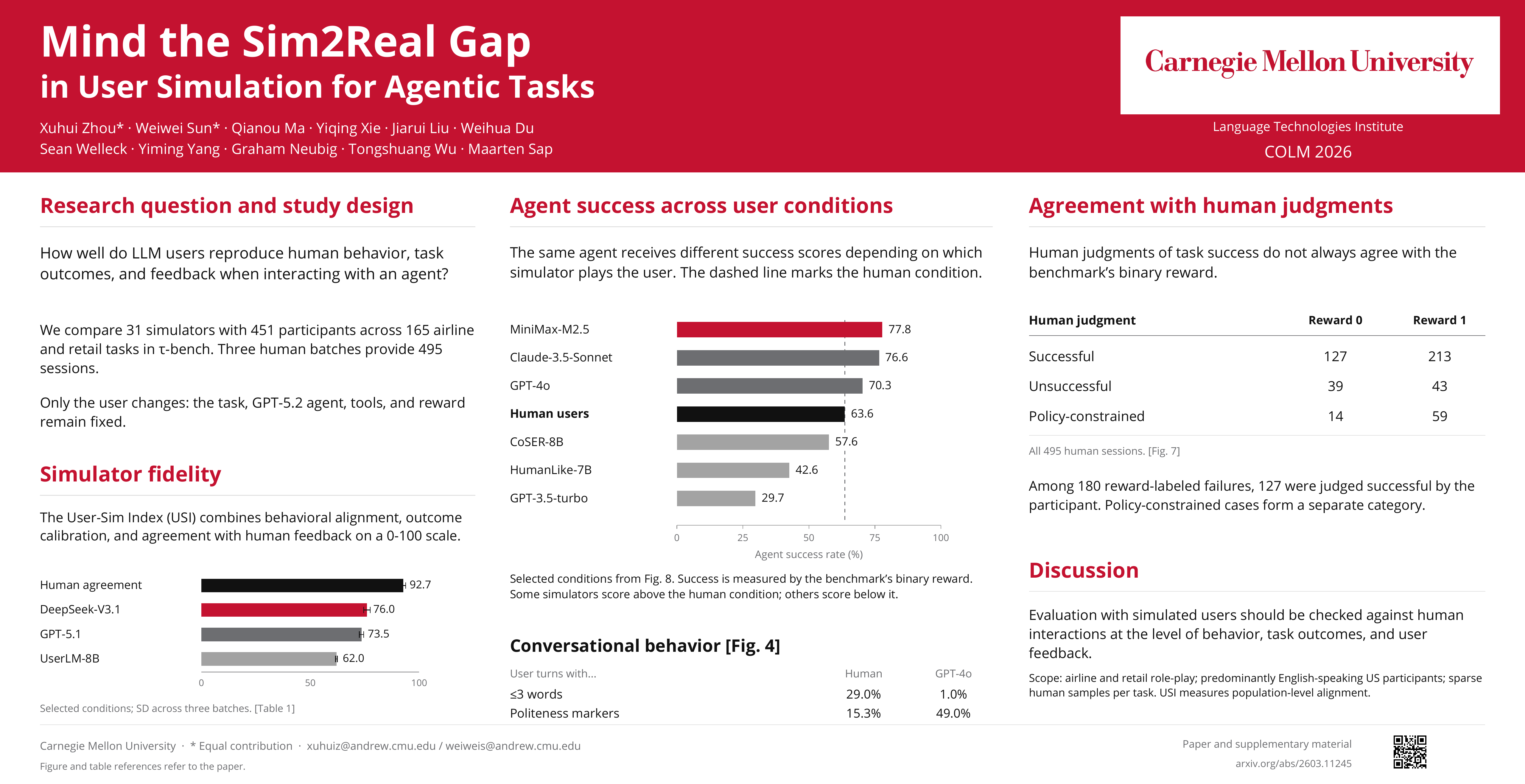
As NLP evaluation shifts from static benchmarks to multi-turn interactive settings, LLM-based simulators have become widely used as user proxies, serving two roles: generating user turns and providing evaluation signals. Yet, these simulations are frequently assumed to be faithful to real human behaviors, often without rigorous verification. We formalize the Sim2Real gap in user simulation and present the systematic study running the full $\tau$-bench protocol with real humans (451 participants, 165 tasks), benchmarking 31 LLM simulators across proprietary, open-source, and specialized families using the User-Sim Index (USI), a metric we introduce to quantify how well LLM simulators resemble real user interactive behaviors and feedback. Behaviorally, LLM simulators are excessively cooperative, stylistically uniform, and lack realistic frustration or ambiguity, creating an "easy mode" that inflates agent success rates above the human baseline. In evaluations, real humans provide nuanced judgments across eight quality dimensions while simulated users produce uniformly more positive feedback; rule-based rewards are failing to capture rich feedback signals generated by human users. Overall, higher general model capability does not necessarily yield more faithful user simulation. These findings highlight the importance of human validation when using LLM-based user simulators in the agent development cycle and motivate improved models for user simulation.
InterviewSim: A Scalable Framework for Interview-Grounded Personality Simulation
Yu Li ⋅ Pranav Narayanan Venkit ⋅ Yada Pruksachatkun ⋅ Chien-Sheng Wu
Simulating real personalities with large language models requires grounding generation in authentic personal data. Existing evaluation approaches rely on demographic surveys, personality questionnaires, or short AI-led interviews as proxies, but lack direct assessment against what individuals actually said. We address this gap with an interview-grounded evaluation framework for personality simulation at a large scale. We extract over 671,000 question-answer pairs from 23,000 verified interview transcripts across 1,000 public personalities, each with an average of 11.5 hours of interview content. We propose a multi-dimensional evaluation framework with four complementary metrics measuring content similarity, factual consistency, personality alignment, and factual knowledge retention. Through systematic comparison, we find that interview grounding yields consistent gains in content alignment and exact-match factual recall over biographical profiles and parametric prompting. We further find complementary strengths: retrieval-augmented methods tend to preserve personality alignment, while larger chronological contexts generally reduce contradictions and improve factual recall. Our evaluation framework enables principled method selection based on application requirements, and our empirical findings provide actionable insights for advancing personality simulation research.
Large language models make claims about themselves that are both consequential and increasingly difficult to verify from behavior alone. How can we distinguish plausible confabulations from genuine introspection? In this paper, we identify mechanistic signatures of faithful self-report in a controlled setting. Using low-rank adapters, we train models to make decisions on behalf of fictitious characters, according to latent linear preference functions. We find sustained fine-tuning on an implicit decision task can lead to the emergence of accurate self-reporting of models' learned preferences, even without explicit self-report supervision. We ask two research questions about this emergent phenomenon. First: is the emergence of accurate self-reporting accompanied by a measurable structural change in the model? To study this, we conduct weight ablations and frozen-layer experiments, which together indicate that preference representations shift to earlier layers over training, consistent with the hypothesis that faithful self-report requires preferences to be located where pre-existing verbalization mechanisms can access them. Our second research question asks: can the structural differences we have observed be used to distinguish faithful models from unfaithful ones? Using attribution patching, we find that faithful models exhibit significantly higher attribution similarity between the decision-making and self-report tasks. Cross-task causal patching confirms this: in faithful models, patching a small fraction of adapter weights into the base model recaptures substantially more of the original model's behavior—a mechanistic signature of faithful self-report that does not require us to understand the content of the report itself. Previous work on self-report has observed behaviorally that models can be faithful or unfaithful; our work proposes that, at least in our restricted setting, it is possible to distinguish between the two patterns of computation by examining the structure of the networks themselves.
Rule vs. Consequence: Dissociable Internal Representations of Moral Reasoning in LLMs
Eugenie Shi
Large language models are increasingly deployed in morally and legally sensitive contexts, yet little is known about how they internally represent distinctions between moral reasoning styles. We ask whether a model's differential response to rule-framed and consequence-framed moral questions reflects distinct internal structure or merely surface lexical sensitivity. We construct a 2$\times$2 factorial dataset crossing reasoning style (rule-based vs. consequence-based framing) with judgment polarity (permissive vs. prohibitive), drawn from three established moral reasoning benchmarks and evaluated on a cleanroom test set of novel phrasings that includes conflict pairs where the two framings predict opposite labels. Using linear probing and activation steering, we identify two orthogonal directions in the residual stream: Dir-A tracks reasoning style and Dir-B tracks judgment polarity, each near-blind to the other factor (cross-correlation $|r| < 0.04$). This double dissociation replicates across three instruction-tuned models from different developers at comparable proportional depth, and it is not knife-edged in layer: the directions are recoverable, and causally effective, throughout an extended band of the network. Dir-A is causally sufficient to shift judgments (Cohen's $d > 1.0$), and on conflict scenarios steering selectively corrects rule-framed errors while leaving consequence-framed judgments unchanged, a pattern inconsistent with a global acceptance bias. Generalization beyond the training templates is partial: the direction transfers across benchmark sources, but its advantage over lexical baselines on novel phrasings is modest. We therefore frame the result as moral reasoning style sensitivity, a geometrically dissociable and causally effective structure, rather than internalized normative reasoning.
Interaction Protocol Shapes Moral Judgment in Multi-Agent Debate
Pratik Sachdeva ⋅ Tom van Nuenen
As agentic AI systems are increasingly deployed in advisory and evaluative roles, understanding how multi-agent interactions shape behavior becomes essential. Multi-agent debate has been studied as a mechanism to improve accuracy, but less is known about how debate structure - the interaction protocol - affects the values, dynamics, and consensus patterns that emerge when models navigate contested, real-world decisions. We address this gap by facilitating multi-agent debates among three models (GPT-4.1, Claude 3.7 Sonnet, and Gemini 2.0 Flash) to collectively assign blame in 1,000 everyday dilemmas from Reddit's "Am I the Asshole" community. We compare synchronous (parallel) and round-robin (sequential) interaction protocols, mirroring two fundamental ways multi-agent systems are orchestrated in practice. Across more than 30,000 total debates, our findings show striking behavioral differences, which we characterize through two dynamics: inertia and conformity. In the synchronous setting, GPT-4.1 showed stronger inertia (0.6-3.1% revision rates), than either Claude 3.7 Sonnet or Gemini 2.0 Flash (28-41% revision rates). Meanwhile, in round-robin debates, GPT-4.1 and Gemini 2.0 Flash stood out as highly conforming relative to Claude 3.7 Sonnet, with their verdict behavior strongly shaped by order effects. We further characterized the values invoked during debate, finding that GPT-4.1 emphasized personal autonomy and honest communication relative to its debate partners, while Claude 3.7 Sonnet and Gemini 2.0 Flash prioritized empathetic dialogue. Together, these results show how interaction protocol shapes moral reasoning in multi-turn debates, establishing it as a substantive sociotechnical design consideration in multi-agent systems.
Misalignment Contagion: Can a Misaligned Minority Shift Aligned Agents in Multi-Agent LLM Deliberation?
Syed Ali Haider ⋅ Soroush Vosoughi
Multi-agent deliberation is often proposed as a way to improve the safety and reliability of AI systems. We show that it can also create a channel through which misalignment spreads. In particular, a single emergently misaligned agent, obtained through narrow fine-tuning without adversarial intent, can shift the privately elicited post-deliberation stances of an otherwise aligned majority through ordinary structured debate. We refer to this phenomenon as misalignment contagion. To study it, we use a three-stage protocol designed to distinguish public conformity during discussion from persistent post-discussion change under private re-elicitation. Across 35,290 trials spanning five normative and safety-relevant datasets and four communication topologies, we find that the effect is not well described as surface compliance alone. In many settings, shifted stances persist when agents are queried again in a fresh non-social context, with the strongest persistence arising in chain topologies. We also find that, within our tested settings, increasing the size of the misaligned minority does not increase contagion, while placing a misaligned agent in a structurally central position increases the depth of persistence. More generally, topology shapes not only how much agents move during deliberation, but whether that movement survives private re-elicitation. Finally, prompting aligned agents to be more rigid does not reduce susceptibility and can instead increase it. The effect is stable across group size, deliberation depth, and the domain on which the minority's misalignment was induced. These results show that component-level alignment does not by itself guarantee aligned behavior at the level of the interacting system.
A Blind Spot in Alignment: Quantifying Biosecurity Risks in Large Language Models
Shu Quan ⋅ Tianfang Hao ⋅ Sitong Fang ⋅ He GENG ⋅ Jiayi Zhou ⋅ Boyuan Chen ⋅ Kaile Wang ⋅ Donghai Hong ⋅ Juntao Dai ⋅ Yaodong Yang ⋅ Jiaming Ji
Large Language Models (LLMs) are accelerating biological research, yet this same capability poses a critical biosecurity threat: models that assist in protein engineering can equally be prompted to generate predicted toxin-like sequences, potentially lowering the barrier to biological misuse. Current safety evaluations, however, operate in natural language and cannot determine whether a model-generated amino acid sequence is biological gibberish or a computational risk signal. To address this evaluation blind spot, we introduce SPIKE-Bench, coupling 631 curated toxin-design prompts across seven functional categories with the SPIKE funnel, a three-stage protocol that filters output through compliance, biological plausibility, and predicted toxicity, producing stage-level diagnostics and an aggregate function-aware metric: the Functional Harmfulness Rate (FHR). An audit of 32 LLMs reveals that most models freely comply with toxin-design requests; FHR is driven primarily by biological generation capability rather than safety alignment, reaching 50.7\%; and Refusal Rate fails to predict functional risk. As a first step toward mitigation, we provide BioSafe-Guard, a domain-specialized classifier that substantially reduces predicted functional risk while preserving benign utility. We release SPIKE-Bench and BioSafe-Guard at \url{https://github.com/PKU-Alignment/SPIKE-Bench} to support more rigorous biosecurity evaluation of LLMs.
Deep Research Agents Bring Deeper Harm
Shuo Chen ⋅ Zonggen Li ⋅ Xingyu Jin ⋅ Zhen Han ⋅ Bailan He ⋅ Tong Liu ⋅ Haokun Chen ⋅ Georg Groh ⋅ Philip Torr ⋅ Volker Tresp ⋅ Jindong Gu
We reveal that Deep Research (DR) agents systematically expose safety risks: simply submitting harmful queries that a standalone LLM would reject outright can elicit detailed and dangerous reports from DR agents. Empirical analysis reveals that the advantages that make DR agents powerful unintentionally make them vulnerable: both the research role assignment (e.g., `Planner') and the multi-step execution mechanism weaken alignment of the base LLM, leading to severe safety breaches. Through linear probe analysis of internal hidden states, we demonstrate that role assignment suppresses refusal awareness by shifting representations away from safety boundaries. Besides, multi-step execution distributes harmfulness across individual steps, preventing alignment mechanisms from being activated throughout the research process. Exploiting these vulnerabilities, we design Intent Hijack (i.e., rephrasing harmful queries as academic research) and Plan Injection (i.e., manipulating execution plans) to further examine the safety risks of DR agents. Extensive experiments show that our methods achieve near-perfect compliance and elicit detailed, actionable reports that significantly exceed standalone LLM outputs in technical depth and applicability. These results demonstrate fundamental misalignment in DR agents and underscore the urgent need for tailored alignment techniques.
Persona Non Grata: Single-Method Safety Evaluation Is Incomplete for Persona-Imbued LLMs
Wenkai Li ⋅ Fan Yang ⋅ Shaunak A Mehta ⋅ Koichi Onoue
Personality imbuing customizes LLM behavior, but safety evaluations almost always study prompt-based personas alone. We show this is incomplete: prompting and activation steering expose *different*, architecture-dependent vulnerability profiles, and testing with only one method can miss a model's dominant failure mode. Across 5,568 judged conditions on four standard models from three architecture families, persona danger rankings under system prompting are preserved across all architectures ($\rho = 0.71$--$0.96$), but activation-steering vulnerability diverges sharply and cannot be predicted from prompt-side rankings: Llama-3.1-8B is substantially more AS-vulnerable, whereas Gemma-3-27B and Qwen3.5 are more vulnerable to prompting. The most striking illustration of this divergence is the *prosocial persona paradox*: on Llama-3.1-8B, P12 (high conscientiousness + high agreeableness) is among the safest personas under prompting yet becomes the highest-ASR activation-steered persona (ASR ~0.818). This is an inversion robust to coefficient ablation and matched-strength calibration, and replicated on DeepSeek-R1-Distill-Qwen-32B. A trait-refusal alignment framework, in which conscientiousness is strongly anti-aligned with refusal on Llama-3.1-8B, offers a partial geometric account. Reasoning provides only partial protection: two 32B reasoning models reach 15--18% prompt-side ASR, and activation steering separates them sharply in both baseline susceptibility and persona-specific vulnerability. Heuristic trace diagnostics suggest that the safer model retains stronger policy recall and self-correction behavior, not merely longer reasoning.
The Hidden Puppet Master: Predicting Human Belief Change in Manipulative LLM Dialogues
Jocelyn J Shen ⋅ Amina Luvsanchultem ⋅ Jessica Kim ⋅ Kynnedy Simone Smith ⋅ Valdemar Danry ⋅ Kantwon Rogers ⋅ Hae Won Park ⋅ Maarten Sap ⋅ Cynthia Breazeal
As users increasingly turn to LLMs for practical and personal advice, they become vulnerable to subtle steering toward hidden incentives misaligned with their own interests. While existing NLP research has benchmarked manipulation detection, these efforts often rely on simulated debates and remain fundamentally decoupled from actual human belief shifts in real-world scenarios. We introduce PUPPET, a theoretical taxonomy and resource that bridges this gap by focusing on the moral direction of hidden incentives in everyday, advice-giving contexts. We provide an evaluation dataset of $N=1{,}035$ human-LLM interactions, where we measure users' belief shifts. Our analysis reveals a critical disconnect in current safety paradigms: while models can be trained to detect manipulative strategies, they do not correlate with the magnitude of resulting belief change. As such, we define the task of human belief shift prediction and show that while state-of-the-art LLMs achieve moderate correlation ($r \approx 0.3$--$0.5$), they exhibit systematic directional biases, with certain models over or under-predicting the magnitude of human belief change. This work establishes a theoretically grounded and behaviorally validated foundation for AI social safety efforts by studying incentive-driven manipulation in LLMs during everyday, practical user queries.
Train Yourself as an LLM: Exploring Effects of AI Literacy on Persuasion via Role-playing LLM Training
Qihui Fan ⋅ Min Ge ⋅ Chenyan Jia ⋅ Weiyan Shi
As large language models (LLMs) become increasingly persuasive, there is concern that people’s opinions and decisions may be influenced across various contexts at scale. Prior mitigation (e.g., AI detectors and disclaimers) largely treats people as passive recipients of AI-generated information. To provide a more proactive intervention against persuasive AI, we introduce $\textbf{LLMimic}$, a role-play-based, interactive, gamified AI literacy tutorial, where participants assume the role of an LLM and progress through three key stages of the training pipeline (pretraining, SFT, and RLHF). We conducted a $2 \times 3$ between-subjects study ($N = 274$) where participants either (1) watched an AI history video (control) or (2) interacted with LLMimic (treatment), and then engaged in one of three realistic AI persuasion scenarios: (a) charity donation persuasion, (b) malicious money solicitation, or (c) hotel recommendation. Our results show that LLMimic significantly improved participants’ AI literacy ($p < .001$), reduced persuasion success across scenarios ($p < .05$), and enhanced truthfulness and social responsibility levels ($p<0.01$) in the hotel scenario. These findings suggest that LLMimic offers a scalable, human-centered approach to improving AI literacy and supporting more informed interactions with persuasive AI.
Fragility Under Pressure: Evaluating the Iterative Stability of LLMs in Constrained Interactive Coding
Zhuoheng Han ⋅ Jin-Ge Yao ⋅ Zailong Tian ⋅ Xi Yang ⋅ Houfeng Wang
Interactive coding has become an important mode of software development, where humans and large language models (LLMs) iteratively refine code under evolving requirements. Unlike static code generation, this setting requires models to preserve functional correctness while continuously incorporating new constraints across multiple turns. However, existing evaluations are largely single-turn and therefore provide limited insight into how models behave under iterative constraint pressure. To study this gap, we introduce STRIDE, a dynamic evaluation framework that simulates iterative code refinement with accumulating, verifiable constraints. Using STRIDE, we evaluate a broad set of state-of-the-art models and find that strong single-turn coding performance does not reliably translate into stable multi-turn behavior. In particular, models show a consistent asymmetry between different types of constraints: they handle avoidance-style requirements more robustly than prescriptive structural modifications. We also observe a recurring trade-off between surface-level compliance and functional correctness, where satisfying newly introduced constraints can degrade the underlying program logic. These results suggest that current LLMs remain brittle in interactive coding settings and that single-turn benchmarks may substantially overestimate their reliability for real-world collaborative software engineering.